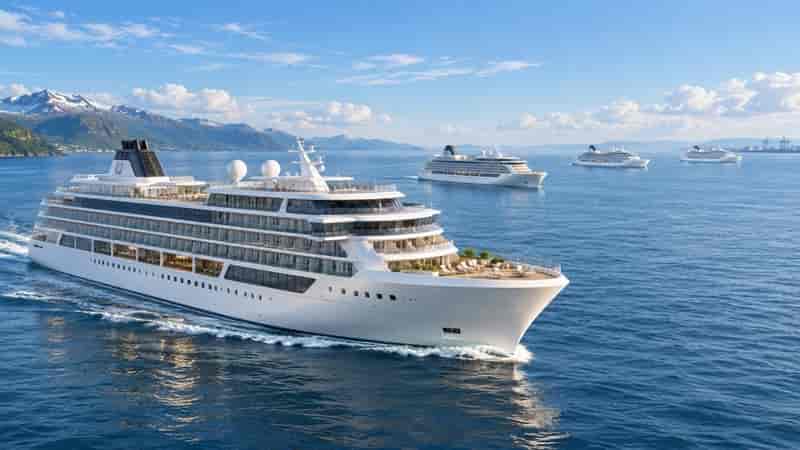
Viking Holdings is planning well beyond the next cruising season. The company has secured options for four additional ocean ships, potentially stretching its newbuild programme to 2036. In an industry where shipyard space is booked years ahead, Viking has decided that looking ten years ahead is apparently the only sensible way to plan.
The agreements were entered into in October 2026, after Viking’s September quarter, and disclosed with its third-quarter results on 17 November. Two proposed ships have delivery years of 2035 and two of 2036. Viking has until December 2027 to exercise these four options.
An option is not a firm order. No matter how attractive a future ship may look on a planning schedule, it remains a possibility until the relevant newbuild contract takes effect.
Nineteen ships in the potential pipeline
Including the October agreements, Viking’s ocean newbuild pipeline comprises 19 vessels: 11 under shipbuilding contracts and eight held as options. Those numbers describe ships to be delivered, not Viking’s entire existing ocean fleet.
The previously contracted delivery schedule includes Viking Libra in 2026, Viking Astrea in 2027, Viking Lyra and Viking Vega in 2028, and Viking Leda plus another vessel in 2029. Two more are listed for 2030, one for 2031 and two for 2032.
There is a qualification to that last pair. Contracts for the 2032 ships are subject to financing and other conditions, and either Viking or the shipyard can terminate them if financing conditions are not met by January 2027. They are part of the contracted pipeline, but describing all 11 ships as unconditional firm orders would overstate the position.
The eight ocean options are spread across four delivery years: two in 2033, two in 2034, two in 2035 and two in 2036. The 2033 options have a July 2027 exercise date; the other six are exercisable in December 2027. Viking says it has no contractual or financial obligation to a shipyard merely by obtaining an option, until a newbuild contract becomes effective.
Each new ocean ship is planned with 998 berths. That is consistent with Viking’s preference for relatively small ocean vessels and destination-focused voyages, rather than the multi-thousand-passenger floating resorts that dominate another part of the cruise market.
Rivers remain part of the expansion
Although the four ocean options provide the headline, Viking’s latest update covers considerably more than the open sea. Since its previous earnings release, it has entered into option agreements for ten additional river vessels: two for possible delivery in 2030, four in 2033 and four in 2034.
It has also exercised options for four Longships scheduled for delivery in 2029. Those four have moved into the contracted programme, although the company says financing and other conditions still apply. If financing conditions are not met by December 2026, the agreements may be terminated.
Viking also announced plans for two additional river vessels to operate in Egypt, with delivery scheduled for 2029. Elsewhere, it has arranged two additional chartered vessels for India, planned to begin operating in 2029 and 2030, and another chartered vessel for Vietnam and Cambodia from 2029. These are river operations, not part of the four ocean options.
Recent deliveries underline how quickly the broader programme is taking shape. Since its second-quarter results, Viking has received the Viking Rota and Viking Haki for European river operations and the Viking Sekhmet for Egypt. The company expects to deliver another ocean ship and two river vessels before the end of 2026.
Demand today, decisions tomorrow
The commercial reasoning is plain enough. As at 8 November, Viking had sold 68 per cent of its available 2027 core-product passenger cruise days, supported by US$5.829 billion in advance bookings. That was 17 per cent more than at the comparable point for the 2026 season, while Viking anticipates a 15 per cent increase in core-product capacity in 2027.
Strong forward sales help explain why a cruise operator wants access to shipbuilding capacity years ahead. They do not guarantee that market conditions in 2035 will resemble those in 2026, or that every option will ultimately be exercised.
For Australian travel advisers, the potential benefit is a wider range of ships and destinations to sell. But no additional Australian deployment, itinerary or fare should be inferred from this announcement. Those decisions, if any, lie further along the timetable.
Viking’s third-quarter results also showed why long-term ambition needs caution: historically low European river levels reduced quarterly revenue by an estimated US$100 million. A growing fleet may spread opportunities across more destinations; it does not remove operational risks.
The conclusion is suitably Viking: reserve tomorrow’s opportunities while running today’s voyages. Four more ocean ships could be sailing in 2035 and 2036. For now, Viking has secured the right to extend its ambitions, without yet committing to pay for all four.
By: Karuna Johnson – © 2026.
Read Time: 4 minutes.
Author Bio:
 Karuna Johnson’s career only makes sense if you know she truly loves travel. Thai by birth and a dual citizen, she moves easily between worlds, equally at home sharing street food in Bangkok or sitting quietly through a Sydney boardroom meeting.
Educated in both Thailand and Australia, she speaks several languages and has applied them across destination management companies and hotels, spanning sales and administration. She’s the sort who keeps things running smoothly while others are still waking up.
Her journeys have taken her across Asia, Europe, and the United States, but it’s the smaller details that stay with her: people, customs, and the stories beneath every trip.
Worldly without being showy, Karuna brings a steady, thoughtful voice to Stephen’s EGT Media, exactly what travel needs.