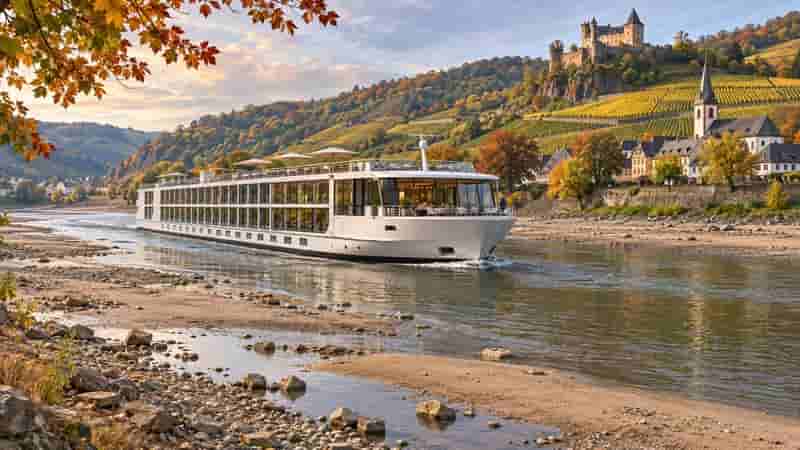
Europe’s rivers have delivered Viking Holdings an expensive reminder that even the most carefully planned cruise cannot sail on good intentions. Historically low water levels disrupted parts of its European river programme during the September quarter, and the company estimates the upheaval reduced revenue by approximately US$100 million.
The difficulty comes with an awkward financial twist. Viking’s revenue for the three months to 30 September 2026 rose 9.2 per cent to US$2.184 billion. Yet net income slipped to US$498.4 million from US$514 million a year earlier, a decline of approximately US$15.6 million. Adjusted earnings before interest, tax, depreciation and amortisation (EBITDA) fell 4.3 per cent to US$673.5 million.
The ships were generating more revenue. The rivers, alas, were not entirely co-operating.
Low water, high cost
Viking’s results, released on 17 November, describe prolonged, historically low water levels on certain European rivers. The conditions forced itinerary changes and contributed to increased guest cancellations. Company-wide occupancy fell to 91.3 per cent from 96 per cent a year earlier, even as available passenger cruise days increased 10.2 per cent through fleet growth.
There is an important distinction for travellers and advisers. Viking says it did not cancel any scheduled cruises. Its teams used mitigation measures to maintain operations, but sailing a cruise and delivering its originally advertised itinerary are not always the same thing. Some passengers chose to cancel after their plans were disrupted.
Viking estimates that low water reduced third-quarter revenue by around US$100 million. It separately estimates an approximately US$100 million impact on adjusted gross margin, a measure that includes lost margin from guest cancellations and additional direct costs of managing the disruption. Those are related estimates of the same event, not two separate losses to be added together.
Nor is the US$100 million figure the company’s reported fall in net profit. That decline was approximately US$15.6 million. The difference is essential to understanding what the accounts actually say.
Viking president and chief executive Leah Talactac credited “our nearly 30 years of experience operating on Europe’s waterways” with helping the company adapt. Experience can provide alternative arrangements and experienced crews; it cannot manufacture more water beneath a keel.
Ocean growth steadies the business
The disruption did not prevent Viking from increasing total revenue. Viking Ocean’s third-quarter revenue rose 13.1 per cent to US$991 million, while Viking River’s revenue advanced just 0.8 per cent to US$974.8 million. Higher revenue per passenger cruise day and the addition of ships helped offset weaker occupancy.
The underlying measures also tell a mixed story. Viking’s gross margin fell 3 per cent to US$855.3 million, but adjusted gross margin rose 4.1 per cent to US$1.388 billion. These are different accounting measures and should not be confused. Adjusted EBITDA declined by US$30 million, reflecting a quarter in which growth came with significant disruption costs.
Over the first nine months of 2026, revenue reached US$5.428 billion, up 13.6 per cent on the same period in 2025, and net income increased to US$1.032 billion from US$847.8 million. At 30 September, Viking reported US$4.1 billion in cash and cash equivalents and an undrawn US$1 billion revolving credit facility.
The wider business, in other words, is not defined by one difficult river season.
Strong bookings, with a qualification
Forward sales provide a further counterweight. As at 8 November 2026, Viking had sold 68 per cent of available passenger cruise days for its 2027 core-product season. Advance bookings stood at US$5.829 billion, 17 per cent above the comparable point for the 2026 season. Advance bookings per passenger cruise day were US$929, up 8 per cent.
The company expects operating capacity across those core products to grow 15 per cent in 2027. Demand appears resilient, although a booking made months in advance is not a guarantee against future operational surprises.
There is also a useful detail in Viking’s accounting: it issued goodwill vouchers to certain guests who travelled on itineraries affected by low water. When customers redeem those vouchers, the new bookings are included in advance bookings at their net value. The headline booking total should therefore not be mistaken for entirely new cash sales.
For Australian travel advisers, the practical lesson is straightforward. River cruising remains attractive, but conditions can alter a journey even when a sailing goes ahead. Advisers should explain itinerary flexibility, confirm the applicable cancellation terms and keep clients informed when conditions change.
A single quarter cannot predict next summer’s river levels, and Viking’s announcement does not establish the cause of this particular event. What it does establish is the commercial price of disruption.
Viking has the ships, the forward bookings and the financial resources to keep expanding. But even a company with nearly three decades on Europe’s waterways must occasionally accept an old maritime truth: the river gets the final word.
By: Prae Lee – © 2026.
Read Time: 4 minutes.
Author Bio:
 You can tell a great deal about a person by how they meet a Bangkok morning. Prae Lee doesn’t charge into it; she glides, unhurried, as if time itself has agreed to behave. There is a calm assurance about her, the sort earned by knowing both your roots and your destination.
A graduate of Chulalongkorn University, she took her business degree with quiet pride, then polished it further in Singapore and Australia. Travel didn’t change her. It refined what was already there: curiosity, discipline, grace.
Back in Bangkok, she slipped modern life into the family business, mastering social media with an instinct for listening and selling with Thai gentleness.
Prae never seeks attention, yet everything she touches grows brighter.
Now with Stephen’s EGT Media, she writes with authenticity, drawing on culture, travel and a rare, steady confidence.