AI has left the airline help desk and started taking on bigger jobs. It can help fix missed flights, spot cyber threats and write code. It may soon do far more. But one question no machine can dodge remains: who takes the blame when things go wrong?
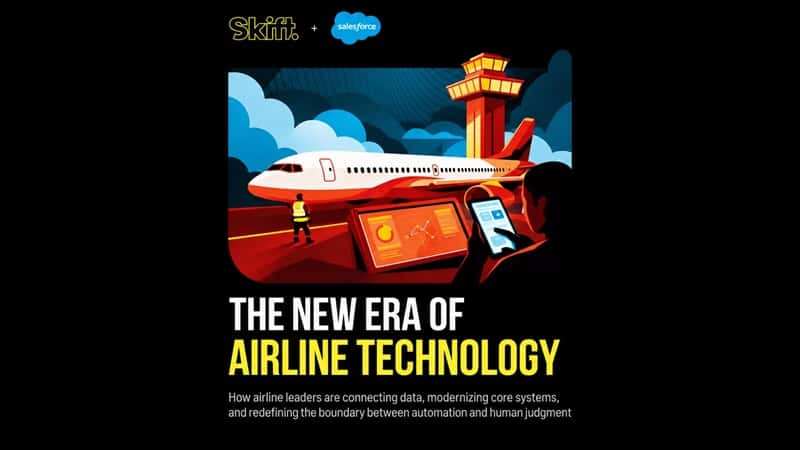
That is the theme of The New Era of Airline Technology, a new Skift Studio report backed by Salesforce. Released on 11 November 2026, it draws on senior staff at IAG, Porter Airlines, ZIPAIR Tokyo, Turkish Airlines and Salesforce.
The message is clear. Airlines want AI to do more than give advice. They want it to act. Yet booking records, flight systems and loyalty data still live in separate worlds. A smart tool is of little use when it cannot see the full problem. Ask anyone stranded at a gate with a boarding pass that no longer works.
The real sale starts after the ticket
Alexa Vignone, Salesforce’s president and chief revenue officer, sees untapped value in the time after a seat is sold. That is when people need help with changes, missed links, upgrades and other travel woes. Good service can also lead to more sales. The catch is that airlines must first know who they are helping.
Take Vignone’s example. One system knows a flight is three hours late. Another knows a top-tier frequent flyer has three children and just 50 minutes to make the next flight. If the systems do not share what they know, that family gets the same bland alert as everyone else.
“Operational systems recover the aircraft; customer systems recover the relationship,” she says. It is hard to build trust with a customer while the airline’s own computers are still being introduced to one another.
Vignone points to Finnair’s AI tool, Sisu. A Salesforce case study says AI now settles 80 per cent of chat queries. It also says the rate of issues solved on first contact doubled in four months. These are figures supplied by the vendor, not results from an outside audit. Even so, they show why carriers are keen to explore the field.
The AI code factory comes with a warning
At International Airlines Group, or IAG, the issue runs much deeper than chat. The group owns British Airways and other European carriers. Its group AI and technology director, Fernando Bosch, says AI can help strip out old code. Work that was once slow and costly may now move much faster.
Bosch even sees scope for a “dark development factory”. There, AI tools could write, test and roll out software with little human input. That may sound like every finance chief’s dream. It is less of a dream if no one can say why a new system has failed.
“The main risk is automation advancing faster than the governance, observability, and security around it,” Bosch says. His point is not to halt change. It is to prove a system is safe, track what it does and keep staff in charge when the stakes rise.
Not every old system needs the axe
Porter Airlines offers a useful dose of common sense. Its chief information officer, Uma Gopinath, notes that some old airline systems still do their jobs very well. There is little sense in ripping one out just because it has been around longer than the newest staff member.
The real test is what stops an airline from moving ahead. Some tools must be replaced. Others need better links or a new front end. Gopinath says the first step should be to look at the business goal, not the age of the code.
She sees a role for AI in fuel-use studies and staff support. But choices that affect flight safety, legal duties or a passenger’s welfare need clear human control. Speed is useful. It is not a defence if an automated call causes harm.
ZIPAIR Tokyo has chosen to build much of its tech in-house. Chief information officer Daisuke Nishiyama says a mix of small, linked systems gives the airline more room to adapt than one large package. The price is a greater need for skilled staff and sound design.
ZIPAIR lets AI tools block suspect online traffic at high speed. But flight dispatch, aircraft safety and major crisis calls remain in human hands. Nishiyama’s view is simple: let AI take the dull jobs, then give cabin crew more time for people. It should be a copilot, not the captain.
Turkish Airlines shows what scale looks like
At Turkish Airlines, the numbers are hard to miss. M. Fatih Durmaz, who leads its digital channels and holidays team, says the carrier has more than 100 AI projects across over 35 business units.
He says its AI help tool deals with about 350,000 chats each month. It settles nearly 90 per cent without passing the case to a live agent. The airline also uses AI in route planning, fuel use, revenue work and aircraft upkeep. These are figures reported by the carrier’s own executive in the study.
The airline has also turned some cameras into smart sensors. These help track more than 100 tasks on the ground. Yet Durmaz warns against making AI a goal in itself. The point is to solve real problems, not win a race to remove the most people from the process.
A quick answer about a meal choice is welcome. A heartless reply to a family caught in a missed flight is rather less so.
Why travel agents should pay attention
This is not just a story for airlines abroad. Australian carriers, airports and travel advisers all face the same test. When plans fail, people need one clear answer across their booking, payment and flight records. A fast answer based on half the facts may be worse than a slow one.
The International Air Transport Association’s modern retailing work aims to link airline sales and service through shared rules, including NDC and ONE Order. In an August 2026 update, IATA said the shift needs common standards and teamwork across the travel trade, not just newer software.
There is a caveat. The Skift report was paid for by Salesforce. It is based on interviews, not a broad survey or an outside test of the claims. The results cited by airlines and vendors should be read in that light.
Even so, its lesson is worth hearing. The best airline of the future may not have the flashiest AI. It may have systems that spot problems early, staff who can fix them, and the good sense to know when a person, rather than a bot, should have the final say.
By: Stephen Peters – © 2026.
Read Time: 5 minutes.
Author Bio:
 Stephen Peters has spent much of his career proving that the straight-and-narrow path is considerably overrated. Armed with a Bachelor’s degree in Technology from the University of Queensland and a Master’s in Management, he first ventured into hospitality, working in and helping open several five-star hotels across Sydney and Asia.
After deciding he’d had enough of five-star hospitality from the operational side of the desk, Stephen returned to technology, working with major US tech companies while based between Australia and Asia.
Then came the ultimate change of scenery. Stephen built his own yacht and, with his family aboard, sailed from Florida through the United States and its Great Lakes before crossing the Pacific to Asia. Several memorable years followed, exploring Indonesian waters before the Peters family eventually returned to Australia with considerably more sea miles, stories and perspective than when they left.