Propellic, the travel marketing and advertising agency, today published Agentic Travel Booking in Meta’s Muse and Instinct, a study examining how AI agents are changing the way people search for and book travel. Meta’s Muse, launched in the US in September 2026 with travel booking built in, and Instinct, an invite-only AI agent users interact with through text messages, are bringing booking capabilities into the AI-powered travel search experience.
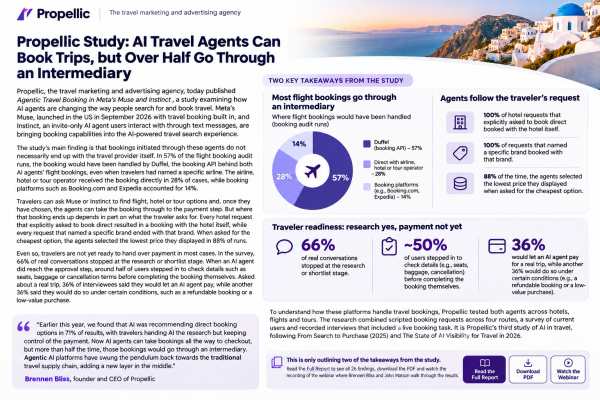
The study’s main finding is that bookings initiated through these agents do not necessarily end up with the travel provider itself. In 57% of the flight booking audit runs, the booking would have been handled by Duffel, the booking API behind both AI agents’ flight bookings, even when travelers had named a specific airline. The airline, hotel or tour operator received the booking directly in 28% of cases, while booking platforms such as Booking.com and Expedia accounted for 14%.
Travelers can ask Muse or Instinct to find flight, hotel or tour options and, once they have chosen, the agents can take the booking through to the payment step. But where that booking ends up depends in part on what the traveler asks for. Every hotel request that explicitly asked to book direct resulted in a booking with the hotel itself, while every request that named a specific brand ended with that brand. When asked for the cheapest option, the agents selected the lowest price they displayed in 88% of runs.
Even so, travelers are not yet ready to hand over payment in most cases. In the survey, 66% of real conversations stopped at the research or shortlist stage. When an AI agent did reach the approval step, around half of users stepped in to check details such as seats, baggage or cancellation terms before completing the booking themselves. Asked about a real trip, 36% of interviewees said they would let an AI agent pay, while another 36% said they would do so under certain conditions, such as a refundable booking or a low-value purchase.
“Earlier this year, we found that AI was recommending direct booking options in 71% of results, with travelers handing AI the research but keeping control of the payment. Now AI agents can take bookings all the way to checkout, but more than half the time, those bookings would go through an intermediary. Agentic AI platforms have swung the pendulum back towards the traditional travel supply chain, adding a new layer in the middle,” said Brennen Bliss, founder and CEO of Propellic.
To understand how these platforms handle travel bookings, Propellic tested both agents across hotels, flights and tours. The research combined scripted booking requests across four routes, a survey of current users and recorded interviews that included a live booking task. It is Propellic’s third study of AI in travel, following From Search to Purchase (2025) and The State of AI Visibility for Travel in 2026.
This is only outlining two of the takeaways from the study. Read the Full Report to see all 26 findings, download the PDF and watch the recording of the webinar where Brennen Bliss and John Matson walk through the results.