
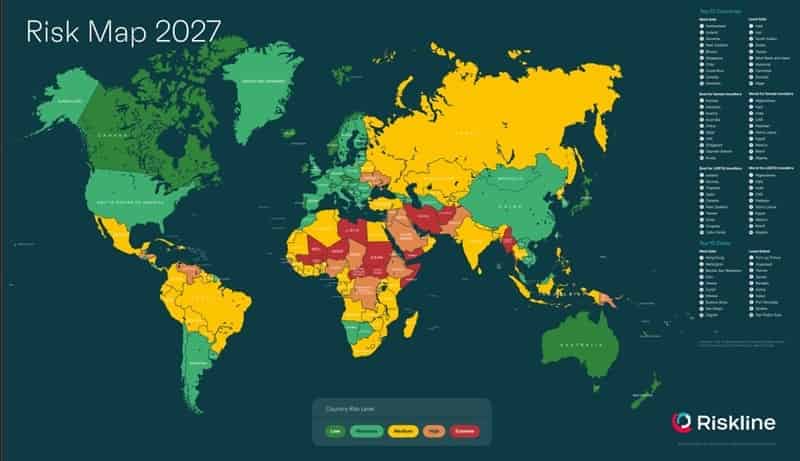
The Gulf has long been a key hub for world travel. Now its record has taken a knock in the latest Risk Map 2027. The new assessment shows 15 destinations moving into higher risk bands and six moving in the other direction. For Australian travellers and their advisers, this is more than a colour change on a map.
Riskline and its technology partner Safeture released the Risk Map 2027 on 5 November. It tracks conflict, crime, health threats and access to medical care. It uses five bands: Low, Moderate, Medium, High and Extreme. In all, 21 ratings have changed in a year. A route that felt safe last month may need a fresh look today.
Gulf gateways face the biggest change
Four Gulf states have risen by two risk levels. Bahrain, Kuwait, Qatar and the United Arab Emirates went from Moderate to High. Saudi Arabia and Jordan rose from Medium to High. Oman moved from Moderate to Medium. Iran is now rated Extreme, up from High.
That is a sharp turn for a region known for grand airports and large airlines. Many people pass through on well-run links between flights. An impressive lounge and a swift transfer remain welcome comforts. Neither, of course, can settle a regional conflict.
These are Riskline’s ratings. They do not mean all flights are unsafe. Nor is every part of each country equally at risk. Yet the shifts matter to airlines, tour firms, travel managers and advisers who use Gulf routes. A stopover is still part of a trip. That holds true even when no one plans to leave the airport.
A trip that looked sound when booked may pose new risks by the time it starts. That calls for up-to-date advice, clear phone numbers and sound backup plans. These are part of good service, not extras.
Six destinations move in the right direction
There is welcome news beyond the Gulf. Bangladesh, Cameroon, Mozambique and Nepal have gone from High to Medium. El Salvador and the Maldives have moved from Medium to Moderate. That does not mean crime, disease or local unrest have gone away. It means Riskline now sees less overall risk than it did a year ago.
That difference matters. The travel trade can quickly call a place a dream escape or a no-go zone. Nepal’s walking trails and the Maldives’ island resorts draw very different guests. Both need sound advice. The route, season and planned activities all count.
Europe is not immune
Germany, Finland and Cyprus have moved from Low to Moderate, as has Greenland. Moderate is still the second-lowest band. That is not a blanket warning to stay away from Europe.
Riskline also warns about the war in Ukraine. It points to cyberattacks, disinformation and election interference. In 2027, it expects elections, shifts in power and protests to affect travel. Tensions between Pakistan and Afghanistan are another issue to watch.
Some risks will arrive without much warning. Elections, at least, tend to appear on a calendar. Travel firms can use those dates to check plans and warn clients. They can also leave room to change course.
Where Riskline sees the safest journeys
Riskline names ten countries among its safest for 2027. They are New Zealand, Singapore, Switzerland, Iceland, Denmark, Slovenia, Bhutan, Chile, Costa Rica and Canada. The choices reflect expert views, not a league table. The order is not a rank.
The least safe list names Haiti, Iran, South Sudan, Sudan and Yemen. It also lists the West Bank and Gaza, Myanmar, Colombia, Somalia and Niger. Among the least safe cities are Tehran, Kabul, Port-au-Prince, Port Moresby and Guayaquil.
City-level results add a useful dose of reality. Wellington, Vienna, Zurich, Hong Kong and Oslo appear among the safest cities. But one safe city cannot make a whole country safe. A long road trip or remote trek brings its own risks.
The map also highlights what broad warnings can miss. Not everyone faces the same risks. Estonia, Denmark and Austria stand out for female travellers. Iceland, Norway and Thailand are among the best for LGBTQ travellers. Local law and public attitudes count. So does the type of trip.
What Australian travel advisers should do now?
For Australians heading abroad, the first official check is Smartraveller. The Department of Foreign Affairs and Trade runs it. Its four advice levels run from ‘Exercise normal safety precautions’ to ‘Do not travel’. They are not the same as Riskline’s five risk bands. A good Riskline rating does not cancel an Australian Government warning.
Insurance deserves the same care. Smartraveller warns that cover can be limited in high-risk places. Many standard policies do not cover trips to places with a ‘Do not travel’ warning. Clients must read the fine print. They should also check each transit point, not just the last stop.
Good advisers check each stop and the latest local advice. They keep key phone numbers on file. They also tell clients whom to call when plans change. Travel managers must also weigh local support and the traveller’s role. Can they leave safely if things get worse?
By: Sandra Jones – © 2026.
Read Time: 5 minutes.
Author Bio:
 Sandra has spent a working lifetime quietly rescuing journeys, one itinerary, one anxious caller, one impossible connection at a time. Years in Australia’s finest travel agencies taught her the art of calm, how to find a flight in a fog of cancellations, how to soothe a traveller when luggage wanders, how to turn nine frantic days in Europe into something resembling sense. Qualified, seasoned, endlessly patient, she learned that good travel advice is part logistics, part listening.
But the storyteller in her was always waiting its turn. Writing offered a new map, a way to turn experience into reflection, detail into delight. At EGT Media, Sandra now writes the truths only insiders know: the mishaps, the laughter, the grace found between gates and goodbyes. She reminds us that travel, for all its fuss, is still one of life’s better ideas.
===================================