
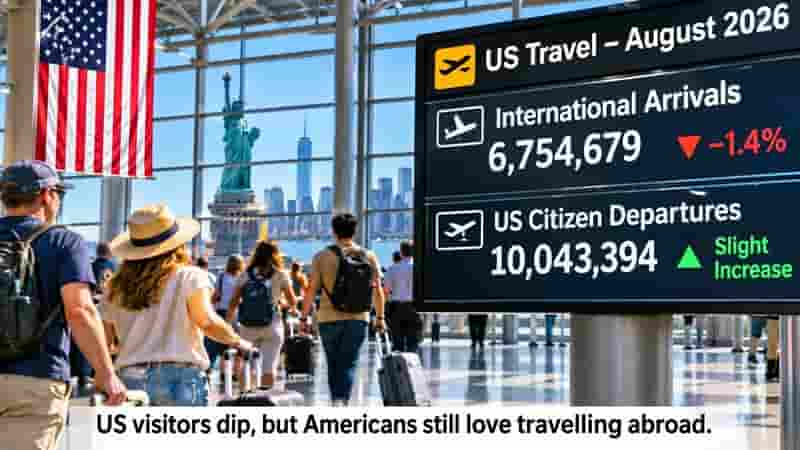
US tourism has a problem that the headline figures almost hide. More people are coming from Canada and Mexico. Far fewer are arriving from the rest of the world. For hotels and tour firms that rely on long trips, the gap is hard to ignore.
The latest US National Travel and Tourism Office (NTTO) figures tell the story. The US welcomed 6,754,679 foreign visitors in August 2026. That was 1.4 per cent fewer than in August last year. Yet arrivals from overseas markets, which exclude Canada and Mexico, fell 11.8 per cent to 3,079,268.
A fall of that size is no small dip. It puts a much sharper edge on what may first look like a fair month for America’s tourism trade.
The neighbours come to the rescue
Mexico sent 1,959,158 visitors to the US in August. That was up 9.9 per cent on the same month a year earlier. Canada sent 1,716,253, up 8.8 per cent. Together, they made up more than half of all foreign arrivals.
The United Kingdom led the markets beyond North America, with 376,681 arrivals. Japan followed with 226,912, then China with 183,120. The top five source markets, including Mexico and Canada, supplied 66.1 per cent of all visitors.
These figures show how much the US gains from its next-door markets. They do not tell us why visits from further afield fell. The NTTO report does not name a cause. Nor does it prove that each overseas country sent fewer visitors.
Nor are all arrivals holidaymakers. India led overseas business arrivals with 38,429. China led overseas student arrivals with 75,752. The trends reach well beyond the leisure trade.
Visitors spend less as well
The cash register news is also hard to miss. Separate NTTO spending data show that foreign visitors spent nearly US$19.9 billion on US travel and tourism-related goods and services in August. That was almost 5 per cent less than a year ago.
Money spent on hotels, meals, shops, local transport and other purchases during trips fell by nearly 9 per cent. The total was close to US$10.8 billion. Fares paid by foreign travellers to US airlines also fell, down 3 per cent to US$2.8 billion.
The wider spending total has a catch. It also counts education, medical travel and some short-term worker costs. It is not just money spent on holidays. Even so, lower spending at the places tourists use will concern businesses that depend on them.
Americans are still heading abroad
US citizens recorded 10,043,394 international departures in August, a slight rise from last year. Mexico was their top choice, with 3,248,570 departures. That was 32.3 per cent of the month’s total.
Europe came next, with 2,435,727 departures, or 24.3 per cent of the total. Yet trips to Europe were down 1.3 per cent from August 2025. Visits to Canada rose 5.9 per cent.
The contrast matters to the travel trade. The US is still a huge source of customers for places abroad. But it faces weaker flows of guests from markets beyond its borders.
For Australian travel advisers, this is a cue to sell the US with care and substance. These figures do not reveal how many Australians visited in August. They cannot, on their own, explain the fall in overseas demand. But they do show why value, clear advice and a strong reason to book will count.
America’s great sights have not moved. The task now is to make sure travellers still want to come and see them.
By: Jason Smith – © 2026.
Read Time: 3 minutes.
Author Bio:
 Jason Smith didn’t learn travel from textbooks. He learned it in airports, taxis and hotel lobbies, watching the business unfold long before he played his own part. Half American, half Asian, he grew up around the quiet workings of tourism, where people come and go, and stories rarely stand still.
Bangkok came first, then formal study, then a career that carried him through Singapore, Malaysia and Vietnam. Each place left something behind. In the end, Thailand felt like home, along with a senior role in hotel sales.
Then everything stopped. Borders shut, planes grounded, and Jason found himself back in America with time to reflect.
Now at Stephen’s EGT Media, he writes travel as it really is, not polished, not perfect, but human, and all the better for it.