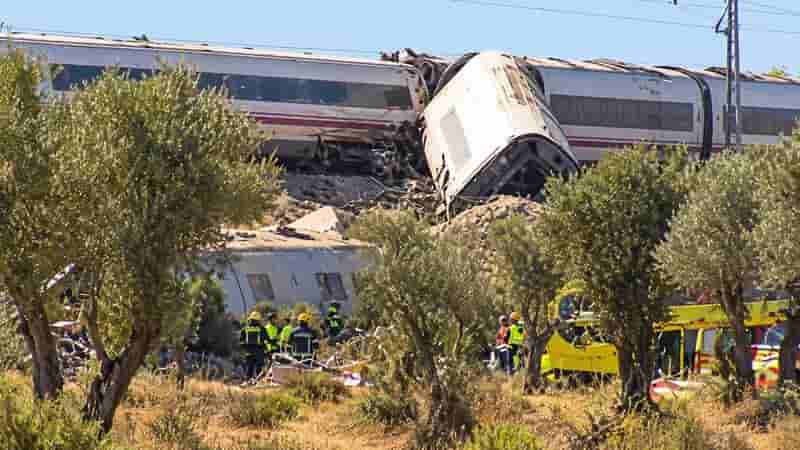
Two deadly collisions in one year have put Spain’s high-speed rail network under intense scrutiny, as travellers face major disruption between Madrid and Andalusia.
Spain’s high-speed trains have long been Europe’s envy. They link major cities, make short breaks easy and offer a convenient alternative to flying. Fast and simple: just what travellers want.
But after two deadly crashes in the same year, Spain faces a difficult question. Can people still trust its rail safety systems?
A crash near Urda, in Toledo province, on Wednesday 28 October 2026 killed at least 69 people. On Thursday, the Associated Press reported, citing regional officials, that 50 people were still in hospital. Rescue crews searched the wreckage as families waited desperately for news.
For the bereaved, the loss is immeasurable. For Spain’s tourism industry, rebuilding public confidence has only just begun.
How the Urda Train Collision Unfolded
The crash occurred on the Madrid–Seville high-speed rail line. A Renfe AVE train struck the rear of an Iryo train that had stopped near Urda, about 140 kilometres south of Madrid. The collision sent carriages off the tracks and down an embankment.
In its initial statement, Iryo said train 6076 had departed Madrid at 7.54 am with 147 passengers, three crew members, a barista and a driver. The statement placed the collision at 8.48 am.
Renfe reported the time as 8.53 am. The discrepancy remains unresolved.
Reports indicated that more than 500 people were aboard the two trains. Police, military personnel and emergency rescue teams rushed to the scene. Rail staff established assistance centres for those affected and their families.
On 18 January, another crash near Adamuz, in Córdoba province, killed 46 people. Both incidents involved Renfe and Iryo trains operating on the Madrid–Andalusia network, although no common cause has been established.
A Signalling Failure Followed by a Disputed Decision
Spain’s transport minister, Óscar Puente, said a computer fault had disabled the LZB train safety system along approximately 63 kilometres of track at 8.30 am. Trains stopped, and staff at infrastructure manager Adif’s control centre assumed responsibility for managing traffic.
According to Puente, control centre staff later authorised the Renfe train to resume at normal speed, despite a stop signal and the Iryo train ahead.
He described the decision as “inexplicable” and said the train drivers were not at fault.
That, however, remains the minister’s account, not the final conclusion of the official investigation.
Several crucial details remain unestablished. Spain’s EFE news agency cited sources close to Iryo who said its driver had been communicating with control centre staff about resuming the journey when the collision occurred.
ABC News also cited Spanish newspaper El Mundo, which reported that Iryo’s management maintained that its train had not received authorisation to move.
The Renfe train’s speed at impact remains unconfirmed. Although trains can travel at up to 200km/h along that section, this must not be confused with the train’s actual speed at the time of the collision.
Investigators must examine recorded communications, signalling logs, operating procedures and train data.
Who issued the instructions? When were they given? And why did the safeguards fail to prevent the collision?
Until those questions are answered, assigning responsibility would be premature.
Why Spain’s Rail Safety Reputation Matters
Spain operates one of the world’s largest high-speed rail networks. Its services connect major cities while supporting hotels, tour operators, business events and regional commerce.
For international visitors, reliable rail connections are essential to planning a seamless journey.
The LZB system, used on the Madrid–Seville route, monitors train speeds and can intervene when permitted limits are exceeded. Spain is also transitioning towards the newer European Rail Traffic Management System, known as ERTMS.
However, technology alone cannot guarantee safety.
The investigation must establish precisely what happened following the reported system failure and the transfer of operational control to railway staff.
Safety is not an optional extra. It comes with the ticket.
Prime Minister Pedro Sánchez acknowledged the seriousness of the situation, saying:
“It is not acceptable for a country like Spain to endure two high-speed train accidents in the same year.”
Spain began three days of national mourning on Thursday 29 October. The government has pledged to establish the facts and restore public confidence.
Madrid-Andalusia Rail Services Disrupted: What Travellers Should Do
For travellers and travel advisers, the immediate priority is ensuring that affected passengers can reach their destinations safely.
Spain’s rail infrastructure manager, Adif, confirmed that high-speed services on the affected Madrid–Andalusia route had been suspended.
However, services between Madrid and Toledo, and between Málaga and Seville, were continuing to operate. Spain’s entire rail network remains open.
Renfe is offering affected passengers free ticket changes and cancellations.
The operator has also introduced slower services connecting Madrid, Ciudad Real and Puertollano, adding approximately 90 minutes to some journeys.
Renfe has announced an alternative transport plan for travel between Madrid and Andalusia, starting Friday 30 October. It will share further details through its official communication channels.
Iryo has suspended services departing Madrid-Puerta de Atocha towards southern Spain. Its initial announcement did not specify when operations would resume.
The company is also offering affected passengers free ticket changes and cancellations.
Renfe has separately warned of planned industrial action on 29 October, which could cause additional service disruptions. Consequently, not every delayed or cancelled train should automatically be attributed to the collision.
Australia’s Smartraveller advice for Spain, updated on 29 October, warns of suspended rail services between Madrid, Ciudad Real and Andalusia.
The overall travel advice for Spain remains to exercise normal safety precautions.
Travel advisers should review affected bookings directly with rail operators, allow additional time for connecting flights, contact accommodation providers where necessary and confirm refund conditions before arranging alternative transport.
After all, a bargain train fare is hardly a bargain if it causes you to miss an international flight.
Travellers should monitor official updates from Adif, Renfe, Iryo and Smartraveller before commencing their journeys.
Spain Must Rebuild Public Trust Through Evidence
No railway can eliminate every risk. However, railway operators and regulators must establish what went wrong and show how similar tragedies can be prevented.
The investigation must be transparent, thorough and fair to train drivers, control centre staff, railway operators and the travelling public.
If operating procedures proved inadequate, they must be improved. If staff training or technical safeguards were insufficient, authorities must explain precisely what corrective measures will follow.
None of this means that every train operating in Spain is unsafe. The current disruption affects specific routes, and investigators are still establishing the circumstances surrounding the collision.
The human tragedy must remain the priority. The economic and commercial consequences will follow.
Spain’s high-speed trains have helped millions of travellers discover the country’s remarkable cities, cultural treasures and regional attractions.
Rebuilding confidence will require more than punctual services, reassuring statements and polished public relations.
It will require credible evidence, independent scrutiny and meaningful improvements to railway safety.
Spain’s rail industry has a difficult journey ahead.
And this time, the answers must arrive before the next tragedy.
By: Michelle Warner – © 2026.
Read Time: 6 minutes.
Author Bio:
 Michelle Warner has always carried stories the way others carry passports lightly, faithfully, and with purpose. She learned her craft in newsrooms, shaping sentences with care, before swapping deadlines for departures as a flight attendant with some of the world’s great airlines. Years aloft sharpened her eye for character and deepened her fondness for travel’s small, dignified rituals: the quiet kindness of strangers, the poetry of arrival, the patience learned between time zones.
Now grounded by choice, Michelle has come home to writing with the same calm authority she once brought to turbulent cabins. Her prose blends an editor’s discipline with a traveller’s wonder, tinged with humour and reverence for the golden age of travel. Each piece feels like a handwritten boarding pass, gracious, observant, and unmistakably alive.