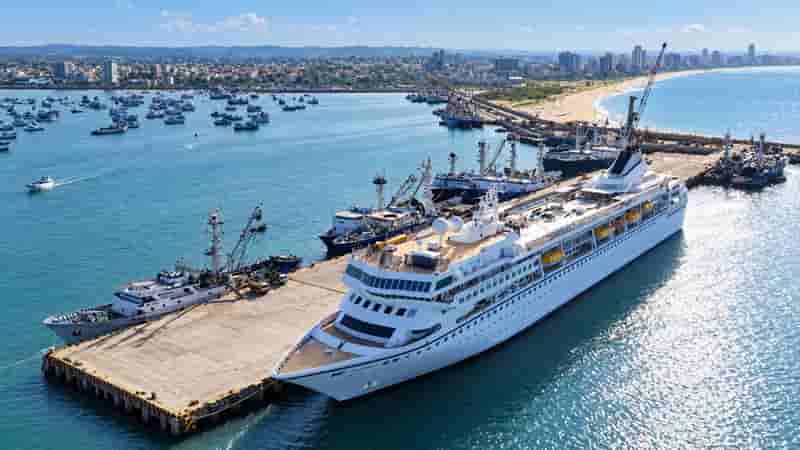
A floating retirement dream has stalled in Cambodia, with 203 passengers ordered ashore, fresh payment requests under scrutiny and the operator considering bankruptcy protection.
For Villa Vie Odyssey residents, the attraction was deliciously simple: leave the household chores behind and wake up somewhere new. Unfortunately, nobody seems to have included an emergency stop in Cambodia, a scramble for hotel rooms, and the prospect of helping pay for the ship’s fuel.
The residential cruise vessel’s round-the-world journey has been suspended in Sihanoukville, where its US-based operator, Villa Vie Residences, says soaring fuel costs have made continued sailing financially unsustainable.
The interruption is grim for a lifestyle sold as freedom from life’s ordinary complications. The sea may stretch to the horizon, but the company’s bank balance, it seems, does not.
Seven hours to pack up a life
The Bahamas-flagged Odyssey arrived in Cambodia from Thailand on 23 October 2026. According to Cambodian officials, including provincial deputy governor Long Dimanche, it was carrying 203 passengers and 156 crew and was scheduled to continue to Vietnam.
Instead, residents were ordered to leave on 27 October. Cambodian officials say they had about seven hours before the 2pm deadline; some passengers told Business Insider they were notified around 6am, giving them roughly eight hours.
For an ordinary holidaymaker, an unexpected disembarkation means rearranging a flight. For people whose cabin is their principal home, it means suddenly needing another address.
Some passengers flew out of Cambodia. Others remained in Sihanoukville to secure accommodation, retrieve possessions and decide whether to wait for the voyage to resume.
Cambodian authorities have indicated the ship may refuel and depart on 31 October. That remains an expected vessel movement, not confirmation that passengers will be allowed back aboard or that the residential voyage will restart.
The fuel bill that broke the voyage
In its 27 October statement, Villa Vie said monthly fuel costs, calculated on an equivalent-per-cabin basis, had risen from a historical average of roughly US$1,800 to an estimated US$6,000–US$8,000 in parts of Asia.
Crucially, that figure reflects the operator’s fuel expenditure allocation. It is not an invoice sent to every resident.
The company linked the increase to the conflict involving Iran and said slower sailing and longer port stays had failed to contain costs. It declared: “Passing the full increase on to residents is not a realistic solution.”
Founder and executive chairman Mikael Petterson gave Bloomberg an estimate of US$3 million in monthly operating expenses, up around 50 per cent. He told CBS News separately that monthly expenses had risen from US$400,000 to US$2 million. Those accounts have not been publicly reconciled and should not be treated as figures from one consistent cost statement.
Either way, the ship needed fuel, and the money was no longer comfortably aboard.
Residents asked to help keep Odyssey moving
The financial strains preceded the Cambodian shutdown. Business Insider reviewed an August message from chief executive Kathy Villalba acknowledging earlier requests for voluntary fuel contributions. Some residents paid, but the amounts collected covered only part of the shortfall, she wrote.
Cruise Industry News reported that sources aboard described a further request for US$360,000 to cover fuel. It also reviewed an April letter seeking US$3 million through an emergency loan investment offer carrying proposed interest rates of 12–24 per cent. It is unclear how much money, if any, was raised through that offer.
Then came the question of surcharges. A May post on the Cruise Critic community forum alleged a compulsory charge of US$1,500 per cabin per month, or US$33 per person per day, for certain programmes. Those specific rates have not been independently confirmed against invoices or contracts and should not be presented as charges universally paid by residents.
More recently, Bloomberg reported Petterson proposing another US$500 monthly fee on top of a fuel surcharge while prices remained high. It was a proposal, not proof that every resident had agreed to pay.
There is a certain irony in buying a home to escape land-based bills, only to discover that the neighbours might be asked to contribute to the next bunker delivery.
An expensive dream, not a typical holiday
The 1993-built vessel, formerly Fred. Olsen’s Braemar, began its residential voyage from Belfast in 2024 after prolonged refurbishment-related delays.
Villa Vie advertised permanent residency from US$119,999 and five-year residency from US$59,999, with additional monthly fees under its ownership arrangements. These were advertised starting prices; they do not establish what individual passengers actually paid.
Some residents sold their land-based homes to join the voyage. Others chose shorter arrangements. The ship offered an unusual blend of travel, retirement and community, which explains why the distress is more than a missed holiday.
Resident Benjamin Schatz told CBS News he was heartbroken. Other residents, interviewed by the Associated Press, described confusion, financial anxiety and concerns about management. Those accounts are important firsthand testimony, but allegations of wrongdoing or unpaid obligations remain allegations unless independently established.
Accommodation, bankruptcy and the next port
Villa Vie says it is working with residents on temporary living arrangements. Petterson told Bloomberg that the company was paying for local lodging and transport, but not for flights leaving Cambodia. Some passengers told reporters they were arranging hotels themselves. It is not yet clear how consistently the promised assistance has reached those affected.
The operator has announced a 60-day effort to explore restructuring and new investment. No completed rescue financing or confirmed restart date had been announced as at 29 October.
CBS News reported Petterson saying the plan was to seek Chapter 11 bankruptcy protection in the United States. That statement signals the seriousness of the company’s position; it does not, by itself, establish that a bankruptcy petition has been filed or approved.
For residents, the unresolved questions are painfully practical. Who pays for flights and accommodation? What rights attach to a purchased cabin? Can personal possessions be collected? And what happens if the vessel never resumes its residential service?
What travel advisers should learn
Odyssey’s ordeal does not prove that residential cruising cannot work. It does show how quickly fuel exposure, occupancy levels, funding needs and uncertain consumer protections can turn a lifestyle investment into an expensive emergency.
Before recommending such arrangements, advisers should examine the residency agreement, the legal entity receiving payments, cancellation and insolvency provisions, and the customer’s options if the ship is taken out of service. Standard holiday-cruise expectations may provide little guidance when a vessel doubles as somebody’s home.
A financial lifeline may still be available for Villa Vie Odyssey. But until it arrives, 203 people have learned that a supposedly endless cruise lasts only as long as the business keeping it afloat.
The sunsets were genuine. So, unfortunately, are the bills.
By: Stephen Peters – © 2026.
Read Time: 6 minutes.
Author Bio:
 Stephen Peters has spent much of his career proving that the straight-and-narrow path is considerably overrated. Armed with a Bachelor’s degree in Technology from the University of Queensland and a Master’s in Management, he first ventured into hospitality, working in and helping open several five-star hotels across Sydney and Asia.
After deciding he’d had enough of five-star hospitality from the operational side of the desk, Stephen returned to technology, working with major US tech companies while based between Australia and Asia.
Then came the ultimate change of scenery. Stephen built his own yacht and, with his family aboard, sailed from Florida through the United States and its Great Lakes before crossing the Pacific to Asia. Several memorable years followed, exploring Indonesian waters before the Peters family eventually returned to Australia with considerably more sea miles, stories and perspective than when they left.