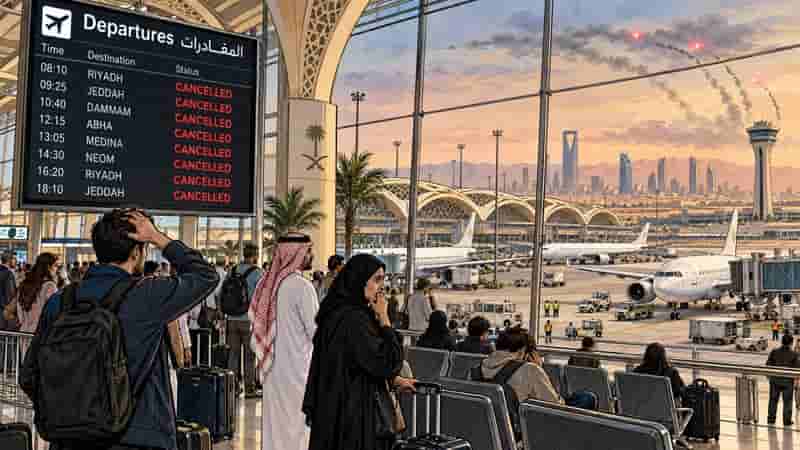
Australia’s highest travel warning remains in force as missile attacks, airport closures and thousands of cancelled flights plunge Saudi Arabia’s aviation industry into turmoil. Here’s what Australian travellers and travel advisers need to know.
Australians considering Saudi Arabia have been given advice that needs no fine print or interpretation: do not travel. That includes holidays, business visits, religious pilgrimages and airport connections.
Australia’s Department of Foreign Affairs and Trade (DFAT) reaffirmed its highest, Level 4 warning in advice updated on 26 October and listed as current on 27 October 2026. Missile and drone attacks, threats against airports and massive flight disruption have turned a once-routine booking decision into a serious safety question.
Saudi Arabia has invested heavily in persuading the world to visit. For now, Canberra’s contribution to the marketing campaign is short: stay away.
Airport chaos measured in thousands
The figures explain the concern. According to aviation analytics company Cirium, as Reuters reported on 26 October, 4,071 of 4,736 scheduled flights at Riyadh’s King Khalid International Airport were cancelled between 8 and 25 October. That is about 86 per cent, close to nine flights in every ten.
Across Saudi Arabia, more than 7,800 flights, or 45 per cent of scheduled departures, were cancelled over the same period. Reuters reported cancellation rates of 42 per cent at Dammam and 46.7 per cent at Abha. These figures cover a defined period, not today’s flight schedule.
Riyadh’s airport was repeatedly targeted. Reuters reported that 13 people died in an attack there on 10 October. Operations partially restarted on 25 October, with domestic flights from Terminal 1 and international services by Saudi carriers permitted from Terminal 2.
Partial reopening should not be mistaken for normal service. Several international airlines suspended Riyadh flights into November, and a newly printed ticket does not guarantee an aircraft will be waiting at the gate.
Nor has the danger disappeared. On 27 October, Reuters reported that the Saudi-led coalition said it had intercepted three ballistic missiles directed towards the Eastern Region and four drones aimed at the south. Saudi civil defence authorities issued alerts before saying the immediate threats had passed.
The coalition’s account, not an independent assessment of every event on the ground.
Australia’s warning names three airports
Smartraveller specifically warns against travelling to King Khalid International Airport in Riyadh, King Fahd International Airport in Dammam and Abha International Airport. It also urges extreme caution around every Saudi airport.
The Houthis, the armed movement based in Yemen, have threatened Saudi airspace and aviation facilities. On 13 October, they also threatened Saudi Aramco’s headquarters in Dammam and its Riyadh refinery, according to Smartraveller.
A conflict that does not consult anyone’s holiday calendar can affect energy sites, transport networks, and other civilian infrastructure.
DFAT’s warning covers Saudi Arabia as a whole. Importantly, the advice also applies to transit. Travellers cannot assume that staying inside an airport terminal makes a connection an acceptable exception.
A Level 4 advisory is a government safety recommendation, rather than an automatic legal ban on entry. That distinction matters. So does the government’s warning that consular assistance may be limited if travellers ignore its advice.
Already there? Safety comes before the timetable
Australians who are already in Saudi Arabia should consider leaving if it is safe. Those final words are crucial. Setting off through an unstable area simply to reach a departure lounge may increase the danger.
Smartraveller says private cars, trains or buses may offer alternatives to flights, including possible links to aviation hubs in the United Arab Emirates or Qatar. Travellers must first check border rules, visas, route security, and whether onward transport is actually running.
Use official border crossings only. Conditions can change without notice.
Anyone choosing to fly despite the warning should reconfirm the service directly with the airline before leaving for the airport, heed local instructions and minimise time spent at the terminal.
Those remaining in Saudi Arabia should keep food, water, essential medicines and a charged phone ready, and be prepared to shelter indoors. If an attack occurs, seek shelter in a substantial building, away from windows. Debris from intercepted weapons is dangerous too.
Put the camera away. Photographing military activity, missile launches or critical infrastructure can lead to criminal prosecution. It is one travel photograph nobody needs for the family album.
Hajj and Umrah plans are not exempt
The Level 4 advice expressly includes religious travel. That will be painful news for Australians who have saved, planned and made personal commitments to complete Hajj or Umrah.
But neither a pilgrimage booking nor an approved visa cancels the security risk.
For future arrangements, pilgrims should check the Saudi Ministry of Hajj and Umrah’s official Nusuk Hajj and Nusuk Umrah platforms for permits, visa conditions and health requirements. Hajj and Umrah follow different rules, and entry arrangements can change during the Hajj season.
Smartraveller also warns that a visa does not guarantee admission to Saudi Arabia. The immediate Australian recommendation remains to postpone travel.
Insurance: inspect the exclusions, not just the price
Travel insurance may not cover a journey made against Level 4 advice. Armed conflict, known events, disruption and evacuation can all be subject to exclusions or restrictions, depending on the policy.
Travellers should check the Product Disclosure Statement and ask the insurer for written confirmation about cancellation, medical care, repatriation and conflict-related claims. The date you purchased the policy and when an event became known may affect the response, but no universal rule applies.
An insurance certificate is useful. Assuming it covers everything is not accurate.
Refunds: cancellation does not always mean cash back
Australian consumer law can provide remedies when a travel service is cancelled or not delivered within a reasonable time. Depending on the circumstances, that may mean another service or a refund.
However, the Australian Competition and Consumer Commission explains that if a third party prevents the supplier from providing the service, such as through government restrictions, the consumer guarantees may not require the supplier to offer a refund or replacement. Booking terms will generally govern the outcome in those cases.
Travellers should check both the airline’s conditions and any separate travel agent or booking platform terms. Ask for cancellation reasons, proposed alternatives and refund decisions in writing before purchasing a replacement ticket or accepting a voucher.
For travel advisers, this is a moment for precise records, prompt supplier checks and frank conversations with clients. Optimism is not a substitute for documented advice.
A temporary passport option
One useful practical development for Australians already in the kingdom. Smartraveller says eligible Australians in Saudi Arabia can currently apply online to renew their passports without attending the Australian Embassy in Riyadh.
The temporary arrangement also extends to eligible Australians in Oman, Bahrain and Yemen. Details are available through the Australian Embassy and the Australian Passport Office.
It does not remove the need to meet Saudi exit requirements or to check that authorities and airlines will accept travel documents.
The message for travellers and the travel trade
Saudi Arabia’s wider tourism ambitions remain substantial. But no grand opening, festival or business conference can override a live safety warning.
Before making any decision, check the current Saudi Arabia advice at Smartraveller, subscribe for updates, and speak directly with the airline, agent and insurer. Check advice for all proposed transit points as well: regional airspace restrictions can upset an itinerary well beyond Saudi Arabia.
For urgent Australian consular assistance, call the 24-hour Consular Emergency Centre on +61 2 6261 3305 from overseas or 1300 555 135 within Australia. In an immediate emergency, follow local authorities’ instructions.
The conclusion is unusually simple for international travel: postpone the trip, reconsider the route and wait until conditions genuinely improve.
The desert will still be there when the skies are safer.
By: Michelle Warner – © 2026.
Read Time: 7 minutes.
Author Bio:
 Michelle Warner has always carried stories the way others carry passports lightly, faithfully, and with purpose. She learned her craft in newsrooms, shaping sentences with care, before swapping deadlines for departures as a flight attendant with some of the world’s great airlines. Years aloft sharpened her eye for character and deepened her fondness for travel’s small, dignified rituals: the quiet kindness of strangers, the poetry of arrival, the patience learned between time zones.
Now grounded by choice, Michelle has come home to writing with the same calm authority she once brought to turbulent cabins. Her prose blends an editor’s discipline with a traveller’s wonder, tinged with humour and reverence for the golden age of travel. Each piece feels like a handwritten boarding pass, gracious, observant, and unmistakably alive.