

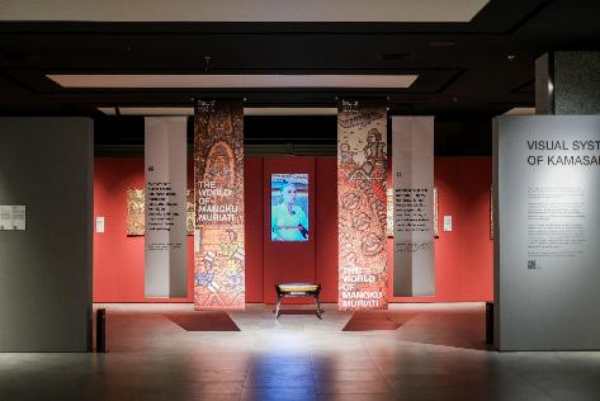
SAKA Museum at AYANA Bali presents KAMASAN: The Noble Tradition of Balinese Painting, beginning 28 August 2026. Bringing together works from the late 19th century to the present, the museum’s first temporary exhibition explores how one of Bali’s most prominent and influential classical painting traditions continues to develop through ritual, inherited knowledge, women’s participation, and contemporary practice.
Running until 30 May 2027, KAMASAN is the first exhibition in a new gallery at SAKA Museum devoted to Bali’s living culture, with a fresh exhibition each year offering a different perspective on the island. The gallery connects the communities who sustain these traditions with artists, researchers, and audiences from Bali and beyond, encouraging cultural understanding, responsible tourism, and support for local knowledge and creative practice.
The Kamasan style is named after a village in eastern Bali’s Klungkung Regency, where it flourished under the 16th-century Gelgel court and matured in the palaces of Klungkung. Closely tied to Balinese-Hindu religion, it draws on the epics of the Ramayana and the Mahabharata, along with Balinese and Javanese folklore, mythology and cosmology, rendering its figures—human, animal, and divine—in a codified language of line, gesture and color. Kamasan figures are instantly recognizable for their elongated limbs, almond-shaped eyes, and kinship with wayang kulit, or shadow puppets, which give them their distinctive, ornate character.
Curated by Farah Wardani and Made Chandra, and designed by architectural designers studiodikubu, the exhibition unfolds as a sequence of Kala, or temporal, chapters. Visitors move from the tradition’s origins to its hereditary master painters, the women of Kamasan, a new generation of contemporary artists, and the visual language that underpins them all.
For that new generation, Kamasan’s pakem, or inherited visual conventions, is something to preserve, challenge, expand, and reimagine. Their works, many made in the past five years, turn Kamasan’s figures and stories toward questions of identity, ecology, technology and the memory of the pandemic.
Recognized by the Indonesian Government in 2015 as Intangible Cultural Heritage, Kamasan represents one expression of a far older tradition of painting in Bali. A copper-plate inscription dated 1022 AD, which is held at Puseh Temple in Batuan Village about ten kilometers south of Ubud, refers to the citrakara, or painter. This shows that painting was a recognized craft on the island centuries before Kamasan itself emerged.
From the Masters to the Current Moment
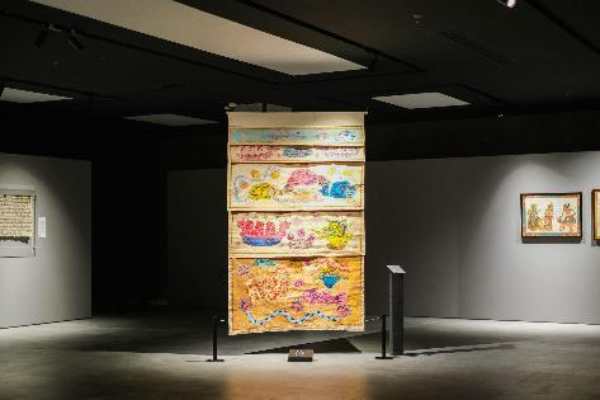
KAMASAN: The Noble Tradition of Balinese Painting brings together more than 30 artworks, including classical ritual cloths, palm-leaf works, a Palelintangan astrological calendar, and paintings by Kamasan masters entrusted by their families and descendants to SAKA Museum. Historical works appear alongside contemporary pieces by young artists who are expanding Kamasan’s visual language. They include Eka Sutha, whose pop-collage aesthetic reinterprets Balinese mythology and spirituality, bridging the ritual life of the Balinese village and contemporary urban Bali, as well as tattoo artist Eka Mardys, who recasts Kamasan figures in a strikingly futuristic style.
A closing chapter is devoted to Mangku Muriati, the first woman of her generation to hold the unique dual role of temple priest and Kamasan artist. One of the tradition’s foremost painters working today, her works have been shown at the 2025 Sharjah Biennial and collected by the Australian Museum in Sydney and the Ibsen Museum in Oslo, carrying the tradition firmly into the present.
Unlike most previous exhibitions of the Kamasan style, this new exhibition at SAKA Museum puts classical masterworks and contemporary pieces on equal footing, presenting Kamasan’s full scope, from its ritual origins to its newest reinventions, as a single continuous story. It shows how each generation, women and young artists among them, keeps the tradition alive by speaking to its own time.
Throughout the exhibition, SAKA Museum will present curatorial and artist talks, workshops, children’s activities, and other public programs. Visitors, families, educators, and cultural communities are invited to meet participating artists and researchers and engage with Kamasan through conversation and practice.
Follow SAKA Museum’s official channels for schedules, registration details, and exhibition updates.











