

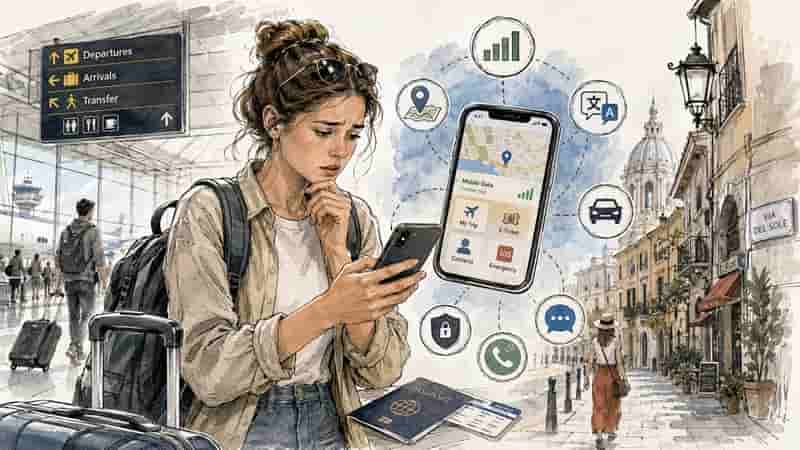
The days of travelling with a paper map, a hotel voucher and a pocket full of coins are fading fast. For many Australians, the mobile phone now does all three jobs and quite a few more.
New research commissioned by travel eSIM provider Saily found that 32% of Australians who travelled overseas in the past two years would feel somewhat or very unsafe without mobile data. Another 45% said they would still feel safe, while 23% were neutral. Current travel-industry reporting independently carries the same Australian findings.
Across the eight countries in the survey, 29% of international travellers said they would feel unsafe without mobile data. Italy topped the list at 46%, followed by Spain at 41%. In the United States, the figure was only 19%.
The result says plenty about how travel has changed. A phone is now a map, boarding pass, translator, booking folder, taxi desk and line home. Take the signal away and a smooth holiday can suddenly feel much less smooth.
“Mobile data used to be something travelers relied on for convenience. Today, it is how they navigate unfamiliar places, access reservations and boarding passes, translate conversations, contact family, or call a ride. When all of those tools disappear at once, being offline can quickly feel less like a digital detox and more like losing a safety net,” says Vykintas Maknickas, CEO at Saily.
Saily’s official company materials confirm Maknickas as the company’s CEO and describe the business as a travel eSIM provider focused on international mobile connectivity.
One point is worth keeping clear. The survey measures how safe people feel. It does not prove that mobile data reduces the risk of crime, injury, or other trouble.
Even so, the sense of control is easy to understand. A live connection can help a traveller check a route, call a ride, open a booking, contact family or find official advice. When plans go wrong, those small things can matter.
Old-school backup still matters
The Australian Government’s Smartraveller service tells travellers to keep hard copies of key flight and accommodation bookings, as well as a written list of emergency contacts in case a mobile phone cannot be accessed.
Its cyber-security advice also reminds Australians that keeping electronic devices and personal data secure overseas is an important part of modern travel preparation.
That is a useful reminder. Mobile data can help, but a phone should not be the only place where vital travel details live.
A flat battery does not care how clever the app is.
Younger travellers feel more exposed
The Saily survey found that younger travellers were more likely to feel unsafe without mobile data. People aged 45 to 54 were the most comfortable going without it.
There may be a simple reason. Many people in that age group travelled before smartphones became part of every trip. Printed maps, paper tickets, fixed meeting points and asking a local for directions were once normal travel skills.
Yes, there was a time when finding a restaurant occasionally involved speaking to another human being.
Women were also more likely than men to say they would feel unsafe without internet access abroad. The survey does not establish why, so it would be wrong to draw a firm cause from the result. Still, quick access to maps, location sharing and communication can offer an extra sense of control in an unfamiliar place.
Income also showed a relationship with offline confidence. Lower-income respondents were more likely to feel exposed without data, while higher-income travellers were more at ease offline.
One possible explanation is that travellers with larger budgets may have more backup options, such as roaming plans, hotel transfers, private transport, or multiple connected devices.
Again, those findings show associations, not proof of cause an important distinction when interpreting survey research.
Travel agents have a role to play
The findings are not simply a telecommunications story. They also carry a message for travel agents, airlines, hotels and tour operators.
Connectivity now sits firmly inside the travel experience. Travellers use their phones to open boarding passes, receive flight alerts, show hotel bookings, pay for services, find transport and contact suppliers.
For advisers, mobile access can therefore sit beside passports, visas, travel insurance and destination advice in the pre-departure conversation.
The aim is not to suggest that an eSIM is some sort of digital Superman cape. It is to make sure clients know how they will connect and what they will do if they cannot.
Cost matters too.
The Australian Communications and Media Authority (ACMA) warns that international roaming for calls, messages and mobile data can be expensive and may result in bill shock. It recommends consumers understand their provider’s international roaming arrangements and charges before using their devices abroad.
For some travellers, an international roaming pack will make sense. Others may prefer a local SIM or travel eSIM.
The right choice depends on device compatibility, destination coverage, trip length, expected data use, and price.
Plan for those dreaded words: “No Service”
Even the best connectivity plan can meet a dead zone.
Mobile networks fail. Phones break. Batteries run flat. Remote areas remain remote, no matter how many signal bars were showing over breakfast.
Maknickas recommends downloading offline maps before departure, saving accommodation details and tickets directly to the phone, taking screenshots of important bookings and directions, and carrying a charged power bank.
He also suggests arranging mobile data before travelling and agreeing on a meeting point when travelling with others, in case someone loses connectivity.
“Travelers do not need to choose between staying connected and being prepared to go offline. The safest approach is to arrange reliable connectivity before the trip while also keeping essential information available offline,” Maknickas adds.
That thinking fits neatly with Smartraveller’s longstanding advice to keep backup copies of important travel information and emergency contacts.
The sensible traveller can embrace the new tools without throwing all the old habits overboard.
Survey details
According to the methodology supplied with the research, the survey was conducted through Cint panels from 26 March to 6 April 2026.
It covered internet users aged 18 to 74 in Australia, Canada, France, Germany, Italy, Spain, the United Kingdom and the United States, with quotas applied for age, gender and place of residence.
The full sample comprised 7,861 respondents, including 1,010 Australians.
Findings on feelings of safety without mobile data were limited to respondents who had travelled internationally in the previous two years. That group totalled 4,732 people, including 592 Australians. The study also reports the international-traveller sample size and the Australian subset within its current travel-trade coverage.
And therein lies the bigger lesson.
Mobile connectivity is no longer just about posting the sunset before the ice melts in the cocktail. For a sizeable share of Australian travellers, it has become part of how they feel ready, informed, and in control overseas.
Yet the smartest travel plan remains a marriage of new and old: reliable data when it works, vital information stored offline, official travel advice checked before departure, and enough common sense to cope when the screen displays two very unwelcome words: “No Service”.
By: Sandra Jones – © 2026.
Read Time: 5 minutes.
Author Bio:
 Sandra has spent a working lifetime quietly rescuing journeys, one itinerary, one anxious caller, one impossible connection at a time. Years in Australia’s finest travel agencies taught her the art of calm, how to find a flight in a fog of cancellations, how to soothe a traveller when luggage wanders, how to turn nine frantic days in Europe into something resembling sense. Qualified, seasoned, endlessly patient, she learned that good travel advice is part logistics, part listening.
But the storyteller in her was always waiting its turn. Writing offered a new map, a way to turn experience into reflection, detail into delight. At Global Travel Media, Sandra now writes the truths only insiders know: the mishaps, the laughter, the grace found between gates and goodbyes. She reminds us that travel, for all its fuss, is still one of life’s better ideas.











