

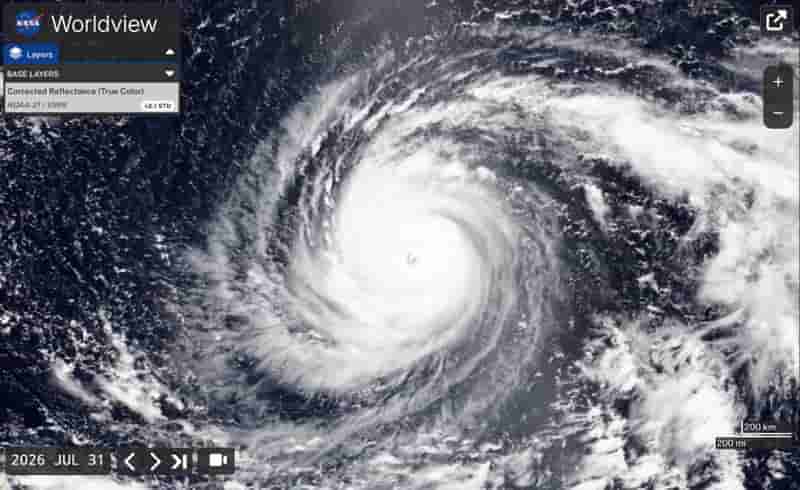
Typhoon Dolphin has delivered a sharp reminder to Asia’s travel industry. Weather still outranks the timetable.
After lashing Japan’s southern islands, Dolphin crossed the East China Sea and struck eastern China on Sunday, 9 August. It grounded flights, shut ports, stopped ferries and upset rail services. It also left thousands of travellers facing the oldest problem in travel: being somewhere they did not plan to be.
The storm made landfall near Yuhuan in Zhejiang province at about 5.30 pm local time. Winds near its centre were about 151km/h. Heavy rain then became the main threat as Dolphin moved inland.
Forecasters warned that rain could continue through Monday across Zhejiang, Shanghai, northern Fujian, Jiangsu, Anhui and nearby areas. Parts of Zhejiang could receive a formidable 250–500mm of rain.
For travellers, that matters. A typhoon may weaken after landfall, but the travel disruption often does not.
Shanghai airports take a direct hit
Shanghai became the clearest sign of Dolphin’s impact on air travel.
Authorities said 1,384 inbound and outbound flights were due to be cancelled on Sunday. That represented close to 60 per cent of the day’s schedule at Pudong and Hongqiao airports. Pudong was set to lose 871 flights, while Hongqiao planned to cancel 513 flights.
Later flight-tracking data cited by Reuters put the total number of Shanghai cancellations at about 1,500 flights.
Those figures have a reach far beyond one city. When hundreds of flights disappear in a day, the next problem begins. Aircraft finish up in the wrong city. Crews can reach duty limits. Connections are missed. Seats on later services disappear rather quickly.
Put simply, Sunday’s cancelled flight can become Monday’s delay.
The storm also hit ground and sea transport. Some rail services in the Yangtze River Delta were suspended, while ports and tourism sites were closed. Shanghai moved more than 30,000 people from higher-risk areas.
For the travel trade, this is where the work becomes less dramatic but more difficult. Rebooking a holiday is rarely as neat as moving one line on a screen.
Japan takes the first blow
Japan felt the effects of the storm before China did.
More than 500 flights were cancelled on Friday as the storm neared south-western Japan. Evacuation orders covered almost 260,000 residents in Kagoshima and Okinawa prefectures.
By Saturday, six people had been injured. Power had been cut to more than 50,000 buildings across Okinawa and Kagoshima. All Nippon Airways and Japan Airlines cancelled flights to and from Okinawa as the typhoon brought sustained winds of up to 162km/h and gusts reaching 216km/h.
For anyone trying to enjoy an island holiday, it was hardly postcard weather.
Dolphin’s strength was serious, but its slow movement made matters worse. Slow storms can keep aircraft on the ground for longer. Ferries remain tied up. Hotel stays stretch beyond checkout day. Tour plans unravel one booking at a time.
There are certainly worse places to be stranded than Okinawa. That thought becomes less comforting when the departure board appears to have learnt only one word: cancelled.
Taiwan and Hong Kong feel the ripple
Dolphin did not need to make a direct strike on Taiwan to cause trouble there.
Its outer rain bands soaked the north of the island. Flights were cancelled, and ferry services were suspended. Taiwan’s transport authorities urged people to reconsider non-essential trips to offshore islands as carriers altered services between Taiwan and Okinawa.
That advice was practical. Once ferries stop, travellers can quickly run out of ways home.
Airlines also changed schedules linking Hong Kong with affected mainland Chinese destinations. HK Express, for example, cancelled and rescheduled flights between Hong Kong and Ningbo, while offering eligible affected passengers options such as rebooking or refunds.
This is where the phrase regional disruption stops being weather-office shorthand and becomes operational reality.
A passenger may never see the worst weather. Yet the aircraft needed for that passenger’s flight might be stuck elsewhere. The crew could be delayed. The incoming service might never have left.
Weather disruption can move through an airline network almost as efficiently as passengers do.
The Philippines faces a different danger
Dolphin also affected the Philippines, although the typhoon did not make a direct strike there.
Instead, it helped strengthen seasonal monsoon rain over northern Luzon. Flooding affected several areas, including parts of metropolitan Manila, while more than 12,000 people were displaced.
In the mountain resort city of Baguio, a landslide struck homes after days of heavy rain. Rescue work was continuing on Sunday, with authorities reporting people missing.
For tourism operators, there is an important distinction here. A typhoon does not have to pass directly overhead to create serious travel risk.
Extra monsoon rain can flood roads and halt tours. It can make mountain travel unsafe and cut access to resorts or communities far from a cyclone’s centre.
That is why watching only the little swirling symbol on a weather map is never quite enough.
What travellers should do now?
Anyone planning to travel through eastern China, southern Japan, Taiwan, or nearby Asian hubs should check the latest operating information before leaving for the airport.
The airline’s latest flight status matters rather more than the original booking confirmation sitting comfortably in an inbox. The same principle applies to rail and ferry services.
Indeed, HK Express has advised affected passengers to check flight status before travelling to the airport and has offered rebooking arrangements for disrupted routes.
Passengers should also review their carrier’s refund and rebooking rules. Anyone holding a tight connection would be wise to allow more time where circumstances permit.
Travellers in areas affected by heavy rain should follow local emergency instructions. Flooding and landslides can remain dangerous long after the fiercest winds have gone.
The Japan Meteorological Agency also cautions that hazardous conditions, including heavy rain, strong winds, and high waves, can persist even after a typhoon weakens into a tropical depression.
Travel agents and corporate travel managers should therefore expect a long operational tail. Missed connections, displaced aircraft and heavily booked replacement services can affect routes that were never close to Dolphin’s centre.
The bigger lesson for Asia travel
Typhoon Dolphin is first and foremost a safety story.
It is also another test of Asia’s tightly linked travel network.
A storm in Okinawa can upset flights in Hong Kong. A closure in Ningbo can affect somebody changing planes elsewhere in the region. A day of mass cancellations in Shanghai can disturb airline schedules well beyond China.
That connectivity is one of modern aviation’s great strengths.
It is also a weakness when something large, wet and rotating turns up without a boarding pass.
Dolphin moved inland after its Zhejiang landfall and was forecast to lose strength. Yet forecasters warned that prolonged heavy rain could sustain the risk of floods and landslides as the system slowed over China.
For airports and airlines, the task now is to rebuild schedules. For hotels and ground operators, it is managing unexpectedly extended stays and altered itineraries. For agents, it means keeping clients informed before they discover the bad news at an airport check-in desk.
And for travellers?
Patience may be the only item of baggage with no weight limit.
By: Michelle Warner – © 2026.
Read Time: 5 minutes.
Author Bio:
 Michelle Warner has always carried stories the way others carry passports lightly, faithfully, and with purpose. She learned her craft in newsrooms, shaping sentences with care, before swapping deadlines for departures as a flight attendant with some of the world’s great airlines. Years aloft sharpened her eye for character and deepened her fondness for the small, dignified rituals of travel, the quiet kindness of strangers, the poetry of arrival, the patience learned between time zones.
Now grounded by choice, Michelle has come home to writing with the same calm authority she once brought to turbulent cabins. Her prose blends an editor’s discipline with a traveller’s wonder, tinged with humour and reverence for the golden age of travel. Each piece feels like a handwritten boarding pass, gracious, observant, and unmistakably alive.











