

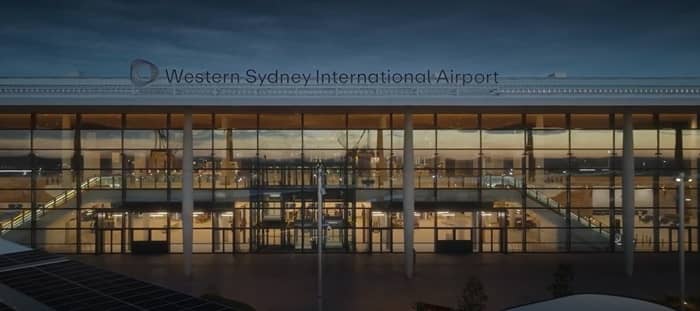
Sydney has talked about its second major airport for decades. Now it actually has one.
For decades, Sydney’s second major commercial airport was one of those Australian projects that seemed destined to remain confined to reports, political speeches and artists’ impressions.
Not any more.
Western Sydney International (Nancy-Bird Walton) Airport is now operating freight services, and its first commercial passenger departure is scheduled for Sunday, 25 October 2026. Jetstar flight JQ362 is scheduled to leave at 11 am for the Gold Coast, turning an argument that has occupied governments for generations into something wonderfully ordinary: people checking bags, hunting for coffee and asking whether boarding has started.
That ordinariness will be rather historic.
After 15 years of formal planning, seven years of construction and around a year of testing, Western Sydney International WSI to the aviation world is moving from mega-project to working airport.
And for the travel trade, that is where the interesting story begins.
Freight is already flying
WSI’s Cargo Precinct formally opened on 26 July 2026, giving the airport its first taste of commercial operations before passenger services begin.
Qantas Freight commenced regular domestic operations the following evening, moving Australia Post freight through the new facility. The precinct has been designed as a substantial logistics hub, with future capacity to support Western Sydney’s growing freight and supply chain economy.
It is a useful dress rehearsal. Airports may be architectural objects while they are being built, but once aircraft, cargo, crews, ground handlers and operating systems begin meeting one another on a timetable, theory gives way rather quickly to reality.
WSI is now in that reality.
Jetstar gets the first passenger departure
Jetstar is set to have the honour of operating WSI’s first scheduled commercial passenger flight, with its Western Sydney services subject to government and regulatory approval.
JQ362 is scheduled to depart Western Sydney at 11 am on Sunday, 25 October, bound for the Gold Coast.
From launch, Jetstar plans to operate up to 14 flights a week between Western Sydney and Melbourne, four weekly services to the Gold Coast and three to Brisbane, using Airbus A320 aircraft.
It is a measured opening network rather than a fireworks display, and that is no bad thing.
New airports need passengers, reliable systems and airlines prepared to build schedules as demand develops. Empty departure boards are not made more impressive by large opening-day speeches.
The Qantas Group has signed a five-year agreement with WSI covering domestic passenger operations and freight, giving both Jetstar and Qantas room to expand their presence as the Western Sydney market grows.
Air New Zealand puts international travel on the board
Just one day after the first domestic passenger departure, WSI is scheduled to gain its first international passenger service.
Air New Zealand plans to begin non-stop Western Sydney–Auckland flights on Monday, 26 October 2026, subject to government approval.
The carrier has scheduled three return services each week, operating on Mondays, Wednesdays and Fridays. NZ166 is listed to depart Western Sydney at 9.05 am, with the route to be served by Air New Zealand’s international Airbus A320 and A321 aircraft.
For Western Sydney travellers, that matters well beyond Auckland.
Air New Zealand’s network provides onward connectivity through New Zealand, while the direct service also introduces genuine competition between Sydney’s two major commercial airport gateways for Trans-Tasman passengers.
For travel agents, the new airport code will therefore require more than casual attention. A customer saying “Sydney” will increasingly need a second question: which Sydney airport?
That may not sound revolutionary, but neither does arriving at the wrong terminal with two suitcases and 90 minutes to spare.
Singapore Airlines makes the international statement
The next major milestone comes on 23 November 2026, when Singapore Airlines is scheduled to launch daily non-stop flights between Singapore and Western Sydney, subject to regulatory approvals.
The airline plans to operate the route with its 303-seat Airbus A350-900 medium-haul aircraft, configured with 40 Business Class and 263 Economy Class seats.
SQ202 is scheduled to depart Western Sydney at 11.55pm, a departure time that highlights one of WSI’s strongest commercial advantages: the airport is designed to operate 24 hours a day, without the overnight curfew that applies at Sydney Airport (Kingsford Smith).
That creates considerably more scheduling flexibility for international airlines, connecting traffic and freight.
It does not mean Kingsford Smith suddenly becomes yesterday’s airport. Far from it. Singapore Airlines plans to retain its four daily services there while adding the WSI flight, taking its combined Sydney schedule to five flights a day.
That distinction is important.
Western Sydney International’s strongest long-term case is not that it should cannibalise every existing Sydney service. It is that Greater Sydney needs additional aviation capacity, more airline choice and an airport able to operate on schedules that the existing curfew makes difficult.
Qantas follows in 2027
Qantas passenger operations are scheduled to commence on 28 March 2027, subject to government and regulatory approval.
The airline plans four weekly services to Brisbane and four to Melbourne, operated by QantasLink Embraer E190 aircraft.
Again, the opening schedule is deliberately modest.
Airlines will add capacity if Western Sydney produces passenger volumes, yields, and connecting opportunities that justify it. Aviation runs on enthusiasm only until the first fuel bill arrives.
The important point is that WSI opens with several credible airline brands committed across domestic, Trans-Tasman, and long-haul international markets, rather than relying on a single launch carrier to carry the entire proposition.
An airport built to grow
Western Sydney International opens with a 3.7-kilometre runway capable of handling the world’s largest passenger aircraft, an integrated domestic and international terminal, and a dedicated cargo precinct.
Its initial infrastructure is designed to cater for up to 10 million passengers annually, with expansion planned as demand increases.
Major terminal, airside and landside construction was completed in June 2025, after which the emphasis shifted to testing, commissioning, airline readiness and operational preparation.
The airport project has created more than 12,800 jobs, with around half going to local workers, while the Australian Government says more than $500 million flowed to more than 360 Western Sydney businesses during major construction.
Those numbers help explain why the airport is bigger than an aviation story.
WSI sits at the heart of a broader attempt to reshape the economic geography of Western Sydney through aviation, logistics, advanced manufacturing, tourism, accommodation, business travel and the developing Bradfield city centre.
The aircraft are the visible part. The jobs and investment around them may ultimately be the larger prize.
Road ready, rail still coming
One of the biggest improvements to WSI’s opening-day proposition arrived months before the first passenger flight.
The new 16-kilometre, toll-free M12 Motorway opened on 14 March 2026, providing the principal motorway gateway between the airport precinct, The Northern Road and Sydney’s wider motorway network.
The M7/M12 interchange subsequently opened on 14 June, completing a direct motorway-to-motorway connection.
That gives WSI a serious road link from day one.
Rail is more complicated.
The 23-kilometre Sydney Metro–Western Sydney Airport line will serve six stations between St Marys and Bradfield, including Airport Terminal and Airport Business Park.
All track had been laid by June 2026, and the first of 12 purpose-built Metro trains arrived in Sydney in July. The trains have been designed with airport travellers in mind, including wider aisles, luggage storage and real-time flight information displays.
But the Metro will not be carrying passengers when WSI’s passenger terminal opens on 25 October.
The NSW Government currently states that the line will open in 2027. The contractual date for completion and full operational services is 30 April 2027, although that contractual milestone should not be confused with a guaranteed public opening date.
Until Metro services begin, a free interim bus will link WSI and St Mary’s station every 30 minutes. The trip is expected to take about 30 minutes in normal traffic, with services planned from 4.30 am until midnight Sunday to Thursday and until 1 am on Fridays and Saturdays.
It is a practical interim solution.
It is not as elegant as opening a new international airport and its purpose-built railway together.
For passengers carrying luggage, aviation’s traditional reminder that every transport interchange looks simpler on a map, the Metro cannot arrive soon enough.
Twenty-four hours brings responsibility
WSI’s curfew-free operations are a significant commercial advantage, particularly for freight and international scheduling.
They also bring a responsibility to surrounding communities.
The Australian Government’s Western Sydney International Airport Noise Insulation Program is now open to eligible landowners in the areas most affected by aircraft overflight noise.
The program provides eligible homes and other noise-sensitive buildings with treatments designed to reduce indoor aircraft noise. Applications remain open until April 2028, while the wider program runs until April 2029.
That belongs in the airport story because credible infrastructure reporting should acknowledge both halves of the equation.
Airports create jobs, connectivity, trade and tourism.
They also create aircraft noise.
A successful 24-hour airport will need to demonstrate that those competing realities can be managed transparently and responsibly.
What this means for travel sellers and tourism
For the Australian travel industry, WSI creates something extraordinarily valuable: another option.
Jetstar will provide domestic leisure capacity. Air New Zealand is scheduled to add a new Trans-Tasman gateway. Singapore Airlines will connect Western Sydney directly with one of Asia’s most important aviation hubs. Qantas will add further domestic network depth from March 2027.
Inbound operators gain another gateway for Western Sydney, the Blue Mountains and surrounding visitor regions.
Hotels can expect new demand from airline crews, business travellers, meetings, stopovers and airport-related commercial activity.
Tourism operators gain access to a population catchment that has long travelled across Sydney to reach Kingsford Smith.
And airlines gain something rarer still in a major global city: substantial new airport capacity with room to grow.
None of that guarantees instant success.
Airlines will judge WSI by passenger demand, operating performance, yields and costs. Travellers will judge it by fares, routes, road access, public transport and how painless the terminal experience proves to be.
The first year will matter enormously.
The countdown has become a launch
Western Sydney International spent decades as an idea and years as a construction project.
It is now an airport.
Freight is already moving. The M12 is open. Passenger tickets are on sale. Jetstar is scheduled to make the first passenger departure on 25 October; Air New Zealand, the first scheduled international passenger carrier, the next day; and Singapore Airlines will follow in November, subject to the relevant approvals.
The Metro remains unfinished, airline schedules will need to grow, and the airport must earn the confidence of both passengers and its surrounding communities.
But the central question has changed.
For most of this project’s modern history, Australians asked whether Sydney’s second major commercial airport would ever really happen.
Now the question is rather more practical.
Who will fly there next?
By: Sandra Jones – © 2026.
Read Time: 7 minutes.
Author Bio:
 Sandra has spent a working lifetime quietly rescuing journeys, one itinerary, one anxious caller, one impossible connection at a time. Years in Australia’s finest travel agencies taught her the art of calm, how to find a flight in a fog of cancellations, how to soothe a traveller when luggage wanders, how to turn nine frantic days in Europe into something resembling sense. Qualified, seasoned, endlessly patient, she learned that good travel advice is part logistics, part listening.
But the storyteller in her was always waiting its turn. Writing offered a new map, a way to turn experience into reflection, detail into delight. At Global Travel Media, Sandra now writes the truths only insiders know: the mishaps, the laughter, the grace found between gates and goodbyes. She reminds us that travel, for all its fuss, is still one of life’s better ideas.











