

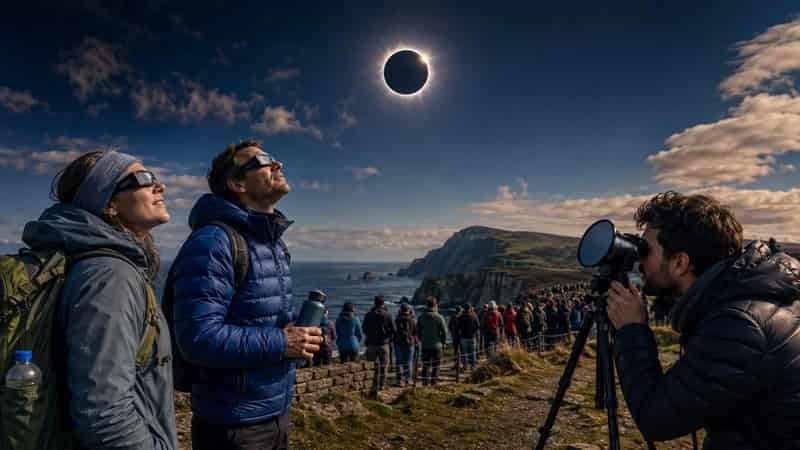
Only days remain before the 12 August 2026 total solar eclipse, and the travel world is moving into high gear.
The eclipse will sweep across northern Russia, Greenland, Iceland, the North Atlantic, Spain and a small corner of Portugal. Much of Europe will see a partial eclipse. Parts of North America and north-western Africa will also get a view. For mainland Europe, it will be the first total solar eclipse since 1999.
For eclipse chasers, the prize is simple: get inside the path of totality and hope the clouds behave.
That sounds easy. It is not.
The road to totality may be crowded
Global Rescue is warning travellers to prepare for crowded roads, packed public transport, weak mobile signals and sudden weather changes. Popular viewing areas may also face access limits. In remote parts of Greenland and Iceland, medical help can be a long way away.
In other words, the Moon may run to schedule. The traffic probably will not.
Global Rescue has previously warned that eclipse tourism can place heavy pressure on roads and infrastructure, particularly when large numbers of visitors head towards relatively small viewing zones. Weather, of course, remains the variable nobody can book, upgrade or negotiate with.
“Looking directly at the sun without proper protection can injure the retina and cause solar retinopathy, potentially resulting in blurred or distorted vision, dark spots in the center of the visual field or permanent vision loss,” said Jeff Weinstein, medical operations senior manager at Global Rescue.
The warning deserves attention.
Designer sunglasses will not save the day
NASA says it is unsafe to look straight at the Sun during the partial stages without proper solar eye protection. Ordinary sunglasses are not enough, no matter how dark or expensive they may be.
Safe eclipse glasses or handheld solar viewers should meet the ISO 12312-2 international standard. The American Astronomical Society also advises buyers to use trusted suppliers. A printed ISO label alone is not proof that a product is safe, with the AAS warning consumers to buy from manufacturers or authorised dealers whose products have been properly tested.
“Regular sunglasses, regardless of how dark they are, are not adequate for directly viewing the eclipse. Safe direct viewing requires eclipse glasses or handheld solar viewers that comply with the ISO 12312-2 international standard,” Weinstein added, noting that eclipse glasses should be obtained from a reputable manufacturer or supplier rather than relying solely on an ISO marking.
Cameras need care too. So do binoculars and telescopes.
These devices need a proper solar filter fixed over the front of the lens or optics. Looking through an unfiltered device can cause severe eye damage. Wearing eclipse glasses while looking through an unfiltered telescope does not solve the problem.
There is one brief exception.
People inside the path of totality may remove their solar viewers only when the Moon fully covers the Sun’s bright face. The glasses must go back on as soon as any bright part of the Sun returns. Outside the path of totality, viewers must keep safe solar protection on whenever they look at the Sun.
Two minutes worth crossing oceans for
That brief window is what travellers have crossed oceans to see.
NASA says totality will last less than two minutes for most people along the path. Near the centre line in parts of Greenland, Russia and the North Atlantic, it can stretch to a little under two and a half minutes.
A long trip for a short show? Certainly.
But eclipse chasers have never been accused of lacking commitment.
For the travel trade, the event is also a fine example of astro-tourism at work. Hotels, cruises, tours and local transport have all become part of the race to the Moon’s shadow. Iceland and Spain are among the key destinations, while Arctic routes offer a far more remote experience.
And there is a considerable lesson for the travel industry here. Natural events of this scale can turn towns, ports and patches of countryside into international destinations almost overnight. Demand follows the shadow, rooms disappear, transport fills, and suddenly a field with a clear western horizon becomes prime tourism real estate.
Weather gets the final vote
Weather remains the great wildcard.
Cloud can turn a perfect viewing site into a very expensive lesson in meteorology.
Global Rescue therefore wants travellers to have a backup plan. Know another viewing point. Download offline maps. Carry water, food and essential medicine. Pack first-aid items and a charged power bank. Leave far more time than usual for road and public transport trips.
Travellers heading into remote areas should also know where the nearest medical help is located. They should understand how to seek help if they become ill, sustain an injury, or become stranded.
That may sound cautious, but this is a major public event spanning some rugged terrain. A flat phone battery or missed road turn can become a much bigger problem when networks are busy and local services are stretched.
Indirect viewing is another safe option. A pinhole projector can show the Sun’s changing shape without anyone looking directly at it.
Children should be watched closely. Eclipse glasses should be checked before use. If they are scratched, torn or punctured, throw them away.
It is not the glamorous part of eclipse travel. Then again, neither is explaining to an eye specialist why a pair of designer sunglasses seemed like a good idea.
“A total solar eclipse is extraordinary, but travelers shouldn’t allow the excitement of the moment to override basic safety,” Weinstein said. “Prepare for the crowds, know what you will do if weather forces you to change locations, and protect your eyes every second the sun is visible.”
Australians chasing the darkness
For Australians making the long trip to Europe or the Arctic, the message is clear.
Plan early. Pack well. Stay alert.
Arrive early. Stay flexible. Keep offline directions. Carry the basics. Protect your eyes.
And keep one eye safely, of course, on the forecast.
If the weather plays along, 12 August could deliver one of travel’s rarest rewards: daylight fading, the solar corona appearing and a slice of the world falling into the Moon’s shadow.
The eclipse may last only minutes. The memory should last much longer.
Just make sure the souvenir is a photograph, not a hospital wristband.
Useful resources:
- NASA – 12 August 2026 Total Solar Eclipse
- NASA – Eclipse Viewing Safety
- American Astronomical Society – Safe Solar Viewers
- Global Rescue
By: Michelle Warner – © 2026.
Read Time: 4 minutes.
Author Bio:
 Michelle Warner has always carried stories the way others carry passports lightly, faithfully, and with purpose. She learned her craft in newsrooms, shaping sentences with care, before swapping deadlines for departures as a flight attendant with some of the world’s great airlines. Years aloft sharpened her eye for character and deepened her fondness for the small, dignified rituals of travel, the quiet kindness of strangers, the poetry of arrival, the patience learned between time zones.
Now grounded by choice, Michelle has come home to writing with the same calm authority she once brought to turbulent cabins. Her prose blends an editor’s discipline with a traveller’s wonder, tinged with humour and reverence for the golden age of travel. Each piece feels like a handwritten boarding pass, gracious, observant, and unmistakably alive.











