

Air New Zealand has lifted its June punctuality result despite winter weather, airport disruption and the occasional operational gremlin refusing to remain grounded.
Air New Zealand has posted a strong rise in its June on-time performance. The result came despite wild winter weather, a fire at Wellington Airport and other events beyond the airline’s control.
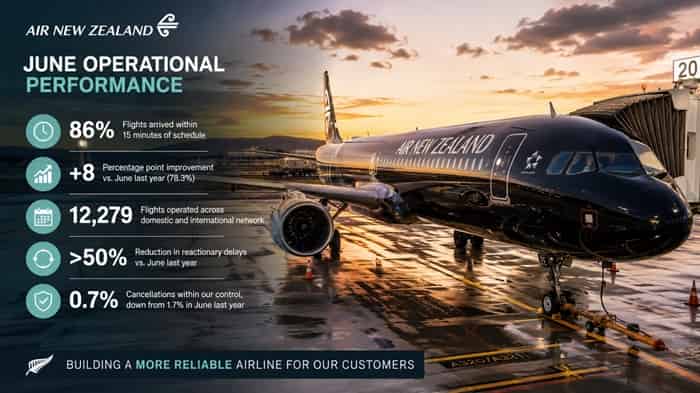
The carrier ran 12,279 flights across its domestic and international network in June. Of those, 86 per cent arrived within 15 minutes of the scheduled time.
That figure was down from May’s record 89.1 per cent. Yet it was well ahead of June last year, when 78.3 per cent of flights arrived on time. The gain was close to eight percentage points in one year.
For travellers, that is more than a neat set of numbers. It means fewer missed connections, fewer rushed walks through airport halls and fewer calls that start with: “Sorry, the flight is late.”
Eight-point lift puts reliability back on schedule
Air New Zealand Chief Operations Officer, Ground and In-Flight, Kate Boyer, said the month showed real progress.
“June was another solid month for our operations. While our on-time performance eased slightly compared with May, it came during a month where we managed several significant operational challenges, including the fire at Wellington Airport, periods of severe winter weather, and other disruptions outside our control.”
Those events could have caused delays to spread across the whole day. In airline terms, these are known as reactionary delays. One late flight can hold up an aircraft, a crew and several later services.
Reactionary delays cut by more than half
Air New Zealand said this type of delay fell by more than 50 per cent from June last year. That helped teams reset the schedule faster when things went wrong. It also reduced the flow-on effect across the network.
It is a key sign of a sound airline. No carrier can stop a storm or brush aside an airport fire. The real test is how fast it gets back on track. On that score, Air New Zealand had a much better June.
“We know reliability is one of the things our customers value most. Every improvement we make means more people arriving on time, making connections, getting home to their families, or starting their holidays and business trips as planned,” Boyer said.
The airline has spent the past year working on the basics. It changed parts of its regional timetable to give flights a better chance of running well. It also put in place a clear plan to improve how teams manage each day’s operation.
The work now moves across the jet network. Air New Zealand will use what it has learnt to fine-tune flight times and improve how staff respond when a problem arises.
Controllable cancellations move sharply lower
The June cancellation rate also needs some care when read. Total cancellations rose to 3.3 per cent of all scheduled flights. Most were due to severe weather and the fire at Wellington Airport.
The rate for cancellations within the airline’s control told a brighter story. It fell to 0.7 per cent, from 1.7 per cent in June last year.
That gap matters. An airline cannot bargain with the weather. It can, however, improve its plans, staffing cover, crew use, maintenance links and technology. June’s result points to gains in those areas.
Boyer said the airline would keep investing in its people, planning and technology as winter moves on.
“Reliable operations are fundamental to delivering for our customers and to our ambition of being the world’s most respected airline. While there’s always more to do, particularly as we move through winter, these results demonstrate the progress we’re making through continued investment in our people, planning and technology at Air New Zealand.”
Why the result matters to travel sellers
For travel agents and business travel buyers, better reliability has clear value. It lowers the risk of missed connections. It helps keep an itinerary on plan. It also gives travellers more confidence when they book a tight connection or an important work trip.
Operational reliability is not merely an airline statistic. It can shape the entire customer experience, from the first airport check-in to the final hotel arrival.
A late inbound service can mean a missed long-haul connection. That can lead to new tickets, extra hotel nights and a considerable amount of paperwork for the travel adviser who thought the booking had been safely tucked away.
Fewer knock-on delays should also give Air New Zealand more room to recover when disruption strikes. That matters during winter, when fog, wind, snow and storms can turn even the best timetable into something closer to a polite suggestion.
June was not perfect. The on-time result did ease from May, and winter has a habit of tearing up even the best flight plan. Still, the year-on-year gain is hard to miss.
The fall in reactionary delays may be the best sign of all. It shows that Air New Zealand is not just getting more flights away on time. It is also getting better at stopping one bad turn from becoming a full day of trouble.
The next task is to make that progress stick. Customers will not ask for a parade. They will be quite content to land on time, collect their bags and get on with the trip.
By: Octavia Koo – © 2026.
Read Time: 4 minutes.
Author Bio:
 Octavia Koo arrived in Australia in the early eighties with little fuss and a good eye. Sydney suited her. At UNSW, she studied Arts, then found her footing in graphic design before drifting, quite naturally, into the digital side of things, building websites and shaping words that made people want to stay.
Singapore followed, and with it, the fast pace of tourism platforms and ITB Asia. Long before SEO became a buzzword, Octavia understood how stories travelled online. That’s where she met Stephen, and the seed for something more was planted.
A few years later, she joined Global Travel Media.
Today, Octavia works with quiet assurance, blending art, instinct and experience to produce stories that don’t shout; they simply work and linger.











