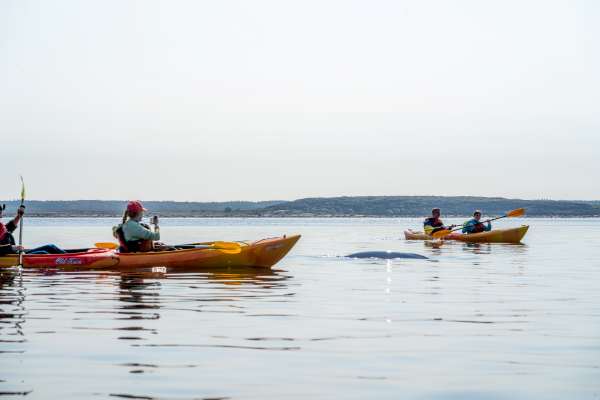
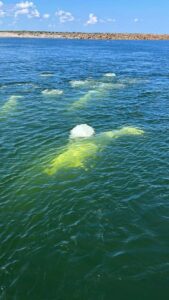
Every summer, one of the planet’s most remarkable wildlife gatherings unfolds along Canada’s waterways, and most travellers have no idea it’s happening. Thousands of beluga whales migrate through the St. Lawrence Estuary in Québec and the Churchill River estuary in Manitoba, transforming these northern waters into a living, breathing concert hall of clicks, whistles, and song.
Unlike their more famous cousins, the dramatic breaching humpback, the iconic orca – the beluga invites a different kind of encounter. Expressive, curious, and playful, these snow-white mammals have a habit of approaching boats, making eye contact, and surfacing close enough to leave visitors soaking.
The Sea Canary: Nature’s Most Vocal Whale
Their high, melodic calls carry through the water and, on still days, even above the surface, turning the estuary into a natural amphitheatre. Canada’s nutrient-rich northern waters attract over a dozen whale species, but it is the beluga – curious, expressive, and utterly distinctive, that consistently steals the show.
Where to Find Them: Canada’s Two Beluga Capitals
Saguenay–St. Lawrence Marine Park, Québec
The Estuary’s cold, plankton-rich waters draw belugas from May through October, alongside humpbacks and blue whales. Even from shore, lookout points and interpretation centres deliver remarkable access. Guiding companies such as the Alliance Éco-Baleine champion ethical wildlife viewing, operating in partnership with Indigenous stewardship initiatives that have protected this habitat for generations.
Churchill, Manitoba
In summer, the Churchill River estuary becomes one of the most concentrated beluga gatherings on Earth, a place where pods of thousands transform the bay into a spectacle of white. Zodiac operators bring guests into the heart of the action, while Lazy Bear Expeditions offers the only Arctic vessel with an underwater viewing lounge, providing eye-level encounters below the surface.
An Indigenous Story at the Heart of It
Some of the most meaningful beluga experiences in Canada are led by the communities who have lived alongside these whales for millennia. Vacances Essipit, operated by the Innu Essipit First Nation near Québec City, offers high-adrenaline zodiac tours that weave cultural knowledge into every sighting – reframing whale-watching not as passive observation, but as an act of relationship with the natural world.
Road Trip Ready: The 940 km Whale Route
For travellers who prefer to set their own pace, Québec’s Route des Baleines follows Highway 138 for 940 km along the St. Lawrence shore, passing through charming towns like Tadoussac, Les Escoumins, and Les Bergeronnes. Each serve as a launch point for kayak and zodiac tours – and each offers the kind of unhurried encounter with wild Canada that is increasingly hard to find.
Plan Your Beluga Encounter
• Saguenay–St. Lawrence Marine Park, QC: Front-row shore access and guided tours; peak season May–October.
• Frontiers North Adventures, Churchill, MB: Zodiac tours into the heart of the summer beluga gathering.
• Lazy Bear Expeditions, Churchill, MB: The only Arctic vessel with an underwater viewing lounge.
• Vacances Essipit, QC: Innu Essipit First Nation-operated zodiac tours combining marine wildlife with Indigenous cultural knowledge.
• Route des Baleines (Highway 138): A self-drive coastal journey spanning 940 km of prime beluga habitat.
3 More Summer Wildlife Experiences Not to Miss
Canada’s summer wildlife calendar extends far beyond the coast. From grizzly bears on the Pacific salmon runs to Inuit-led Arctic expeditions, here are four encounters that belong on every nature traveller’s radar.
Grizzly Bears on the Salmon Run
Toba Inlet, British Columbia
Each autumn from August through October, grizzly bears congregate along BC’s coastal inlets to forage during the Pacific salmon run – one of the most primal and awe-inspiring wildlife spectacles in North America. The new Toba Bears & Wilderness Tour, a partnership between Homalco Wildlife & Cultural Tours and Klahoose Coastal Adventures, brings guests by boat from Campbell River deep into Toba Inlet, where grizzlies wade the shallows and dense rainforest lines the shore. The tour reinforces historic ties between the Homalco and Klahoose First Nations, whose ancestral territories encompass this wilderness, giving visitors a cultural dimension that extends well beyond the bear sightings. Humpback whales and orcas are frequently spotted along the way.
Arctic Wildlife Through Inuit Eyes
Nunavik, Québec
Two landmark Indigenous-led expeditions launched in 2025 in Nunavik, opening a region of Canada that few travellers have ever seen. Ungava Polar Eco-tours invite guests into the Gyrfalcon Islands of Ungava Bay – just offshore from the Inuit community of Tasiujaq, where polar bears, muskoxen, seals, and whales share a landscape shaped by the biggest tidal currents on Earth. Further inland, the Inuit-owned Nunawild transports visitors from Kuujjuaq into the Arctic wilderness for journeys that combine wildlife observation with visits to archaeological sites and deep cultural interpretation. Both operations are fully Inuit-led, ensuring that the knowledge passed on to visitors comes directly from the people who have stewarded this land for thousands of years.
Mega-Fauna at Dawn: Jasper National Park
Jasper, Alberta
Jasper National Park is home to 53 mammal species – one of the highest concentrations of large wildlife in any protected area in Canada. Maligne Adventures’ Jasper National Park Wildlife Tour makes the most of the critical golden hours, heading into the park at first light or dusk when bighorn sheep, black and grizzly bears, elk, bald eagles, moose, mountain goats, and coyotes are most active. A naturalist guide provides context on the challenges of managing wildlife within a national park – from predator-prey dynamics to the pressures of increasing visitor numbers, making the experience as educational as it is exhilarating. For travellers who want maximum wildlife density in minimum time, this three-hour outing is the most reliable bet in the Canadian Rockies.