

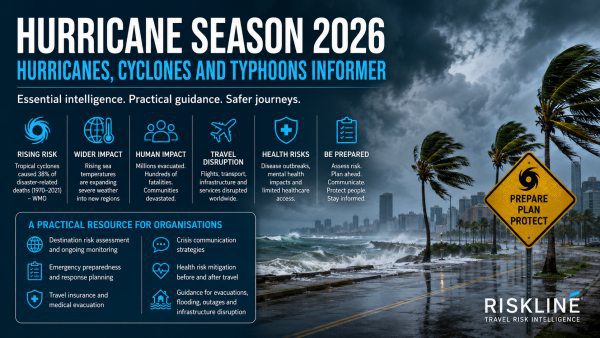
Riskline, a leading travel risk intelligence company, announced today the release of its Hurricane Season 2026: Hurricanes, Cyclones and Typhoons Informer, a comprehensive guide designed to help organisations and travellers better understand and prepare for tropical cyclones and other severe weather events.
The report examines the growing consequences of tropical storms across every major region of the world and provides practical travel, health and safety recommendations to support informed decision-making before, during and after severe weather events. Its release comes as meteorological authorities forecast a high probability of a very strong El Niño between June and November, a climate pattern associated with significant shifts in rainfall, storm activity and extreme weather conditions worldwide.
Data from the World Meteorological Organization (WMO) shows that tropical cyclones accounted for 38% of the roughly two million disaster-related deaths recorded between 1970 and 2021, making them the costliest and deadliest natural hazard during that period.
The analysis also highlights how rising sea temperatures and shifting weather patterns are expanding the reach of tropical cyclones and severe storms into regions previously considered lower risk, including parts of Europe and the Middle East.
“Organisations can no longer rely solely on historical weather patterns when assessing travel risk,” said Bumjoon Park, Senior Analyst at Riskline. “Severe weather events are becoming more dynamic and geographically widespread, creating new operational and safety challenges. Effective preparation requires flexible travel policies, trusted accommodation partners with robust emergency procedures and clear traveller response plans.”
Storm Impacts Are Intensifying Worldwide
The report documents several major weather events from the past year, including:
-
1.5 million people evacuated in the Philippines ahead of Super Typhoon Uwan in November 2025.
-
297 fatalities linked to Typhoon Tino and Super Typhoon Uwan in the Philippines.
-
More than 856,000 people affected and 215 fatalities following catastrophic flooding in Mozambique after La Niña-driven rainfall and Cyclone Gezani.
-
Over 600 deaths caused by Cyclonic Storm Ditwah in Sri Lanka and southern India.
-
13 named storms, five hurricanes and four major hurricanes recorded across the Caribbean during 2025.
-
Storm Leonardo caused widespread displacement and travel disruption across the Iberian Peninsula, illustrating how severe weather is affecting regions not traditionally associated with tropical storm activity.
Travel Disruptions Continue to Escalate
The guide outlines how severe weather events continue to disrupt global mobility through:
-
Flight cancellations and airport closures.
-
Road, rail and maritime transport disruptions.
-
Power outages and telecommunications failures.
-
Evacuation orders and movement restrictions.
-
Long-term effects on hotels, tourism infrastructure and local economies.
Health Risks Extend Long After the Storm
Following severe weather events, travellers and local communities may face increased exposure to:
-
Malaria and dengue fever.
-
Cholera and other waterborne diseases.
-
Respiratory illnesses linked to mould and water damage.
-
Mental health impacts, including stress, anxiety and post-traumatic stress disorder (PTSD).
-
Reduced access to healthcare due to damaged infrastructure and overwhelmed medical facilities.
A Practical Resource for Organisations
The publication provides actionable recommendations for travel managers, duty-of-care teams and business travellers, including:
-
Destination risk assessment and ongoing monitoring.
-
Emergency preparedness planning.
-
Travel insurance and medical evacuation considerations.
-
Crisis communication strategies.
-
Health risk mitigation before and after departure.
-
Guidance on responding to evacuation orders, flooding, power outages and infrastructure disruptions.











