There was a time when choosing a holiday destination involved little more than comparing beaches, hotel rates and whether the local beer was drinkable.
For many LGBTQ travellers in 2026, the calculation is becoming considerably more complicated.
A new global assessment from Riskline suggests that the travel industry’s favourite buzzword, inclusivity, is colliding head-on with a geopolitical reality moving in the opposite direction.
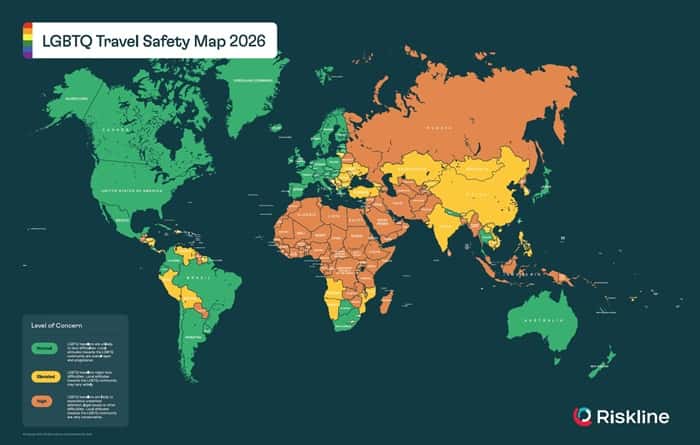
The travel intelligence specialist’s newly released LGBTQ Risk Map paints a picture that is difficult to ignore. Ninety-one countries have now been classified as “high concern” destinations for LGBTQ travellers, while another 62 sit in the “elevated concern” category. Just 80 countries remain in the normal concern bracket.
For an industry that likes to present itself as increasingly open, connected and welcoming, those numbers land with all the subtlety of a delayed long-haul flight announcement.
And they arrive at a time when the duty of care has become one of the most talked-about issues in corporate travel.
The inclusion paradox
Walk through any major travel trade show, and you’ll struggle to find a tourism board, airline or hotel group not proudly displaying its diversity credentials.
Rainbow logos appear every June. Inclusion statements are now standard corporate furniture.
Yet beyond the conference halls and polished marketing campaigns, the legal environment facing LGBTQ travellers is becoming increasingly fragmented.
According to Riskline, Western Europe remains the safest region globally, with every destination rated as of normal concern. Meanwhile, much of the Middle East and North Africa sits firmly in the high-risk category, with Israel the only destination assessed as normal concern and Lebanon classified as elevated concern.
Sub-Saharan Africa tells a similarly challenging story, with nearly 80 per cent of destinations categorised as of great concern.
It is a stark reminder that travel freedom cannot always be measured by airline capacity, visa waivers or tourism arrivals.
Sometimes it comes down to whether a traveller can safely be themselves.
The world is not standing still
The most concerning aspect of the report is not where countries currently sit.
It is how quickly some are moving.
Several destinations recorded notable setbacks during the past year.
Burkina Faso introduced legislation criminalising homosexuality for the first time following the 2022 military coup, while Senegal doubled prison penalties relating to same-sex relations.
In Eastern Europe and Central Asia, governments are increasingly pursuing restrictions through legislation aimed at limiting visibility and public discussion of LGBTQ issues.
Kazakhstan introduced restrictions on information relating to what authorities describe as “non-traditional sexual orientation”, while Slovakia moved to tighten adoption rules affecting same-sex couples. Belarus has advanced legislation targeting so-called LGBTQ propaganda.
Meanwhile, India and Japan, two countries frequently featured in global tourism campaigns, also saw developments that have raised concerns among advocacy groups.
Even the United States found itself on Riskline’s list of notable setbacks following legal developments affecting passport gender markers for non-binary travellers.
None of these changes may immediately alter tourism demand.
But collectively they point to a trend that travel professionals can no longer afford to overlook.
Some destinations are moving forward
Not every story in the report is negative.
Thankfully, the world has not completely lost its compass.
St Lucia recorded one of the most significant positive developments after the Eastern Caribbean Supreme Court struck down laws criminalising male same-sex relations. Botswana also removed penal code provisions that had long criminalised same-sex relationships.
Progress, while limited, remains possible.
The challenge is that advances in one part of the world are increasingly being outweighed by setbacks elsewhere.
Why travel managers should pay attention
For travel managers, this report is far more than an academic exercise.
Corporate travel programs have traditionally focused on terrorism, political instability, natural disasters and health emergencies.
Today’s risk landscape is considerably more nuanced.
Lorena Peña, Riskline Travel Intelligence Team Leader, says organisations must recognise that legal and cultural realities can create very different experiences for different travellers.
“With 67 countries still criminalising same-sex relations, travel policies should reflect this reality. For LGBTQ travellers, whether for work or leisure, these figures translate into real legal, cultural, and in some cases physical risk.”
That is the uncomfortable conversation many organisations are only beginning to have.
A destination that appears perfectly safe on a generic travel risk dashboard may present significant challenges for an LGBTQ employee.
The difference between a successful business trip and a serious incident can sometimes be found in a law, a border-crossing procedure, or a cultural norm that never appears in a standard itinerary.
Duty of care enters a new era
The days when organisations could simply hand employees a travel policy and wish them bon voyage are fading quickly.
Riskline’s assessment methodology draws on sources including the ILGA World database, Equaldex, NGO reports, traveller reviews and destination intelligence. The analysis evaluates factors including the legality of same-sex relationships, transgender recognition, social acceptance and passport documentation requirements.
In other words, modern travel intelligence is becoming increasingly personalised.
And perhaps that is the biggest takeaway from the 2026 LGBTQ Risk Map.
Risk is no longer just about where someone is travelling.
It is also about who is travelling.
For an industry built on moving people around the globe, that may have been one of the most important travel trends of the decade.
Further Information: Riskline LGBTQ Travel Safety Intelligence.