

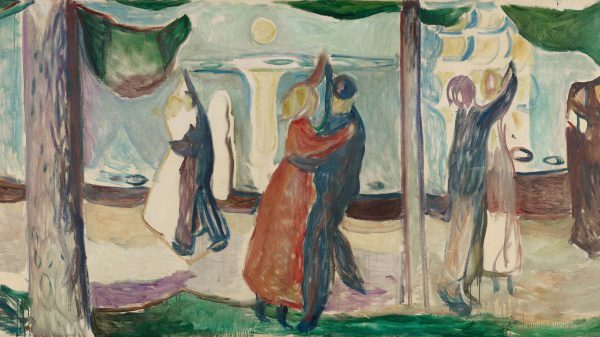
MUNCH presents for the first time outside the Freia chocolate factory Edvard Munch’s Freia Frieze, a series of 12 monumental paintings commissioned for the factory worker’s canteen, where it was installed in 1923. Shown together at MUNCH,
the exhibition presents a rare opportunity to experience one of the artist’s most significant public commissions before the works return to their original factory location.
Edvard Munch and the Chocolate Factory presents the Freia Frieze alongside a wide selection of works from MUNCH’s collection, several of which have not been on public view since the 1990s. The exhibition offers new insight into Munch’s artistic practice during the interwar period and places the frieze within a broader context of labour, everyday life, and social change.
“Alongside showing these unique Munch paintings, we also tell the story of the working class and shed light on the global connections of the chocolate industry. This is an opportunity the public will not get again,” says Tone Hansen, Director of MUNCH.
The Freia Frieze was commissioned by factory owner Johan Throne Holst for the women’s canteen at the Freia Chocolate Factory in Rodeløkka, Oslo – an artistic commission for a period shaped by industrialisation, labour struggles, and the emergence of the modern welfare state. The commission was formalised in 1922, with a fee of 80,000 Norwegian kroner. The frieze depicts summer life in a coastal town, featuring scenes of work, community, and recreation. Several motifs are based on earlier works, including Munch’s Linde Frieze and Reinhardt Frieze, as well as elements from his major series The Frieze of Life.
Plans for a corresponding decoration for the men’s canteen were never realised due to the economic crisis and increased taxation on cacao and chocolate products introduced in 1922. Sketches for both the women’s and men’s canteen projects are included in the exhibition.
Edvard Munch and the Chocolate Factory situates Munch’s work within a broader narrative of strikes, labour conflicts, and economic instability in Norway during the interwar period. Through paintings, sketches, and historical materials, it highlights themes of labour, community, and daily life, with particular emphasis on female factory workers—the so-called “chocolate girls”—and the global connections between Norwegian industry and cocoa production.
Archival material is also presented, including advertising and informational films produced by Freia between 1920 and 1930, documenting the factory’s role in shaping Norwegian cultural history.
The Freia Frieze marks a pivotal moment in Munch’s practice with monumental decorations for public and semi-public spaces. Rather than creating individual paintings, Munch developed a cohesive pictorial cycle closely connected to the workers’s struggles of the times, like the struggle for summer holidays. The frieze was relocated in 1934 to a new canteen, where Munch himself determined the sequence that remains in place today.
Curator Ana María Bresciani said: “Edvard Munch’s Freia frieze and the history of the Freia Chocolate Factory offer a unique lens to examine the intersections of art, industry, and gender in interwar Norway. The significance of decorative art commissions in Munch’s work is highlighted, especially his pursuit of alternative, movable, and non-monumental forms. The Freia commission exemplifies this and challenged the boundaries between public and private art.”
Munch completed only two major public commissions during his lifetime: the Aula decorations at the University of Oslo and the Freia Frieze. The exhibition also includes sketches for his monumental but unrealised proposal for the Oslo City Hall, known as the Workers’ Frieze.
The exhibition opens on 21 May and runs until 113October 2026. After the exhibition period, the 12 monumental paintings will return to the Freia Chocolate Factory.
The exhibition is accompanied by a publication which further illuminates the historical context of the Freia Frieze. Curator Ana María Bresciani examines the Frieze as a decorative art project and the material conditions behind its production. Author Marta Breen sheds light on the experiences of the ‘chocolate girls’ and their struggle for labour rights; political scientist Chipo Dendere discusses the democratization of cCocoa and the trade surrounding it; and author Per Petterson shares a personal story about his mother, a worker at Freia who used the canteen where the paintings were hung.
The exhibition is also accompanied by a programme of talks and seminars throughout its run.











