There was a time not so long ago when choosing a flight to Europe was a straightforward exercise in price versus convenience. Cheapest fare wins, shortest route is a close second, and perhaps a fleeting glance at the airline if one felt particularly fussy.
That time, it seems, has quietly passed.
This European summer, travellers are being asked to think like seasoned logisticians rather than carefree holidaymakers. The culprit? A growing thicket of border queues stretching across major hubs, from the elegant sprawl of Paris Charles de Gaulle Airport to the sunburnt terminals of Barcelona, El Prat Airport and the ever-busy corridors of Lisbon Airport.
And the message from those watching closely is simple: when you land, now matters just as much as where.
Timing, Not Just Ticket Price, Is Now King
According to Jürgen Himmelmann, co-founder of Global Work & Travel, travellers who ignore arrival timing do so at their peril.
“The biggest shift for travellers this summer is that arrival time matters much more than it used to,” he says.
It’s not a dramatic statement, but it carries weight. Airports across Europe are grappling with the rollout of biometric border systems, efficient in theory, but in practice, still finding their rhythm. The result has been a steady chorus of missed connections, stalled passport lines, and travellers left pacing arrival halls with the uneasy sense that their carefully laid plans are unravelling.
Himmelmann puts it plainly: “If you are landing at a busy European airport late in the afternoon, during a weekend peak, or with a tight connection afterwards, you are giving yourself very little room if border queues are longer than expected.”
The Sweet Spot: Early, Midweek, and Unhurried
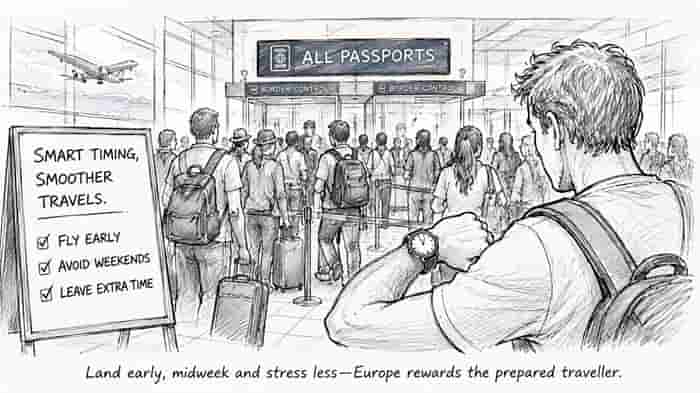
If there is a golden rule emerging from the chaos, it’s this: fly early, and preferably midweek.
Tuesday through Thursday mornings, Himmelmann suggests, offer the closest thing to a safe harbour. Not empty, mind you, Europe in summer rarely is, but certainly less frantic than the heaving rush of weekend arrivals.
“There is no guaranteed queue-free time at a busy airport,” he concedes. “But travellers are likely to have more breathing room if they arrive earlier in the day and avoid the busiest leisure travel windows.”
It’s a small adjustment with outsized consequences. An early arrival buys time, the one commodity that smooths over almost every travel inconvenience. A delayed queue in the morning might cost an hour; the same delay at night can cost a hotel check-in, a train connection, or worse, the start of a long-awaited holiday.
The Danger Zone: Weekends and Late Arrivals
If midweek mornings are the calm, weekends are the storm.
Friday afternoons and evenings see a convergence of short-break travellers, holidaymakers and business passengers, all funnelling through the same immigration desks. Saturday midday arrivals are scarcely better, while Sunday evenings bring the inevitable surge of return traffic.
Late-night arrivals, once favoured for their lower fares, now carry a particular sting. Delays at that hour can leave travellers stranded not just in queues, but without transport, open reception desks, or viable alternatives.
It is, in short, a gamble and not a particularly clever one.
The Real Risk: A Fragile Itinerary
What’s striking is that the longest queues are not necessarily the biggest threat. The real danger lies in what Himmelmann calls being “booked into a corner”.
“If you land at 4pm and have a train at 6pm, or a cruise departure the same day, even a two-hour border delay can become a serious problem,” he explains.
It’s a scenario familiar to many: the neatly aligned itinerary, the tight connection that works beautifully until it doesn’t.
For travellers embarking on multi-stop itineraries, cruises, or working holidays, the stakes are even higher. One delay can ripple through an entire journey, turning a carefully planned adventure into a logistical headache.
Arrival Day: The New Buffer Zone
In response, a subtle but important shift is taking hold: arrival day is no longer a sightseeing day.
It is, rather, a buffer.
“One of the simplest changes travellers can make is to stop overloading arrival day,” Himmelmann advises. “Arrival day should be the day you get through the airport, reach your accommodation, check in, eat, rest and reset.”
It sounds almost quaint, an echo of an earlier era when travel was less hurried and expectations more forgiving. Yet in today’s climate, it’s practical wisdom.
The temptation to squeeze in a walking tour, a dinner reservation, or a quick hop to another city is understandable. But with border processing times fluctuating, that ambition can quickly become a liability.
Smart Travellers Are Playing the Long Game
Beyond timing, there are small, almost old-fashioned habits making a quiet comeback.
Having documents ready rather than buried in hand luggage. Saving bookings offline instead of relying on patchy mobile signals. Choosing flexible fares when schedules are tight. Checking official entry requirements before departure rather than assuming nothing has changed.
None of it is revolutionary. But taken together, it forms a kind of insurance policy against the unpredictable.
“Travellers should not assume the process will be exactly the same as it was on their last Europe trip,” Himmelmann notes. “Check official entry guidance before you leave, and give yourself more time than you think you need.”
A Sensible Rule for Summer 2026
If there is one takeaway, a single rule to pin above the desk while booking flights, it’s disarmingly simple:
Do not make your arrival day too fragile.
“Choose the flight that gives you the best chance of recovering from a delay, not just the one that looks cheapest on the booking page,” Himmelmann says.
It’s advice that harks back to a more measured approach to travel, where prudence often trumped price, and a little breathing room was considered essential rather than optional.
The Bottom Line
Europe remains, as ever, irresistible in summer. The cafés spill onto cobblestones, the coastlines shimmer, and the cities hum with life. But the journey there now demands a touch more care.
A well-timed arrival, a flexible first day, and a willingness to trade convenience for certainty, these are the quiet adjustments separating a smooth trip from a stressful one.
And in a season where border queues are as much a feature as the destinations themselves, that’s a trade most travellers would be wise to make.