There’s a quiet revolution underway in the travel trade and, like most revolutions worth watching, it’s not happening in the spotlight, but in the back office.
From cruise lines to airlines, travel companies are quietly rewriting their operating playbook, shedding costs, tightening service delivery, and perhaps most critically finding a way to keep the wheels turning in an industry that rarely sleeps. The catalyst? A deceptively simple concept called co-sourcing.
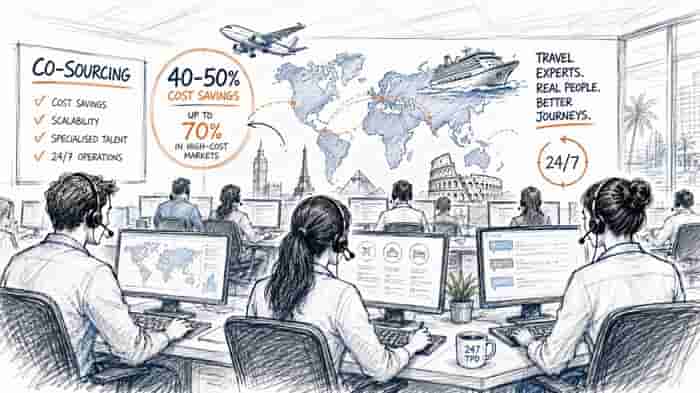
According to figures from the 24/7 Travel Partner Desk (247tpd), businesses embracing this hybrid model are trimming operational costs by 40%-50%. In high-cost markets such as the United States and Northern Europe, those savings can climb to a striking 70%.
That’s not a rounding error. That’s a structural shift.
A middle road that’s suddenly the main road
For years, travel operators have been caught between two imperfect choices: build expensive in-house teams or outsource, risking loss of control over brand and service quality. Co-sourcing, as the name suggests, threads the needle.
It embeds external teams within the business’s operational DNA, aligning them with internal KPIs, processes, and brand expectations without the overhead of hiring and maintaining large domestic workforces.
In plain English: it behaves like your team, just without the payroll headaches.
And in today’s climate, that matters.
Rising labour costs, persistent talent shortages, and the relentless expectation of 24/7 service have created a perfect storm across the travel sector. Add geopolitical uncertainty and increasingly complex traveller needs, and suddenly the old models begin to creak.
Co-sourcing isn’t just filling the gaps; it’s quietly becoming the preferred model.
The human edge in an automated world
There’s a persistent myth that automation will swallow customer service whole. The reality, as anyone who has dealt with a disrupted itinerary at 2 am will attest, is rather different.
Gerardo Ariño, founder and CEO of 247tpd, puts it bluntly:
“AI has raised the standard of what is expected from human agents; it has not eliminated them.”
And that distinction is critical.
Handling a last-minute cruise disruption, navigating airline IRROPS, or resolving a tangled post-sale issue still demands something machines struggle to replicate: judgment, experience, and a working knowledge of both product and passenger temperament.
247tpd blends technology with human expertise by deploying real-time monitoring tools, analytics platforms, and KPI-tracking systems. But the centrepiece remains the agent.
Or as Ariño succinctly frames it:
“We are not a technology company. We are a people company that uses technology to deliver excellence.”
There’s an old-school wisdom in that sentiment. Technology may set the tempo, but it’s people who carry the tune.
Cali calling: a talent hub emerges
Much of this operational alchemy is being driven from an unlikely but increasingly influential location: Cali.
Here, 247tpd has built a workforce of more than 600 travel-specialised professionals, trained in the Gallup methodology and attuned to the nuances of the industry. It’s not just about answering calls, it’s about understanding the journey behind them.
And that’s where many traditional outsourcing models have faltered.
High turnover has long plagued contact centres, particularly across Latin America, where churn rates of 30% to 40% are not uncommon. Each departure represents not just a vacancy, but a loss of knowledge, continuity, and brand familiarity.
Ariño is clear-eyed about the cost:
“Every departure involves recruitment and training costs, as well as a loss of operational knowledge that directly impacts the customer experience.”
The co-sourcing approach flips that narrative. Investing in continuous training and aligning agents closely with client brands fosters longer tenure, deeper expertise, and crucially, consistency.
And in travel, consistency is currency.
Big names, quiet endorsement
The proof, as ever, is in the passenger manifest.
A growing roster of major travel players, including Norwegian Cruise Line Holdings, Air Europa, Oceania Cruises, Viajes El Corte Inglés and Ávoris, have already embraced the model.
These are not tentative pilots or trial runs. Many have been working with co-sourcing partners for years, deploying teams across everything from transactional support and incident management to finance operations and quality control.
What’s more, these teams can be scaled rapidly, often within weeks, giving companies the flexibility that traditional staffing models struggle to match.
In an industry where demand can spike overnight, that agility is worth its weight in frequent flyer points.
A structural shift, not a passing trend
It would be easy to dismiss co-sourcing as another management buzzword destined for the same fate as “synergy” and “paradigm shift”. But that would miss the point entirely.
This isn’t about terminology. It’s about survival and, for those who get it right, competitive advantage.
Travel is a business built on movement, and the companies that thrive are those willing to adapt their internal mechanics as swiftly as they adapt their routes and products.
Co-sourcing offers a compelling proposition: lower costs, stronger service delivery, and access to specialised talent without the burden of building it from scratch.
In a world where travellers expect instant answers and seamless journeys, that combination is difficult to ignore.
The bottom line
If the past few years have taught the travel industry anything, it’s that resilience isn’t optional; it’s essential.
Co-sourcing, with its blend of flexibility, cost efficiency, and human-centred service, is fast becoming one of the more pragmatic tools in the operator’s kit.
It may not have the glamour of a new aircraft or the allure of a luxury resort opening, but make no mistake, it’s reshaping the industry from the inside out.
And quietly, efficiently, it’s saving a small fortune along the way.
Interested in how co-sourcing could reshape your travel operations? Explore scalable solutions and industry insights with leading providers like 247tpd to stay ahead of the curve.