

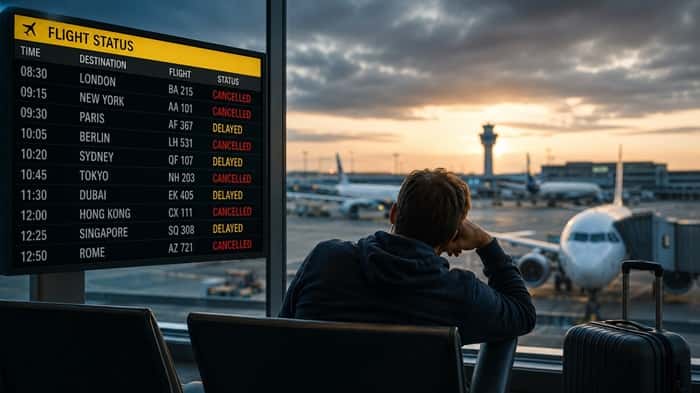
There was a time when travellers feared wars, coups and terrorist attacks.
Now they fear Gate 43.
Not because the coffee is dreadful, though often it is, but because the departure board has become modern travel’s version of Russian roulette. Cancelled. Delayed. Rebooked. Delayed again. Somewhere along the line, international flying stopped being glamorous and started resembling organised panic with duty-free.
And according to new findings from Global Rescue, travellers have officially had enough.
Fresh data from the company’s Spring 2026 Traveller Sentiment and Safety Survey reveals flight cancellations and airline reliability now rank virtually level with geopolitical instability when people decide whether to travel overseas.
That is an extraordinary shift.
For decades, danger was the dominant fear. Civil unrest. Conflict zones. Terror attacks. Political instability. They sat squarely at the top of the traveller anxiety pyramid.
Now? A missed connection in Singapore appears almost as terrifying as a coup in some corners of the world.
According to the survey, 79 per cent of travellers say flight cancellations and airline reliability are “important” or “very important” factors in travel planning. Geopolitical instability sits barely behind at 77 per cent.
Two years ago, few in the industry would have predicted that airlines would become almost as stressful as global politics.
Yet here we are.
And frankly, after watching passengers sleep on terminal floors while airlines issue apology vouchers barely sufficient for a lukewarm sandwich, perhaps the public’s patience has simply expired.
“Travelers are telling us that what disrupts their trip is just as important as what threatens it,” said Dan Richards, CEO of The Global Rescue Companies.
“Airline reliability has narrowly overtaken geopolitical instability as the top concern for most travelers, signaling a shift toward practical, experience-driven risk assessment. At the same time, geopolitical instability remains nearly as influential, which shows travelers are balancing both disruption and danger in their decision-making.”
That balancing act is now shaping how holidays are booked, how destinations are chosen and how airlines are judged.
Because modern travellers no longer buy tickets with blind optimism. They buy with suspicion.
Will the aircraft leave on time?
Will baggage arrive?
Will strikes erupt midway through the journey?
Will air traffic control collapse under pressure?
Will some mysterious “operational issue” suddenly strand 400 people in Doha at 2 am?
These are no longer fringe concerns muttered by weary business travellers nursing airport chardonnay. They are now mainstream travel calculations.
Women surveyed appeared especially alert to broader risk factors. Eighty-five per cent rated geopolitical instability as important or very important, while 84 per cent expressed the same concern about airline disruptions.
Men leaned slightly more toward operational reliability, with 75 per cent prioritising airline performance, compared with 70 per cent prioritising geopolitical instability.
The numbers may shift slightly across demographics, but the broader picture is unmistakable: travellers now see disruption itself as a genuine threat.
And geography barely changes the equation.
Among US-based respondents, 79 per cent prioritised airline reliability, narrowly ahead of geopolitical instability at 75 per cent.
Outside the United States, the figures are almost entirely reversed. Seventy-six per cent of non-US travellers ranked geopolitical instability as important, while 75 per cent cited airline reliability.
In other words, whether someone lives in Boston, Brisbane or Berlin, the travel mindset now sounds remarkably similar: “Can I trust this journey to work properly?”
That is not a small issue for an industry built on aspiration, escapism and polished advertising campaigns showing impossibly happy people drinking champagne at 35,000 feet.
Consumers today are far less interested in cinematic marketing and far more interested in operational competence.
Get them there.
Get them home.
Do not lose the suitcase.
Simple goals, historically speaking. Revolutionary ones in 2026.
The survey also found cost pressures remain significant, though secondary. 57% of travellers rated rising airfares as important or very important.
Non-US travellers were more financially sensitive, with 61 per cent concerned about airfare increases compared with 52 per cent of Americans.
Given the current cost of some international flights, many travellers likely feel they should at least receive shares in the airline alongside their boarding pass.
Another interesting divide emerged around anti-American sentiment overseas.
Overall, 50 per cent of respondents rated it as important or very important. But among Americans themselves, concern jumped to 58 per cent. Outside the United States, only 28 per cent viewed it as a major issue.
Women again showed slightly stronger sensitivity to perception-based risks, with 56 per cent rating anti-American sentiment as important compared with 49 per cent of men.
Taken together, the findings reveal a travel industry confronting a far more cautious and calculating customer than the carefree holidaymakers of the past.
The modern traveller is no longer merely dreaming about destinations. They are assessing systems, weighing probabilities and mentally preparing contingency plans before departure.
Richards believes that complexity now defines travel decision-making.
“The modern traveler is balancing multiple variables simultaneously,” he said.
“What’s changed is not just what they worry about, but how much weight they assign to each factor, and that balance varies significantly across different groups.”
For airlines, tourism boards and travel advisors, the message could hardly be clearer if it arrived flashing across an airport departures screen.
Travellers are no longer buying dreams alone. They are buying confidence.
That means operational reliability, flexible booking policies, honest communication and strong customer support are rapidly becoming the travel industry’s new competitive weapons. The destinations may still sell the fantasy, but reliability now closes the deal.
Industry experts say travel businesses that reduce uncertainty and communicate transparently during disruptions are far more likely to retain customer loyalty in an increasingly nervous global market.
For travellers, preparation has become a modern travel essential, sitting somewhere between a passport and noise-cancelling headphones.
Experts recommend international travellers in 2026:
- Check airline reliability before booking
- Monitor geopolitical travel advisories regularly
- Take comprehensive travel insurance seriously
- Allow longer transit windows for international connections
- Use experienced travel advisors for complicated itineraries
For additional travel safety insights and preparedness information, visit Global Rescue.
For airlines, tourism boards and travel brands, the warning is impossible to ignore.
Travellers still want adventure.
They would simply prefer it not begin at the departure gate.
by Michelle Warner – (c) 2026.
Read Time: 4 minutes.
About the Author.
 Michelle Warner has always carried stories the way others carry passports lightly, faithfully, and with purpose. She learned her craft in newsrooms, shaping sentences with care, before swapping deadlines for departures as a flight attendant with some of the world’s great airlines. Years aloft sharpened her eye for character and deepened her fondness for the small, dignified rituals of travel, the quiet kindness of strangers, the poetry of arrival, the patience learned between time zones.
Now grounded by choice, Michelle has come home to writing with the same calm authority she once brought to turbulent cabins. Her prose blends an editor’s discipline with a traveller’s wonder, tinged with humour and reverence for the golden age of travel. Each piece feels like a handwritten boarding pass, gracious, observant, and unmistakably alive.











