

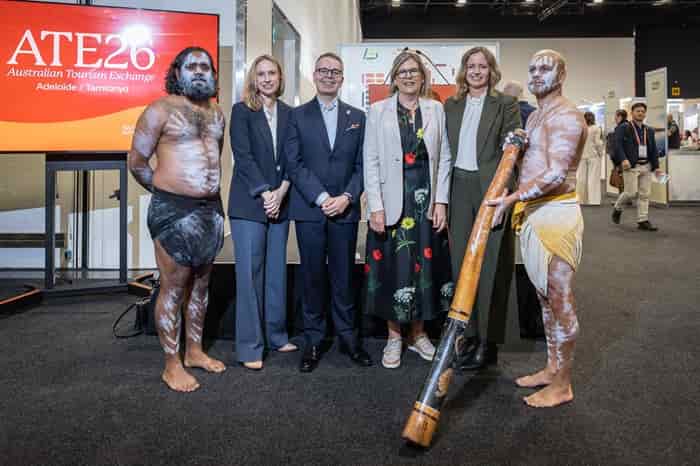
The travel industry has descended on Adelaide this week with all the energy of a packed departure lounge before Christmas, as the 46th Australian Tourism Exchange 2026 officially opens at the Adelaide Convention Centre.
And if ever Australia’s tourism sector needed a shot of espresso strong enough to wake the nation’s economic ambitions, this is it.
More than 2,700 tourism delegates are converging on South Australia for ATE26, including 730 international buyers and travel agents from 32 countries. They are here for one reason: to buy Australia. Beaches, bush, luxury lodges, Indigenous experiences, food trails, reef adventures, wine regions, outback rail journeys and the sort of hospitality Australians casually call “no worries” while the rest of the world calls “exceptional”.
For Adelaide, it is far more than another convention. It is a global shopfront.
Over the next four days, more than 55,000 business appointments will take place between overseas buyers and 1,400 Australian tourism representatives from 674 organisations. Add the networking dinners, familiarisation tours and corridor conversations where billion-dollar ideas are often born over a shiraz and a canapé, and the real number is likely to soar higher than a fully loaded Dreamliner leaving Sydney on a tailwind.
The scale of ATE26 underlines one unmistakable truth: global appetite for Australia remains remarkably strong.
According to Tourism Australia Managing Director Robin Mack, the event arrives at a critical moment for the sector.
“This year will see 74 new products offered, and 131 new buyer organisations attending for the first time highlighting strong demand in the sector and in Australia in particular,” Mack said.
“We acknowledge the impact of global shocks on the sector at this time, which makes the role of Tourism Australia more important than ever – to shape international demand, lift sustainable yield and support dispersal, directing tourism revenues into Australia and across its regions.”
In travel industry language, “global shocks” covers everything from geopolitical instability and aviation disruptions to inflation, cautious consumer spending and the occasional airline route map that changes more often than Melbourne weather.
Yet amid those challenges, Australia continues to have an enviable pull.
Part of that appeal lies in what competitors cannot easily replicate. Australia sells space, authenticity and experiences that still feel refreshingly real in an increasingly manufactured world. International travellers can sip wine in the Barossa Valley one day, snorkel the Great Barrier Reef the next, and finish the week standing beneath ochre skies in the Red Centre, wondering why their smartphone suddenly seems less important.
That emotional connection matters. Increasingly, global travellers are chasing meaningful experiences over checklist tourism. Australia’s tourism operators know it, and ATE26 gives them the perfect commercial runway to prove it.
The event is also a timely reminder that tourism is not simply about holidays and glossy brochures. It is one of Australia’s economic heavyweights.
The industry supports more than 700,000 jobs nationally and sustains approximately 300,000 businesses, many of them in regional communities where tourism dollars often mean the difference between thriving and merely surviving. Every international visitor booking a reef tour, a regional hotel stay, or a winery lunch sends money deep into local economies that rarely enjoy the spotlight of Sydney or Melbourne.
That is precisely why events like ATE matter.
The ripple effect begins immediately. Adelaide alone is expected to receive an economic injection of $13.6 million from hosting ATE26. Hotels are bustling, restaurants are booked solid and local operators are enjoying a rare and welcome surge of global attention.
The city itself could hardly ask for better timing.
Adelaide has spent the past decade quietly transforming its tourism reputation from “pleasantly underrated” to one of Australia’s most compelling destinations for leisure and business events. Once unfairly dismissed as merely a church-and-festival town, Adelaide now wears its sophistication comfortably, pairing major events infrastructure with world-class wine, food and cultural experiences.
Delegates attending ATE26 are expected to experience much of that firsthand through organised familiarisations and networking events across South Australia.
The event is being delivered in partnership with the South Australia Tourism Commission, which has worked extensively behind the scenes to showcase the state’s tourism strengths to international buyers.
Notably, Adelaide last hosted the Australian Tourism Exchange in 2018. Much has changed since then. The world endured a pandemic that brought global tourism to a standstill, grounded airline fleets, and left operators fighting desperately for survival.
Today’s atmosphere feels very different.
There is renewed confidence in the room. Optimism, even.
And perhaps that is the biggest takeaway from ATE26. Australia’s tourism industry may have endured turbulence, but it is still very much airborne and judging by the crowds arriving in Adelaide this week, the world is more than ready to climb aboard once again.
by Stephen Morton – (c) 2026.
Read Time: 5 minutes.
About the Author.
 Stephen Morton has spent nearly fifty years shaping how the travel industry thinks, speaks and sells itself. From a family agency in 1976 to today’s digital frontier, he’s rarely followed the crowd; more often, he’s been waiting at the front long before anyone noticed the line forming.
In the mid-nineties, he pushed Agents Support Systems online while the industry still clung lovingly to the fax machine. In 2001, e-Travel Blackboard, a daily bulletin that grew into Australia’s most read industry newsletter, expanded across New Zealand, Asia, the Americas, and MICE.
Global Travel Media followed in 2009, earning international awards and spawning new titles, from Destination Thailand News to Global Cruise News and now GTM Holidays and the forthcoming GTM Mall.
Lecturer, founder, agitator Morton has always turned instinct into impact.











