

The global events business has always enjoyed spending money with Olympic enthusiasm. If there is a shiny stage, an oversized LED screen, an espresso cart, or a mood lighting rig available anywhere on Earth, chances are an event organiser has already ordered three of them.
But somewhere between rising hotel rates, eye-watering airfares and production invoices large enough to frighten small nations, the industry has finally discovered a rare and beautiful phrase:
“Here’s one way to save money.”
That sentence belongs to Lakshman Rathnam, the founder and CEO of Wordly, an American company quietly becoming one of the more disruptive players in global meetings and conferences.
The company announced this week that its real-time AI translation and captioning platform has now saved the live events sector more than US$100 million in production costs since launching in 2019.
In the current climate, that figure lands like complimentary champagne at a budget meeting.
For conference organisers battling what many now call “the high cost of everything,” the timing could hardly be better.
Venues cost more.
Flights cost more.
Labour costs more.
Coffee apparently now requires financing.
Against that backdrop, multinational events are under increasing pressure to justify every line item in the budget. Boards, sponsors and finance departments no longer accept vague promises about “delegate engagement” and “global reach” without hard numbers attached.
That scrutiny is reshaping how events are built.
And translation services, once considered an unavoidable expense of international conferences, are suddenly being viewed through a far sharper commercial lens.
Traditionally, multilingual events operated on a simple but painfully expensive formula: every added language meant more interpreters, more booths, more headsets, more technicians and more logistical complexity.
In other words, the bigger the audience, the bigger the bill.
Wordly’s model attempts to blow up that equation entirely.
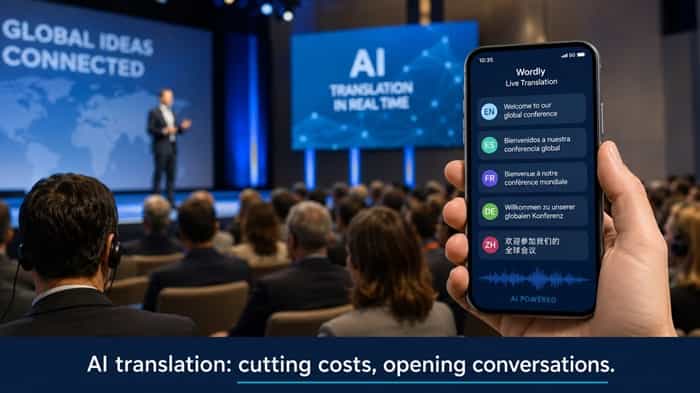
Its cloud-based platform delivers live AI translation and captions in dozens of languages simultaneously, with attendees accessing the service directly on their phones, tablets, or laptops. No interpreter booths. No truckloads of hardware. No frantic backstage coordinator waving clipboards like an airport marshal.
Just language delivered digitally and instantly.
Rathnam says the savings are not theoretical.
“The $100 million in savings we’ve tracked represents a breaking point in event production economics,” he said.
“With costs rising everywhere, organisers are being forced to make tough choices. When multilingual access depends on multiple interpreters, travel, and on-site logistics, costs scale quickly, making it a prime area for meaningful savings.”
And organisers are listening.
The numbers behind multilingual events are changing rapidly as conferences chase international audiences far beyond traditional English-speaking markets. According to Wordly, its platform has now supported more than one billion minutes of real-time translation across 120 countries since launch.
That is not niche experimentation anymore.
That is mainstream event infrastructure.
Importantly, the conversation around translation has also changed. Accessibility is no longer treated as a nice public relations exercise tucked quietly beside the registration desk.
It is now a revenue strategy.
If delegates can follow keynote sessions in their native language, organisers improve attendance, engagement and retention. Sponsors receive broader reach. International participation becomes easier to scale. Suddenly, translation stops being a cost centre and starts becoming part of the growth engine.
Naturally, that makes finance directors considerably happier creatures.
To strengthen the commercial argument, Wordly has also introduced an ROI Calculator, allowing organisers to compare traditional interpretation costs against AI-driven translation models. Users can enter the number of languages and event hours to estimate real production savings.
It is exactly the sort of practical budgeting tool the industry increasingly wants.
Gone are the days when event technology could survive on buzzwords alone. Organisers now expect measurable outcomes, preferably attached to spreadsheets and preferably before someone signs the purchase order.
Rathnam believes the industry has entered a broader transition period where economics and accessibility are finally aligning.
“As events become more global, accessibility and economics become a common goal,” he said.
“What we’re seeing is a shift where organisers want to reduce costs and expand reach in a way that is financially sustainable. AI translation makes both possible at the same time.”
Of course, human interpreters are unlikely to disappear entirely. Diplomacy, legal negotiations and highly nuanced discussions still demand the cultural subtlety and instinct only experienced professionals provide.
But for large-scale conferences, exhibitions, association meetings and hybrid events, AI translation is rapidly becoming less novel and more necessary.
And perhaps that explains why this story matters beyond technology itself.
The meetings industry has spent decades trying to make global events feel more connected. AI, for all the anxiety surrounding it, may simply be solving one of the oldest barriers in international business:
Understanding each other without bankrupting the production budget.
In today’s event economy, that is not merely innovation.
That is survival.
by Yves Thomas – (c) 2026.
Read Time: 4 minutes.
About the Author.
 There’s a quiet pull about Yves Thomas, the kind you only notice after a moment. It comes from having lived travel from both sides of the reception desk. A graduate of Bangkok University International, she stepped straight into Thailand’s tourism industry, learning early how much care goes into making someone else’s holiday feel effortless.
She worked with some of the country’s best destination management teams, polishing the details most travellers never see but always remember. Eventually, the road began calling louder than meetings and schedules. Yves packed a bag and went looking again, trading conference calls for compass points.
Somewhere between Chiang Mai and Copenhagen, she started writing it down. Those reflections became a warm, observant blog.
Now based in Hua Hin and writing for Global Travel Media, Yves shares travel not as a publicist, but as a traveller, attentive, thoughtful, and deeply human.











