

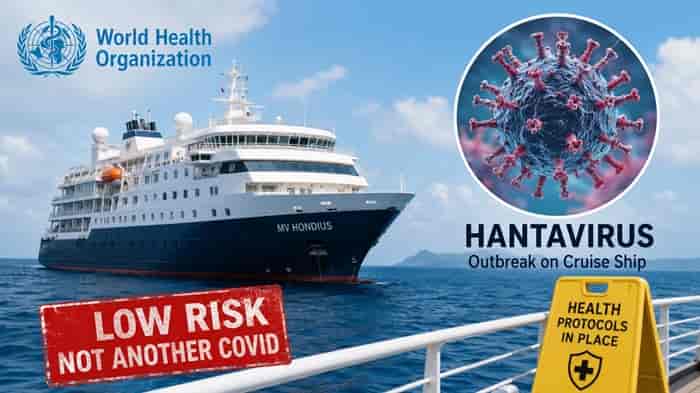
When a cruise ship outbreak hits international headlines, seasoned travellers tend to do two things. First, they cancel dinner reservations. Second, they remember 2020 and immediately begin eyeing the nearest packet of face masks like they’re wartime ration coupons.
Thankfully, the World Health Organisation has stepped in firmly to hose down fears that the deadly hantavirus outbreak aboard the Dutch-flagged MV Hondius is about to become “COVID at sea: the sequel nobody wanted”.
And that reassurance matters.
The outbreak, which has already claimed three lives and sickened several passengers aboard the expedition vessel travelling through the Atlantic, understandably sent nerves jangling across the cruise industry this week. Yet WHO officials have been emphatic: this is not another coronavirus catastrophe waiting in the wings.
“This is not SARS-CoV-2. This is not the start of a COVID pandemic,” declared Maria Van Kerkhove, WHO acting director for epidemic and pandemic management, in Geneva.
That blunt assessment will come as welcome news for an industry still carrying emotional and financial scars from the pandemic years, when cruise ships became floating symbols of global lockdown chaos.
But while WHO insists the public health risk remains low, the outbreak itself is still deadly serious.
Cruise Turns Into Medical Emergency
The trouble began during a voyage from Argentina to Cabo Verde, when passengers aboard the MV Hondius developed severe respiratory symptoms.
Eight cases have now been identified, including five laboratory-confirmed infections and three suspected cases linked to the Andes strain of hantavirus, a rare but dangerous virus primarily carried by rodents.
Three people have died.
The first passenger to become ill reportedly developed symptoms on 6 April before later dying aboard the vessel. His wife subsequently fell ill and died after evacuation to South Africa, where laboratory tests confirmed hantavirus infection.
Prior to boarding the cruise, the pair had travelled extensively through Argentina, Chile and Uruguay on a birdwatching expedition, an important detail because the Andes hantavirus is associated with rodent populations found in parts of South America.
A third passenger later died on 2 May.
Another patient remains in intensive care in South Africa, although WHO officials say his condition is improving. Other infected travellers have since been transferred to hospitals in the Netherlands for treatment and observation.
In a reassuring sign, the WHO says no remaining passengers or crew aboard the vessel are currently showing symptoms.
That distinction matters enormously.
Unlike COVID-19, which spread globally with frightening ease through airborne transmission, hantaviruses behave very differently.
Why WHO Says This Is Not Another Pandemic
Hantaviruses are zoonotic viruses, meaning they jump from animals to humans, and are typically spread through exposure to infected rodents or their urine, saliva and droppings.
In the Americas, hantavirus infection can trigger hantavirus cardiopulmonary syndrome (HCPS), a severe respiratory illness with mortality rates that can reach a sobering 50 per cent.
However, the Andes strain involved in this outbreak is unusual because it is the only known hantavirus capable of limited human-to-human transmission.
Even so, WHO officials stress that transmission generally requires prolonged, close contact.
Think of households, intimate partners and caregivers, not someone briefly sharing an elevator or standing beside you at the breakfast buffet while hunting desperately for the last hash brown.
“At this stage, the overall public health risk remains low,” WHO Director-General Tedros Adhanom Ghebreyesus said.
That measured language reflects decades of scientific understanding surrounding hantaviruses, which have existed long before cruise ships started offering Pilates classes and unlimited soft-serve ice cream.
WHO emergency specialist Dr Abdirahman Mahamud also addressed online misinformation now swirling across social media platforms, where amateur epidemiologists armed with Wi-Fi and too much spare time have already begun predicting the collapse of civilisation.
He pointed to a similar limited Andes hantavirus outbreak in Argentina during 2018–2019, which remained contained and resulted in only a small number of cases.
Public health tools, including contact tracing, isolation and monitoring, remain highly effective against this virus, officials say.
In short, the global health community knows this opponent well.
International Health Authorities Mobilise
Even with the risks assessed as low, the international response has been swift and highly coordinated.
The outbreak has triggered procedures under the International Health Regulations (IHR), the global framework for managing cross-border health threats.
WHO is now working alongside authorities in:
- Spain
- South Africa
- Argentina
- United Kingdom
- Netherlands
- Cabo Verde
The European Centre for Disease Prevention and Control has also joined the response effort.
Spain agreed to allow the vessel to dock in the Canary Islands after Cabo Verde declined entry due to public health concerns.
Tedros praised Spanish Prime Minister Pedro Sánchez for demonstrating what he described as “solidarity” and “moral duty”.
A WHO expert team, accompanied by Dutch doctors and European disease specialists, boarded the ship in Cabo Verde earlier this week to oversee medical assessments and infection control procedures during the vessel’s onward journey to Tenerife.
Speaking to UN News, WHO Representative in Cabo Verde Ann Lindstrand said medical supplies and doctors had been placed aboard the ship to manage any new cases that emerge during transit.
Passengers still aboard have reportedly been instructed to remain inside their cabins while extensive disinfection procedures continue.
Anyone developing symptoms is being isolated immediately.
Cruise Industry Watches Nervously
For the cruise sector, the outbreak arrives at an awkward time.
Cruise lines have spent years rebuilding traveller confidence following the pandemic, while expedition cruising, particularly to remote regions such as Antarctica and South America, has become one of tourism’s fastest-growing premium sectors.
The MV Hondius itself operates polar expedition voyages popular with birdwatchers, photographers and adventure travellers seeking bragging rights beyond the standard Mediterranean selfie circuit.
Naturally, memories of COVID-era cruise disasters remain painfully fresh.
Yet travel health experts say the current situation demonstrates how much better prepared global health agencies and cruise operators are today.
Rapid laboratory testing, international coordination, isolation procedures and onboard medical interventions have all been deployed quickly.
That speed matters.
WHO has warned that additional cases may still appear because the incubation period for Andes hantavirus can extend up to six weeks.
But officials remain confident the outbreak can be contained.
And perhaps the most telling observation came from Tedros himself.
“Viruses don’t care about politics, and they don’t care about borders,” he said.
“The best immunity we have is solidarity.”
After the bruising lessons of recent years, that message may resonate just as strongly as the medical advice itself.
For now, travellers can probably shelve the panic-buying and return their attention to more pressing cruise dilemmas, such as whether the buffet really needs fourteen varieties of cheesecake.
by Anne Keam – (c) 2026.
Read Time: 6 minutes.
About the Author.
 Anne Keam’s story begins in Queensland, on a grain farm in the state’s wide western reaches, where the days were long and the lessons simple: work hard, look after your own, and don’t make a fuss. Those early years left their mark.
She later studied Arts at the University of Queensland, before doing what felt natural at the time, heading back home to the family property. But the world was calling. Anne packed a backpack and went looking, spending years on the road and finding herself most alive in South America. She wrote everything down along the way. Those notebooks, full of dust, colour, and curiosity, eventually became her blog, a quiet, personal record of seeing the world and learning from it.











