

There are moments in travel that remind the industry it is still at the mercy of geopolitics. This past weekend delivered one of them. Five cruise ships effectively marooned in the Persian Gulf amid escalating Middle East tensions have now made their escape, completing a carefully orchestrated transit through the strategically vital Strait of Hormuz.
It was not a leisurely sail-by. It was a calculated, tightly managed operation.
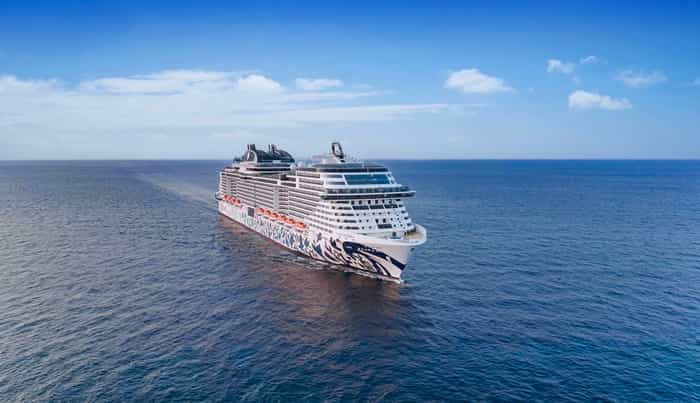
MSC Euribia -transited the Strait of Hormuz
Leading the charge was the Celestyal Discovery, which departed Dubai on Friday, April 17, becoming the first cruise vessel to pass through the strait since hostilities flared. What followed was a coordinated procession. Over the next two days, four more ships, MSC Euribia, Celestyal Journey, Mein Schiff 4 and Mein Schiff 5, threaded the narrow maritime corridor, hugging Oman’s coastline en route to safer waters.
For the cruise sector, it was less a voyage and more a logistical ballet.
Measured Moves, Professional Nerves
MSC Cruises confirmed that MSC Euribia has now departed Dubai and is bound for Northern Europe, having completed the transit without incident. The ship’s redeployment signals a return to operational certainty, something the industry has been craving.
Meanwhile, TUI Cruises offered a measured note of relief, stating: “The Mein Schiff 4 and Mein Schiff 5 have successfully passed the Strait of Hormuz. We would like to thank the captains and crews, as well as all those involved who supported and enabled the safe passage with great professionalism and prudence.”
In an industry built on timing and trust, those words carry weight.
Each vessel operated with skeleton crews during the transit, a prudent move reflecting both security concerns and operational discipline. Stops were minimal. The Celestyal Journey briefly paused offshore near Khor Fakkan before pressing on, while Muscat emerged as the immediate waypoint for several ships.
The Long Way Home or Not
Now comes the next calculation. Cruise lines must decide how to reposition these vessels to Europe. The options are stark: the shorter but still volatile Red Sea and Suez Canal route, or the significantly longer detour around Africa.
It is a classic trade-off between time and certainty, one that will test operational nerve as much as balance sheets.
Schedules Stabilise For Now
The immediate upside is tangible. MSC Cruises has confirmed that MSC Euribia will meet its upcoming European commitments, with departures from Kiel on May 16 and Copenhagen on May 17 proceeding as scheduled. In an industry where itinerary disruptions can ripple across months, that’s no small victory.
Similarly, Celestyal Discovery is expected to resume its Eastern Mediterranean programme from Lavrion on May 1, returning to familiar waters with itineraries across the Greek Islands and Turkey.
Not all vessels are out of harm’s way, however. Cruise Saudi’s Aroya remains in the Persian Gulf, a reminder that the situation, while improved, is far from resolved.
A Timely Reminder
If there’s a lesson here, it’s one the cruise sector knows well but occasionally forgets: the sea may be open, but it is never entirely predictable.
What this episode has demonstrated quietly but convincingly is the professionalism of crews, the resilience of operators, and the industry’s ability to pivot under pressure. Not glamorous, perhaps, but essential.
And in travel, as in life, it’s often the steady hand rather than the grand gesture that gets you home.