

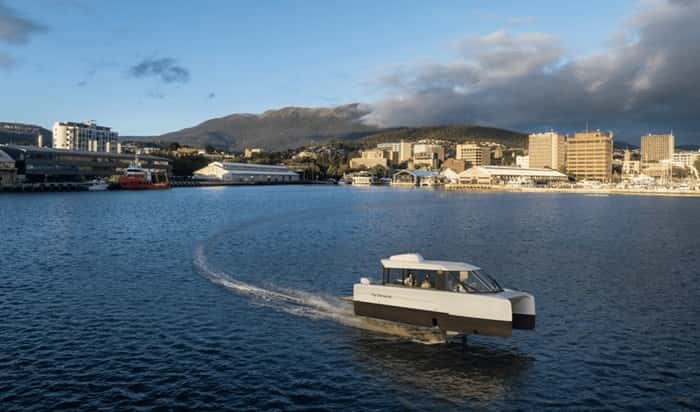
Hobart has always had the river. It just hasn’t quite known what to do with it.
That may be about to change decisively.
In a development that feels less like a trial and more like a turning point, Fly Derwent has confirmed plans to launch Australia’s first electric hydrofoiling network on the Derwent River, partnering with New Zealand marine outfit Vessev.
It’s a neat idea on paper. On water, it could be something far more consequential.
At the heart of the rollout is the VS–9, a 10-seat, nine-metre electric catamaran that rises above the surface on carbon fibre foils. Not metaphorically. Physically. Once it’s up, drag drops away, the ride smooths out, and the usual churn and wake, the things that have long made fast river transport problematic, largely disappear.
And that last detail matters more than it sounds.
Not another ferry story
We’ve been here before, of course. Fast ferries, slow ferries, ferries that promised the earth and quietly disappeared when the economics didn’t stack up, or the environmental questions got awkward.
This is pitched differently.
Fly Derwent’s principal, Cameron McCulloch, is not talking about a ferry service. He’s talking about a system.
“This world-leading technology unlocks affordable, river-based commuter and tourism transport in Hobart without the need for large-scale infrastructure changes,” McCulloch said.
The emphasis is telling. No terminals the size of shopping centres. No drawn-out rebuild of waterfronts. The pitch is simple: use what’s already there, the river and layer in smarter hardware.
“It’s an entirely new mode of transport that enables us to use waterways in a way that is more like a metro system than a ferry service,” he added.
That’s a big claim. But then, this is a small city with a habit of making big ideas look sensible.
Fast, quiet and finally workable
The vessels cruise at around 25 knots, but speed is only part of the story. The real advantage is what they don’t do. They don’t throw a heavy wake. They don’t drag half the river behind them. And crucially, they don’t chew up sensitive shorelines.
That’s been the sticking point for years on the Derwent and in plenty of other waterways around the country.
McCulloch was blunt about it. Conventional electric boats were considered and dismissed.
“We explored more conventional electric vessels, but they couldn’t solve the core challenges of range, efficiency and wake in Tasmania’s sensitive river environments. Hydrofoiling changes that completely.”
It’s a practical solution to a problem that has quietly stalled better intentions for decades.
Powered properly
Then there’s the energy story, which, in Tasmania, reads better than most.
The state already runs close to 100 per cent renewable electricity over a typical year, largely hydropower, with wind and solar filling the gaps. That same grid will charge the fleet.
Water-powered vessels that skim across water. You can almost hear the marketing team smiling.
More importantly, it keeps operating costs predictable and cuts exposure to imported diesel, no small consideration in a market that has had its fair share of fuel price shocks.
Scaling up and quickly
The VS–9 is just the opening act.
Multiple VS–12 vessels, each carrying around 30 passengers, have already been reserved. Significantly, this is the first global order for that model, putting Tasmania at the front of the queue rather than somewhere in the middle.
For Eric Laakmann, the local project is a proving ground.
“Electric hydrofoiling enables an entirely new category of water transport,” Laakmann said.
“With projects now underway in both Tasmania and Perth, we’re seeing genuine momentum build in Australia.”
He’s not wrong. Most major cities have waterways that do very little heavy lifting when it comes to moving people. If this works in Hobart, and that’s still an “if”, not a given, others will be watching closely.
Commuters first, tourists close behind
The initial network will stretch roughly 60 kilometres, linking New Norfolk through to Opossum Bay and reconnecting key parts of Hobart’s waterfront.
Early services will focus on commuter routes and premium tourism experiences, a sensible mix that acknowledges both daily demand and visitor appeal.
For locals, it’s the prospect of a faster, quieter run across the city. For visitors, it’s something a little more novel, a way to experience Hobart that feels contemporary without losing its character.
Still work to do
None of this is signed, sealed and sailing just yet.
Regulatory approvals are still in play, and as with any new vessel class, there are standards to meet and boxes to tick. Fly Derwent says it is working closely with authorities, and local partnerships are already in place, both of which are essential if this is to move beyond a good idea and into daily reality.
The first VS–9 is expected to arrive in early 2027, with efforts underway to accelerate the delivery of the larger vessels.
A quiet shift or something bigger?
It’s tempting to treat this as a niche Tasmanian story. A clever bit of engineering. A local transport upgrade.
But it may be more than that.
If hydrofoiling delivers on its promise of lower costs, minimal environmental impact, and a genuinely useful service, it changes the equation for cities that have long ignored their waterways.
In that sense, Hobart is not just catching up.
It’s testing the future without making a fuss.
by Octavia Koo – (c) 2026.
Read Time: 5 minutes.
About the Author.
 Octavia Koo arrived in Australia in the early eighties with little fuss and a good eye. Sydney suited her. At UNSW, she studied Arts, then found her footing in graphic design before drifting, quite naturally, into the digital side of things, building websites and shaping words that made people want to stay.
Singapore followed, and with it, the fast pace of tourism platforms and ITB Asia. Long before SEO became a buzzword, Octavia understood how stories travelled online. That’s where she met Stephen, and the seed for something more was planted.
A few years later, she joined Global Travel Media.
Today, Octavia works with quiet assurance, blending art, instinct and experience to produce stories that don’t shout; they simply work and linger.











