

There are moments in this business when the numbers whisper. And then there are moments like this one when they practically shout.
The latest read from GlobalData suggests the Gulf’s economic outlook has taken a solid knock, courtesy of rising tensions between Israel and Iran and the increasingly unreliable Strait of Hormuz. For a region that lives and breathes trade, energy flows and aviation connectivity, that’s not just inconvenient, it’s deeply unsettling.
Let’s not sugar-coat it. When the Strait sneezes, the Gulf catches a cold.
A choke point under pressure
The Strait of Hormuz isn’t just another shipping lane; it’s the world’s most critical maritime artery for oil and gas. When things go wrong here, they go wrong everywhere.
And things are, by all accounts, going rather wrong.
Heightened security risks, vessel seizures, disrupted sailings, and infrastructure concerns have pushed insurance costs north and freight rates even further. Ships are delayed. Supply chains are stretched. Timetables, once the pride of logistics planners, are now more suggestion than certainty.
It’s the sort of scenario that makes CFOs reach for the aspirin.
Business confidence wobbles
According to GlobalData, the impact is already cascading through the region’s core sectors, energy, aviation, tourism, construction and trade. In other words, the entire economic ecosystem.
Ramnivas Mundada, Director of Economic Research and Companies at GlobalData, doesn’t mince his words:
“The impact is highest in economies highly exposed to regional trade, shipping corridors, and reliable energy-export logistics. Supply-chain disruptions, postponed investment decisions, and tighter financial conditions are weighing on major corporates operating across the region.”
That’s economist-speak for: everyone’s getting nervous.
And nervous businesses tend to do predictable things: they slow hiring, trim spending, and quietly push big decisions down the road. It’s not dramatic, but it’s effective. Growth, in the meantime, slips into a lower gear.
The numbers bite back
The revisions are not small, and they’re certainly not polite.
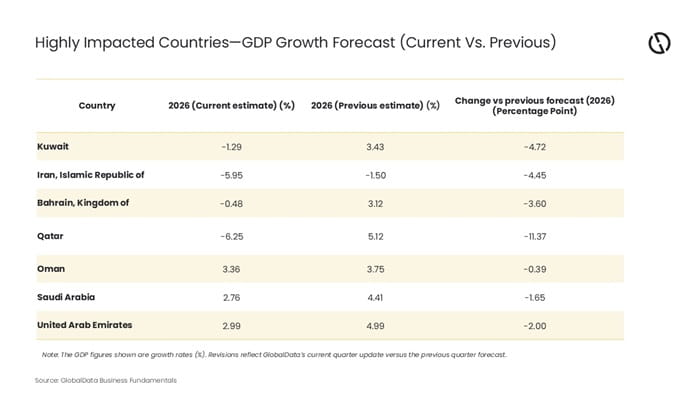
Qatar cops the heaviest downgrade, with growth expectations slashed by a hefty 11.37 percentage points. Kuwait isn’t far behind, down 4.72 points, while Bahrain and Iran also take a hit. Even the UAE and Saudi Arabia, usually the region’s economic stalwarts, are feeling the squeeze.
It’s a reminder, if one were needed, that in a tightly connected region, nobody gets to sit this one out.
Trade routes overlap. Capital flows freely until it doesn’t. And once risk premiums start creeping up, they rarely stop at the border.
Iran feels the full force
For Iran, the outlook has shifted from difficult to distinctly uncomfortable.
GlobalData now expects the economy to contract by 5.95% in 2026, a marked deterioration from the earlier projection of a 1.50% decline. That’s a serious downgrade, reflecting not just the direct impact of conflict but also restricted access to finance, declining confidence, and slower cross-border activity.
In short, the economic screws are tightening.
Travel and aviation in the firing line
In the travel sector, a familiar pattern is emerging, and it’s not one the industry particularly enjoys.
Higher fuel costs, disrupted air corridors, and jittery travellers tend to arrive as a package deal in times like these. Airlines adjust capacity. Routes are reconsidered. Tour operators, meanwhile, keep one eye on bookings and the other firmly on the news cycle.
Tourism, ever sensitive to perception, rarely thrives on uncertainty.
The waiting game begins
The uncomfortable truth is that much of what happens next sits well outside the control of economists, airlines, or tourism boards.
As Mundada notes:
“The outlook is contingent on how long the war persists, the degree of disruption in maritime routes through the Strait of Hormuz, and the pace at which confidence returns.”
There it is again, confidence. The one ingredient you can’t manufacture on demand.
If tensions ease and shipping normalises, the damage may yet prove manageable. If not, expect further pressure on costs, project timelines, and the region’s broader growth story.
A lesson the Gulf knows well
If there’s one thing history tells us, it’s that the Gulf is no stranger to disruption. The region has a habit of bending without quite breaking.
But even by those standards, this latest episode is testing the nerves.
Because when the world’s most important waterway becomes unpredictable, the consequences don’t stay at sea; they wash straight through balance sheets, boardrooms and, ultimately, the bottom line.
by Jason Smith – (c) 2026.
Read Time: 3 minutes.
About the Author.
 Jason Smith didn’t learn travel from textbooks. He learned it in airports, taxis and hotel lobbies, watching the business unfold long before he played his own part. Half American, half Asian, he grew up around the quiet workings of tourism, where people come and go, and stories rarely stand still.
Bangkok came first, then formal study, then a career that carried him through Singapore, Malaysia and Vietnam. Each place left something behind. In the end, Thailand felt like home, and I landed a senior role in hotel sales.
Then everything stopped. Borders shut, planes grounded, and Jason found himself back in America with time to reflect.
Now at Global Travel Media, he writes travel as it really is, not polished, not perfect, but human, and all the better for it.











