

There’s a quiet truth in long-haul flying that the industry rarely admits out loud: for most passengers, it’s still an endurance test dressed up as a journey.
For decades, the formula has barely shifted: tilt the seat, wrestle a blanket, and hope sleep finds you somewhere over the Pacific. Now, Air New Zealand is having a proper crack at changing that, and not before time.
From 18 May 2026, the airline will open bookings for its much-trailed Economy Skynest™, with the product entering service in November aboard its refurbished Boeing 787-9 Dreamliner fleet. The launch route? Auckland to New York is an ultra-long haul that separates the romantics from the realists.
And if ever a route demanded a rethink, this is it.
Not Just Another Seat Tweak
Let’s be clear, Skynest isn’t another incremental upgrade dressed up in marketing polish. It’s a structural shift.
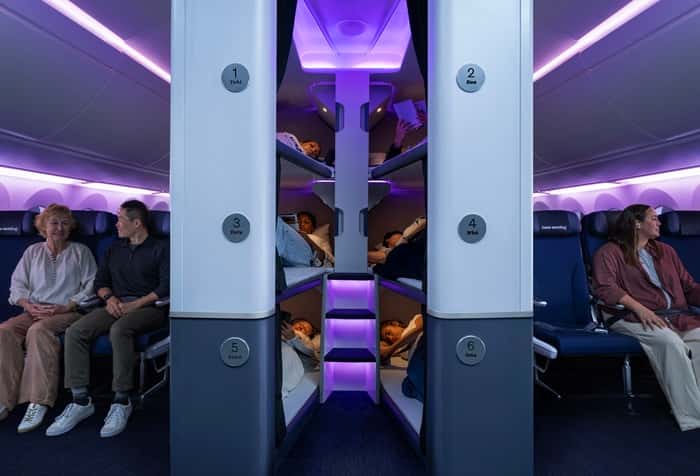
Six lie-flat pods, stacked bunk-style between Economy and Premium Economy, will be available for booked sessions during the flight. Not a clever recline. Not a “near-flat” compromise. A proper horizontal rest.
It’s the sort of idea that feels obvious until you realise no one has pulled it off at scale before.
Air New Zealand Chief Executive Nikhil Ravishankar didn’t overcook it when explaining the rationale:
“On some of the world’s longest commercial flights… Skynest is designed to make a real difference to the journey.”
That’s airline-speak for: we know this is a slog, and we’ve finally done something meaningful about it.
Built for Sleep, Not Survival
The airline has taken its time here, and wisely so. Skynest has been tested with more than 200 passengers, enough to iron out the gimmicks and keep what works.
Each pod comes with a full-length mattress, fresh linen for every session, soft lighting calibrated for rest, ventilation, charging ports, and a privacy curtain. It’s not luxury in the traditional sense, but it’s something arguably more valuable: functional comfort.
There’s even a so-called “Nestcessities” kit: an eye mask, socks, earplugs, skincare, and the basics to freshen up. Sensible, not showy.
Sessions will run for four hours, with two available per flight at launch. That’s just enough time to fall asleep properly and wake without the usual cabin fog.
A Sensible Evolution
Those who remember Air New Zealand’s earlier attempt to give Economy passengers a horizontal option, Skycouch, will see the lineage. That idea had merit, particularly for couples and families, but it was always a compromise.
Skynest isn’t.
“It’s a simple idea with a powerful impact: swap the headrest for bedrest,” Ravishankar said.
And for once, the line holds up.
The Price of Proper Rest
Let’s talk brass tacks. Sessions will start from AUD $495.
Not cheap. But also not unreasonable when you consider the alternative, a full cabin upgrade that can run into the thousands. For travellers facing 16-plus hours in the air, a guaranteed block of sleep may well be money wisely spent.
In truth, it’s also smart business. Airlines have long squeezed yield out of premium cabins; Skynest opens a new revenue stream without redesigning the entire aircraft economics.
Expect others to take notes.
Beyond Skynest: A Cabin Rebalance
What’s interesting is how Skynest fits into a broader rethink of the onboard experience.
Business Premier passengers will see new Luxe seats with closing doors privacy now being the currency of the front cabin. Premium Economy gets fixed-shell seating, sparing passengers the indignity of a reclining neighbour in their lap. Even standard Economy has been sharpened up, with larger screens and better storage.
Then there’s the Sky Pantry™, a self-serve snack station. A small touch, perhaps, but one that signals a shift away from rigid service models towards something more passenger-led.
The Bigger Picture
Air New Zealand has built a reputation for trying things others hesitate to touch. Sometimes it lands squarely. Occasionally, it doesn’t. But it keeps moving.
Skynest, however, feels different. Less experiment, more inevitability.
Because once passengers experience proper sleep in Economy, even in a shared, time-limited format, the old model will feel increasingly dated.
And that’s the quiet risk for the rest of the industry.
The Bottom Line
For years, airlines have asked passengers to accept discomfort as part of the deal. Skynest challenges that assumption.
Not by turning Economy into Business Class but by offering something far more practical: choice.
On ultra-long-haul routes, that might be the most valuable upgrade of all.
Key Facts: Skynest at a Glance
- Bookings open: 18 May 2026
- Service entry: November 2026
- Route: Auckland–New York (initially)
- Pods: 6 lie-flat bunks per aircraft
- Session length: 4 hours
- Sessions per flight: 2 (initially)
- Price: From AUD $495
by Octavia Koo – (c) 2026.
Read Time: 5 minutes.
About the Author.
 Octavia Koo arrived in Australia in the early eighties with little fuss and a good eye. Sydney suited her. At UNSW, she studied Arts, then found her footing in graphic design before drifting, quite naturally, into the digital side of things, building websites and shaping words that made people want to stay.
Singapore followed, and with it, the fast pace of tourism platforms and ITB Asia. Long before SEO became a buzzword, Octavia understood how stories travelled online. That’s where she met Stephen, and the seed for something more was planted.
A few years later, she joined Global Travel Media.
Today, Octavia works with quiet assurance, blending art, instinct and experience to produce stories that don’t shout; they simply work and linger.











