


Every now and then, a statistic lands on your desk that makes you pause, not because it’s surprising, but because it’s so quietly enormous.
China records around six billion domestic trips a year.
No fanfare. No drum roll. Just a number that sits there, rather like an old landmark everyone has stopped noticing.
Six billion.
I’ve spent most of my working life in and around Asia, and I still find that figure slightly difficult to hold in the mind. It’s not just big, it’s constant. That’s the difference.
It’s Not a Boom, It’s a Routine
In many parts of the world, travel still feels like an event. You plan it, save for it, and occasionally recover from it.
China doesn’t quite see it that way.
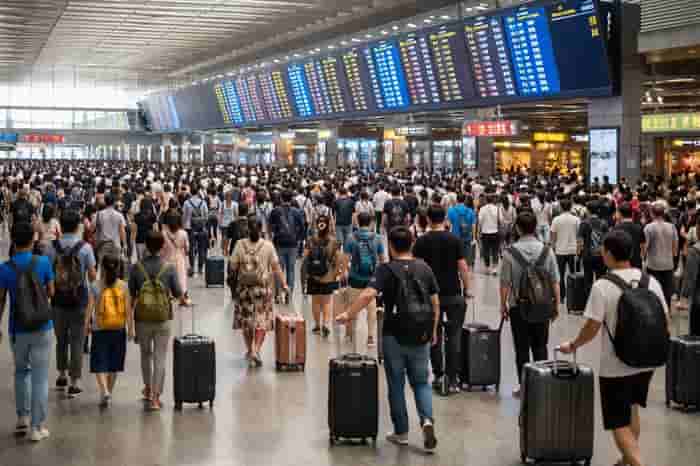
Millions moving daily, quietly redefining global travel norms. – Image by Charmaine Lu & created using Canva.
Travel here has settled into something closer to routine. People move because it’s easy to move. A few days away, a quick visit, a change of scene, it doesn’t require much ceremony.
Stand in a railway station in Beijing or Shanghai, and you’ll see it. No rush, no sense of occasion. Just people getting on with it.
And they do, again and again.
That’s how you arrive at six billion journeys, not through bursts of enthusiasm, but through repetition.
The Ease of It All
Of course, none of this works without the machinery behind it.
China’s high-speed rail network has been discussed endlessly, but what strikes you after a while is how unremarkable it has become. It simply works, and because it works, people use it.
The same goes for the digital side of things. Booking a ticket, paying for a hotel, adjusting plans, it all happens quickly, often without much thought.
There’s very little friction. And when you remove friction, you remove hesitation.
People travel more.
It’s not complicated.
Looking Inward, Quite Comfortably
What’s perhaps most interesting is that China isn’t particularly dependent on the rest of us.
Yes, international visitors return steadily, drawn by the Great Wall, the Forbidden City, and a fair number of places that don’t make the brochures. But they are not what keep the system moving.
Domestic travel does that.
And it does it rather well.
While destinations elsewhere spend considerable effort courting international markets, China seems content to rely on its own. It’s not indifference, more a sense that the engine at home is already doing the heavy lifting.
There’s a certain calm in that.
A Different Kind of Scale
We tend to reach for comparisons, almost out of habit. It helps us make sense of things. Though in this case, it only gets you so far.
The United States, for example, turns over roughly 2.4 billion domestic trips a year. By any measure, that’s a serious number. Europe, meanwhile, keeps itself busy welcoming tens of millions of international visitors, season after season.
Then there’s China.
Six billion journeys, quietly ticking over in the background.
It doesn’t really sit comfortably alongside the others. Not bigger in the usual sense, just operating on its own terms.
Interestingly, when you follow the money rather than the movement, the picture softens a little. The United States still comes out ahead on revenue, helped along by higher spending and a steady stream of international visitors.
China, by contrast, feels less hurried about it. The emphasis isn’t on squeezing more from each trip, but on keeping people moving again and again.
There’s a certain patience in that approach.
And, if you look closely, a fair bit of confidence too.
Travellers, Changing Gently
Chinese travellers are evolving, though not in any dramatic fashion.
There’s more curiosity now about smaller cities, about local culture, about places that sit just off the main routes. You see it in the way secondary destinations are beginning to fill out.
But the fundamentals haven’t shifted much.
Convenience still matters. Time still matters. Value still matters.
People are travelling more, not necessarily travelling differently.
What Comes Next
At six billion trips, you get the sense that China’s tourism market has already found its natural rhythm.
Growth will come, but it will likely be incremental rather than explosive. Shorter trips, taken more often, will continue to shape the landscape.
International tourism will rebuild, slowly finding its place again. But it won’t redefine the market.
That role belongs firmly to domestic travel.
A Final Thought
China doesn’t quite play that game.
It isn’t chasing attention. It simply keeps people moving. Day in, day out, on a scale that doesn’t need much advertising.
Six billion journeys a year.
Say it out loud, and it still feels a bit far-fetched.
But stand in a station for a while, watch the rhythm of it, the comings and goings, the ease, the lack of drama, and it starts to feel less like a statistic and more like everyday life.
Nothing remarkable about it.
That’s precisely what makes it so.
by Andrew Wood and edited by Charmaine Lu – (c) 2026.
Read Time: 4 minutes.
About the Author.
 Andrew J. Wood has lived in Thailand since 1991. He is a former Director of Skål International and a Past President of Skål International Asia, Skål International Thailand, and Skål International Bangkok.
A former hotelier with senior management experience at leading hospitality groups including Shangri-La, Minor International, Landmark and Royal Cliff, he writes regularly for international travel and hospitality publications.
His work focuses on tourism trends across Asia, sustainable tourism development, and the future of travel and hospitality in the Asia-Pacific region.











