The global travel industry has a long memory when it comes to geopolitics.
From Gulf wars to volcanic ash clouds, the sector has learned often the hard way that events far from a check-in counter can very quickly ripple through aircraft schedules, fuel bills and passenger confidence.
This week’s escalating conflict involving the United States, Israel and Iran is shaping up to be one of those moments.
According to market intelligence platform GlobalData, the crisis has already produced the sharpest shock to global energy markets since the oil crises of the 1970s. Crude prices surged past US$110 a barrel within days, shipping routes are tightening, and airlines across the region are dealing with airspace closures that have grounded thousands of flights.
For an industry that thrives on stability and predictability, neither is welcome news.
And the impact is spreading fast.
Strait of Hormuz: The World’s Most Important Bottleneck
Much of the economic drama centres on the Strait of Hormuz, the narrow waterway separating Iran from the Arabian Peninsula.
Normally, it’s one of the world’s busiest maritime corridors, carrying roughly one-fifth of global oil supply.
Right now, it’s effectively paralysed.
Following threats and tanker attacks linked to the conflict, commercial traffic through the strait has slowed to a trickle, leaving almost 200 vessels stranded or waiting for safer conditions.
Markets reacted almost instantly.
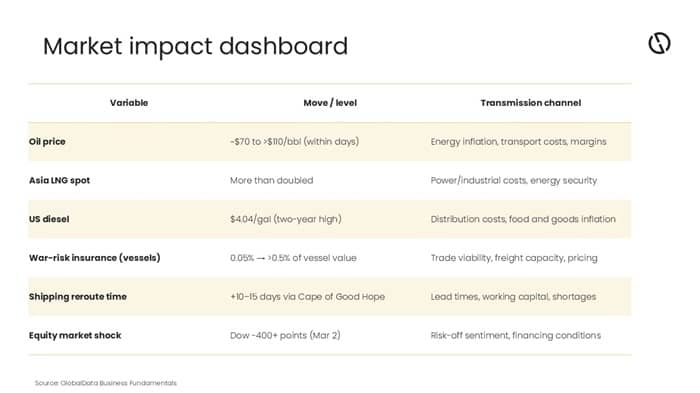
Oil prices jumped from roughly US$70 to more than US$110 per barrel, while Asian LNG spot prices surged sharply as energy buyers scrambled to secure alternative supply.
Fuel, of course, sits at the heart of aviation economics.
So when oil markets spike, airline balance sheets tend to feel the strain.
Shipping Detours Stretch Global Supply Chains
The shock is also playing out across global shipping lanes.
Major operators have begun rerouting vessels away from the Gulf and down around the Cape of Good Hope, the long way around Africa.
It’s a familiar route from the days before the Suez Canal, but in modern logistics terms, it’s far from ideal.
The detour adds 10 to 15 days to shipping journeys, burns significantly more fuel and squeezes global freight capacity.
For airlines and tourism economies reliant on stable supply chains from catering logistics to aircraft parts, the knock-on effects could be substantial.
Ramnivas Mundada, Director of Companies and Economic Research at GlobalData, says the commercial disruption is already significant.
“Corporate disruption is already severe across several sectors,” Mundada said.
“Qatar Energy and several Gulf refineries have suspended production or declared force majeure due to direct strikes and logistical blockades.”
Shipping companies have also reacted quickly.
“Major shipping groups such as Maersk have halted Gulf operations, with many vessels rerouting around the Cape of Good Hope and adding 10–15 days to journeys alongside sharply higher fuel burn.”
That extra fuel, of course, comes at precisely the moment when energy prices are surging.
Not an ideal combination.
Airlines Ground Flights as Airspace Closes
While shipping grapples with maritime chokepoints, airlines face a different kind of obstacle: closed skies.
Airspace restrictions across parts of the UAE, Qatar and Kuwait have forced carriers to cancel or reroute services across one of the busiest aviation corridors on the planet.
Among the most affected is Qatar Airways, whose Doha hub normally links Europe, Asia, Africa and the Americas through an intricate network of connecting flights.
With Qatari airspace temporarily closed, the airline has paused normal operations while safety conditions are assessed.
In a message to passengers, the carrier acknowledged the disruption while emphasising its efforts to assist stranded travellers.
“With Qatar Airways scheduled flight operations still temporarily suspended due to the closure of Qatari airspace, we want you to know that we are doing our utmost to support you with your journey, and to reunite you with your family and loved ones,” the airline said.
“We recognise this situation may be unsettling, and are working to keep you moving while we prepare for the safe return of our usual operations.”
It’s a measured response, though the operational challenge is anything but small.
Limited Flights Offer a Path Home
Following temporary approval from the Qatar Civil Aviation Authority, the airline has begun operating a limited number of services through designated corridors.
The aim is simple: help passengers get home.
Flights departing Doha include key long-haul destinations such as London Heathrow, Frankfurt, New York, Johannesburg and Beijing, alongside regional routes to Asia and the Middle East.
Inbound flights include services from Melbourne, Bangkok, Seoul, Paris and Madrid, reconnecting travellers stranded by the sudden airspace shutdown.
However, the airline has been careful to manage expectations.
“These flights do not constitute a confirmation of the resumption of scheduled commercial operations,” Qatar Airways said.
Passengers have also been urged not to travel to the airport unless they hold confirmed bookings.
In the meantime, the airline is offering affected travellers two complimentary date changes within 14 days of their original travel date, or a full refund for unused tickets for journeys scheduled between 28 February and 22 March 2026.
Insurance and Markets Add to the Pressure
Beyond the operational challenges, financial markets are beginning to feel the strain.
War-risk insurance premiums for vessels operating in the region have jumped dramatically from around 0.05 percent to more than 0.5 percent of ship value.
That increase alone can render some shipping routes commercially unviable.
Equity markets have also reacted nervously.
Early in the conflict, the Dow Jones Industrial Average fell more than 400 points in a single trading session, reflecting concerns about rising fuel costs and geopolitical instability.
When investors start talking about inflation again, travel executives tend to listen closely.
The Bigger Economic Picture
The broader economic risks could be significant if the conflict drags on.
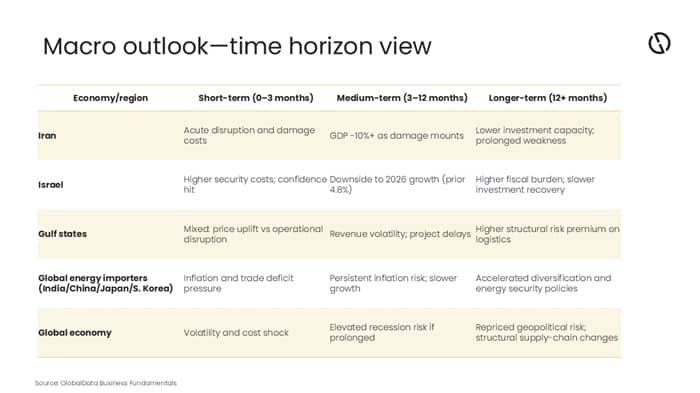
According to GlobalData, Iran could face GDP contraction exceeding 10 percent over the next year if infrastructure damage and sanctions escalate.
Israel’s economic outlook is also shifting.
The country’s 2026 growth forecast of 4.3 percent now faces downside risk, as defence spending climbs and investment slows.
Meanwhile, energy-importing economies, including India, China, Japan and South Korea, are particularly exposed to rising oil prices.
For those economies, higher fuel costs quickly translate into inflation.
And inflation tends to cool travel demand.
Mundada says the global outlook will depend heavily on how long the disruption lasts.
“If the war continues beyond two to three months, the probability of a global recession and more entrenched inflation pressures rises materially,” he said.
In economic terms, that’s the scenario policymakers dread: stagflation, where growth slows while prices continue climbing.
Travel Industry Watches and Waits
For now, airlines, tour operators and travel managers are watching events closely.
The sector has shown remarkable resilience over the past decade, navigating pandemics, geopolitical crises and the occasional volcanic cloud.
But energy shocks remain one of aviation’s most stubborn vulnerabilities.
As one airline executive quietly remarked this week, planes can fly around storms.
Oil prices, unfortunately, are harder to avoid.
And with the Strait of Hormuz unsettled and Middle Eastern airspace partially closed, the travel industry is once again reminded that global mobility is never quite as predictable as it seems.