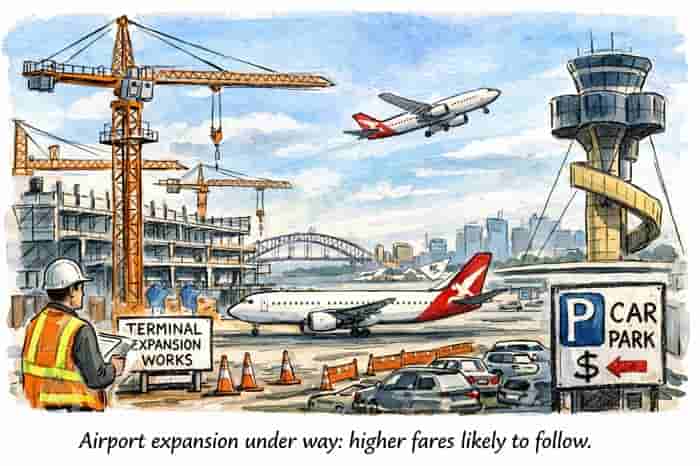
Airports are not places that sit still for long.
Even on a quiet afternoon, something is always moving: baggage belts humming away behind walls, aircraft gliding toward gates, and construction crews quietly preparing for the next decade of growth.
Across Australia’s four largest airports, that sense of motion has taken on a very literal meaning.
According to the Australian Competition and Consumer Commission’s latest Airport Monitoring Report, Brisbane, Melbourne, Perth and Sydney airports collectively spent $1.5 billion on aeronautical infrastructure during the 2024–25 financial year.
That represents a 43.6 per cent jump on the previous year, signalling a decisive shift away from the cautious spending that followed the pandemic.
Airports are building again.
The only small catch, and it is not a minor one, is that travellers may eventually help pay for it.
The Infrastructure Cycle Begins Again
For a few years after COVID, Australia’s airport infrastructure plans largely sat in limbo.
Passenger numbers had collapsed, airlines were struggling to rebuild networks, and expansion projects quietly moved to the “later” pile.
That pause is now well and truly over.
Major construction programs are underway at all four airports, reflecting renewed confidence that aviation demand will continue to grow over the coming decade.
And the scale is significant.
The four airports together have flagged almost $20 billion in infrastructure investment over the next ten years.
Among the headline projects:
-
Perth Airport’s new terminal development and runway works
-
Melbourne Airport’s long-awaited third runway
-
Sydney Airport’s proposed integration of its T2 and T3 domestic terminals
-
A third terminal development at Brisbane Airport
Anyone who has travelled through these airports recently will have noticed the cranes, scaffolding and occasional detour.
In aviation, expansion is rarely tidy.
But regulators say it is necessary.
“Ongoing investment is needed to ensure airports can continue to meet the needs of travellers and airlines, with Sydney, Melbourne, Brisbane and Perth airports collectively handling about 120 million passengers in 2024-25,” said ACCC Commissioner Anna Brakey.
Yet the investment cycle comes with a familiar economic ripple effect.
“Large capital programs are likely to place upward pressure on airport charges paid by airlines, which may result in higher airfares for passengers as these costs are recouped.”
In short, airports charge airlines, and airlines charge passengers.
That circular equation has existed for decades.
A Question of Market Power
Airports occupy an unusual position in the aviation economy.
Airlines compete fiercely with one another.
Passengers can choose between carriers.
But when it comes to the airport itself, there is rarely much choice.
Sydney Airport, for instance, remains the primary international gateway for Australia’s largest city. Brisbane, Melbourne and Perth enjoy similar regional dominance.
That market power is why the ACCC continues to monitor airport pricing even though the charges themselves are not directly regulated.
The watchdog has long argued that the monitoring framework lacks sufficient leverage to constrain pricing behaviour.
In its latest report, the ACCC again suggested that improvements could include binding commercial arbitration between airports and airlines, along with greater financial transparency.
It also floated the idea of revisiting the broader regulatory framework.
The last Productivity Commission review of airport regulation occurred in 2018–19, a very different aviation world from today.
Given the scale of investment now planned, regulators believe the conversation may be due for another round.
Sydney Airport Still Leads the Profit Table
If the ACCC report contains one figure that jumps off the page, it is this one.
Sydney Airport recorded $584.3 million in aeronautical operating profit during 2024-25.
That produced a 20.8 per cent return on aeronautical assets, the highest level recorded during more than two decades of ACCC monitoring.
To put it another way, Sydney’s aeronautical profits were greater than the combined profits of Melbourne, Brisbane and Perth airports.
“Sydney Airport continues to earn significantly more aeronautical revenue and profit than the other major airports, both from a total and per passenger perspective,” Brakey said.
Part of that gap is structural.
Sydney handles the largest volume of passengers in Australia and a higher proportion of international travellers, who typically generate greater airport revenue.
But the numbers still underline Sydney Airport’s central role in Australia’s aviation landscape.
Perth Quietly Delivers the Biggest Profit Jump
While Sydney dominated overall profitability, Perth Airport produced the most dramatic year-on-year improvement.
Aeronautical operating profit surged 73.7 per cent, reaching $130.6 million.
The result reflects both growing passenger demand and Perth’s long-term redevelopment plans to consolidate terminals and strengthen its role as Western Australia’s international gateway.
With the expansion of routes across Asia and the Middle East, Perth’s aviation profile continues to rise.
Passenger Growth Slows But Remains Strong
Passenger traffic across the four major airports continued to grow during 2024-25, though the pace has eased slightly.
Total passenger numbers rose 4.6 per cent, reaching around 120 million travellers.
That compares with 13.7 per cent growth in the previous year, when aviation demand surged following border reopenings.
International travel continues to drive much of the expansion.
International passenger numbers climbed 9.5 per cent to 40.4 million.
Perth recorded the strongest international growth at 17.8 per cent, followed by:
-
Brisbane Airport – 16.3 per cent
-
Melbourne Airport – 8.3 per cent
-
Sydney Airport – 5.5 per cent
Domestic travel also remained steady, increasing 2.2 per cent to nearly 80 million passengers.
For the travel industry, those figures reinforce a simple truth: Australians still travel enthusiastically when the opportunity arises.
Passenger Experience Mostly Positive
Despite major construction works across several airports, passenger satisfaction remained broadly positive.
Sydney, Melbourne and Perth airports were rated “good” for overall service quality in the ACCC assessment.
Brisbane Airport, somewhat paradoxically, received the highest passenger satisfaction ratings, yet its overall rating slipped to “satisfactory” after airlines reported infrastructure pressures.
Airlines cited issues with:
-
aerobridge availability
-
check-in facilities
-
baggage handling infrastructure
The challenges largely stem from ongoing construction projects.
Growing airports are rarely the tidiest places.
The Other Revenue Engine: Parking
Airports may be providers of aviation infrastructure, but they are also, quietly, car-park operators.
And profitable ones at that.
The four airports collectively generated $402.1 million in car parking operating profits in 2023-24.
Brisbane Airport recorded the largest profit at $125.3 million, followed by Sydney Airport at $108.7 million.
Melbourne and Perth reported $101.3 million and $66.7 million, respectively.
Profit margins exceeded 60 per cent at Brisbane, Perth and Sydney airports.
In other words, parking remains one of aviation’s most reliable side businesses.
Travellers looking to trim costs may find relief by booking parking online early or exploring off-airport alternatives.
Sometimes the simplest tricks remain the most effective.
What It Means for Travellers
Australia’s airports are entering a new infrastructure cycle.
Terminals will expand. Runways will be extended. Passenger capacity will increase.
Those investments are essential if Australia is to accommodate future aviation demand.
But infrastructure spending never happens in isolation.
Eventually, the economics find their way through the system.
Airports raise charges.
Airlines adjust fares.
Passengers notice.
For now, the cranes are still rising above the terminals, a familiar sight in an industry that never really stops evolving.
And if the ACCC’s latest report is any guide, Australia’s airports are preparing for a very busy decade ahead.
by Christine Nguyen – (c) 2026.
Read Time: 5 minutes.
About the Writer.
 Christine’s story is one of quiet courage, told without fuss and lived with remarkable grace. She arrived in Australia as a young refugee from Vietnam, carrying little more than hope, family, and a curiosity that refused to be extinguished. Sydney became home, built patiently, brick by careful brick.
She studied Tourism at TAFE and soon found her place in inbound travel, working with one of the city’s leading destination companies. Christine loved showing visitors the Australia that lives beyond postcards, warmer, truer, and far more interesting.
When the sea began to whisper, and life asked for a gentler rhythm, she listened. Designing brochures, writing blogs, she discovered storytelling waiting quietly inside her.
Today, at Global Travel Media, Christine writes with warmth and wisdom, softly and persuasively, reminding us why travel still matters.