There are airline recoveries, and then there are airline reinventions.
Philippine Airlines is chasing the latter, doing so in a way that feels less like a tech rollout and more like a slow, deliberate return to itself.
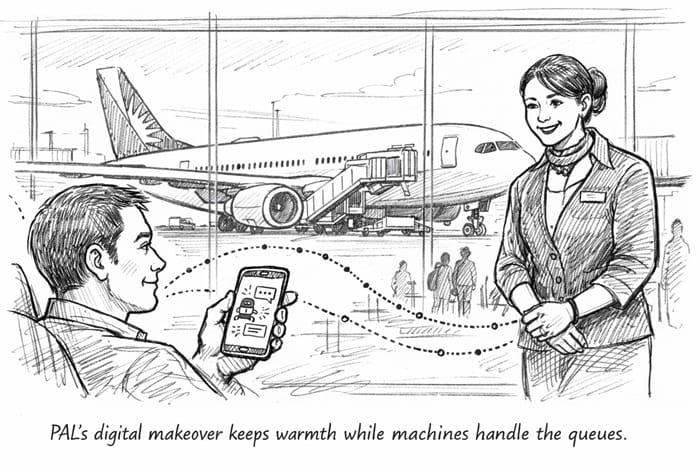
If that sounds counterintuitive in an era obsessed with artificial intelligence, it probably should. But talk to the people steering PAL’s customer experience strategy, and the emphasis is not on machines replacing humans. It’s about making the airline feel human again, just with better tools behind the curtain.
That distinction matters.
Because for an airline that stared down insolvency not long ago, survival alone would have been a respectable outcome. Reinvention? That’s a far braver play.
A comeback with scars
PAL’s brush with Chapter 11 in 2021 wasn’t just a financial episode. It was existential. The restructuring forced the airline to rethink not only its cost base, but its identity.
Out went complexity. In came clarity.
The visible pieces were easy enough to spot: a tighter fleet strategy, smarter long-haul bets, and a network trimmed with more discipline than nostalgia.
Less visible, but arguably more important, was the recalibration of how PAL wanted to be experienced.
“It’s been a story of transformation,” said Mark Anthony Munsayac, the airline’s Vice President for Customer Experience. “We refocused our strategies around digital transformation and reshaping our culture.”
Airlines love the word transformation. But here, it carries a slightly heavier meaning. PAL wasn’t polishing a model that worked. It was rebuilding trust after it had been tested.
“For us, loyalty is about earning passenger trust,” Munsayac said. “Passengers may still fly for convenience or price even after a poor experience, but our goal is for them to choose Philippine Airlines because we’ve earned their trust.”
There’s something refreshingly old-school about that sentiment. Loyalty is something earned daily, not assumed.
Sixteen million reasons to get it right
By 2025, more than 16 million passengers were flying PAL annually, each one bringing expectations shaped by a world that had moved on rapidly during the pandemic years.
Travel is now digital by default. Patience is not.
Every disruption, refund, rebooking or baggage query is no longer just a transaction. It’s a test of whether an airline feels responsive or stuck in another decade.
“We want to provide a personalized experience at scale while maintaining the Filipino warmth passengers expect from us,” Munsayac said. “Technology helps us deliver sustainable service quality and supports long-term revenue growth from loyal customers.”
The balancing act is obvious. Technology delivers speed. Culture delivers connection. Lose either, and the equation breaks.
The quiet engine room: Twilio Flex
Behind PAL’s service rethink sits a platform most passengers will never see but increasingly feel.
Twilio Flex now underpins the airline’s contact centre ecosystem, consolidating fragmented conversations into a closer-to-single-narrative experience. Emails, chats, calls and service histories no longer live in separate silos.
For frontline staff, that matters enormously.
“Since implementing the platform, our average contact center wait time has dropped to under one minute,” Munsayac said. “Shorter handle times and expanded self-service options have helped drive operational efficiency and cost savings.”
Sub-one-minute wait times may sound like a KPI footnote. In reality, they’re reputation currency.
In aviation, memory is short, but irritation is long.
Personalisation without the creep factor
Where PAL’s strategy gets interesting is not speed, it’s subtlety.
The airline is using data more deliberately, but with restraint. Not surveillance-style hyper-personalisation, but context-aware nudges.
A regular flyer who usually pre-pays baggage but forgets to do so this time? A quiet reminder via their preferred channel. No hard sell, no push notification frenzy. Just relevance.
“Our focus is on servicing first,” Munsayac said. “Revenue follows when we offer the right ancillary services to the right passenger, at the right moment.”
That’s a notable shift from the industry’s traditional ancillary playbook, which often feels like retail bolted onto aviation. PAL is trying to make it feel like a service that happens to generate revenue, rather than the other way around.
It’s a subtle pivot, but an important one.
Letting AI in slowly
Artificial intelligence is, of course, part of the story. But here again, PAL is moving with a measured gait.
A generative AI chat layer is already live. Voicebots are being trialled. The airline’s ambition is to reach what Munsayac describes as a “super AI agent” by April 2026, capable of handling roughly 80 per cent of tasks a human agent manages today.
At present, AI handles closer to 10 per cent.
“Our deflection rate is about 45%, meaning nearly half of customer concerns are resolved without being transferred to a live agent,” he said.
The telling detail is what PAL hasn’t done.
“We’re not hiding our live agents; passengers can always choose to connect with one,” Munsayac added. “Our goal is for customers to use digital and automated options because they deliver a better experience, not because they’re forced to.”
That restraint feels culturally astute. In many Asian markets, the human touch is still part of the brand promise. Remove it too aggressively, and loyalty evaporates.
Savings without soullessness
Efficiency gains are already material. PAL reports roughly 30 per cent monthly savings across customer service operations, a figure that would make most airline CFOs quietly smile.
But the more interesting metric may be satisfaction. Internal tracking puts recent customer satisfaction scores around the 95 per cent mark, placing the airline comfortably among stronger performers globally.
The real test, of course, is durability. Service scores are easy to polish in calm conditions. The true verdict arrives during typhoons, IT outages and holiday peaks, aviation’s equivalent of stress fractures.
PAL seems acutely aware of that.
AI beyond the cabin door
Customer service is only one frontier. PAL is also deploying AI deeper into operations, particularly in predictive maintenance, aviation’s quietly revolutionary discipline.
“With the terabytes of data generated by aircraft sensors and maintenance reports, we can anticipate which components may require attention before a failure happens,” Munsayac said.
In practical terms, that means fewer unexpected aircraft swaps, tighter schedules and a smoother passenger experience that most travellers will never consciously notice.
Which, in aviation, is the point.
The long game: connected everything
The airline’s next ambition is more ambitious still: a unified customer data platform that links loyalty, communications, and service layers into a single ecosystem.
On paper, it sounds almost mundane. In execution, it’s brutally complex.
“It sounds simple, but delivering a personalized and consistent experience requires alignment across different stakeholders and the right technology and partners,” Munsayac said. “It’s not just a project or a department’s job it’s a capability we must build together as an organization.”
That line may be the most honest in the entire transformation narrative. Airline reinvention is rarely about software. It’s about alignment.
And alignment is hard.
A transformation that feels… human
For Australian travel professionals watching Asia’s aviation rebound, PAL’s evolution carries a familiar lesson: the most convincing transformations rarely arrive with fireworks.
Instead, they creep in through consistency.
Better wait times. Smarter nudges. Fewer disruptions. More coherent journeys.
No single change makes headlines. Together, they reshape perception.
And perhaps that’s why Philippine Airlines’ reinvention feels quietly credible. It isn’t trying to out-tech Silicon Valley or out-luxury Gulf carriers. It’s trying to rediscover its own voice just with 21st-century tools.
In an industry addicted to big announcements, that restraint feels almost radical.
Sometimes, the most modern move an airline can make is remembering what made people care in the first place.
PAL, it seems, is learning that lesson all over again.
by Soo James – (c) 2026.
Read Time: 7 minutes.
About the Writer.
 There’s nothing rehearsed about Soo James, and that’s precisely the point. Malaysian by heritage, Sydney by schooling, she arrived at UNSW to study Arts, then took a left turn into IT, not out of ambition, but curiosity. Somewhere among systems and schedules, she worked out what really held her attention: people, language, and the quiet spaces between them.
Writing followed naturally. Travel and lifestyle gave her room to observe, to listen, to notice the details others rush past. Soo writes the way good travellers move, watching the room before admiring the view, catching the gesture before chasing the headline.
At Global Travel Media, her stories don’t shout or sell. They linger. They slow you down, open a door, and gently suggest there’s more to see if you’re willing to look.