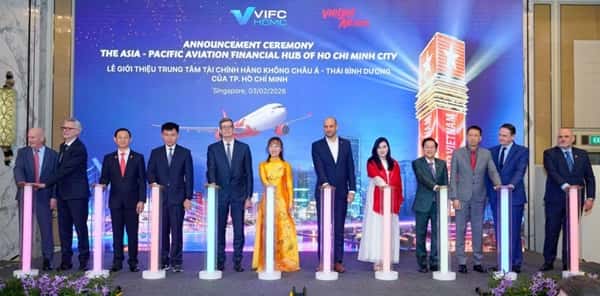
If aviation were a theatre, the Singapore Airshow has always been its grand stage, part spectacle, part strategy, and entirely serious business. This year, however, one airline took the lead with unusual confidence. Vietjet, Vietnam’s fast-rising aviation contender, unveiled a sweeping set of initiatives worth more than US$6.1 billion, signalling not merely ambition but a carefully engineered future.
At the heart of the announcement was the airline’s partnership in the newly launched Asia-Pacific Aviation Financial Hub (AAFH) an undertaking that could reshape how aircraft are funded, leased, and deployed across one of the world’s most dynamic travel corridors.
The message was unmistakable: Vietjet is no longer content to grow steadily. It aims to help architect the financial framework for the region’s aviation future.
A Financial Engine for Aviation’s Next Era
Unveiled by the Vietnam International Financial Centre in Ho Chi Minh City, the AAFH is designed to support aviation finance, infrastructure investment, and leasing activity across Asia-Pacific, a region widely expected to dominate global passenger growth for decades.

Vietjet Chairwoman, Nguyen Thi Phuong Thao, outlines the vision for developing an aviation financial ecosystem
Backed by early-stage transactions exceeding US$6.1 billion, the hub carries an even more arresting projection: approximately US$50 billion in aviation transaction value by 2035.
Not bad for a concept, just leaving the hangar.
Mr Truong Minh Huy Vu, Chairman of the Vietnam International Financial Centre, captured the broader vision with measured authority:
“The launch of the Asia-Pacific Aviation Financial Hub marks an important step in realising our vision of building VIFC into a modern, open, and trusted international financial platform. We attract investors not only through incentives, but through institutional quality, innovation capacity, and our ability to directly connect capital flows with the real economy.”
It is the sort of statement financiers appreciate, grounded, forward-looking, and reassuringly practical.
Industry heavyweights were present to underscore the initiative’s credibility, including Airbus, Boeing, Rolls-Royce, Pratt & Whitney, CFM International, and the International Air Transport Association (IATA). Their attendance suggested that this was less a ceremonial ribbon-cutting and more the quiet beginning of something structurally important.
Paul Meijers, Executive Vice President of Airbus, was equally emphatic:
“Airbus highly values the role of the Asia–Pacific Aviation Financial Hub in establishing an effective platform that connects the demand for next-generation fleet development with the global financial ecosystem. Participating as an Honorary Strategic Member reflects Airbus’ long-term commitment to advancing innovative financing solutions and supporting the sustainable growth of the aviation industry.”
In aviation, money moves aircraft and aircraft move economies.
Vietjet’s Strategic Hand on the Controls
With nearly 600 aircraft already on order, Vietjet is expected to generate substantial early deal flow through the hub, effectively helping it gain altitude from day one.
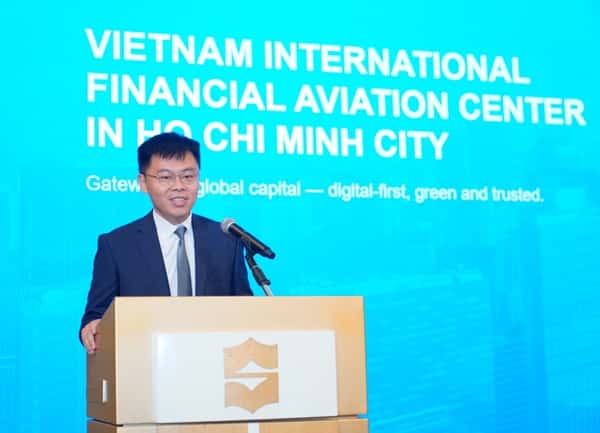
Dr Truong Minh Huy Vu, Chairman of VIFC-HCM, delivers remarks at the announcement ceremony of the Asia-Pacific Aviation Financial Hub
Chairwoman Dr Nguyen Thi Phuong Thao framed the partnership as more than financial engineering:
“The Asia-Pacific Aviation Financial Hub marks a strategic milestone in reshaping how global capital supports the advancement of aviation and the broader economic landscape of Vietnam and the region. Vietjet is committed to leading high-impact transactions that help strengthen a forward-looking and sustainable aviation finance ecosystem to support future regional growth.”
There is a certain inevitability about Vietnam’s emergence as a financial and aviation node. Geography helps, of course, planted firmly amid some of the busiest air routes on earth, but policy ambition and commercial agility are proving just as decisive.
Engines of Efficiency Literally
Not content with financial manoeuvres alone, Vietjet also confirmed a significant engine agreement with Pratt & Whitney, ordering 44 additional GTF-powered aircraft for the Airbus A320neo family, comprising 24 A321neos and 20 of the long-range A321XLR variant.
Deliveries begin in July 2026, accompanied by a 12-year EngineWise® Comprehensive maintenance agreement.
The order lifts Vietjet’s total commitment to 137 GTF-powered aircraft, a figure that speaks less of incremental growth and more of deliberate scale.
For context, the geared turbofan engine offers up to 20 percent lower fuel consumption and a noise footprint reduced by 75 percent compared with earlier-generation powerplants. In an era increasingly shaped by environmental scrutiny, such efficiencies are not optional luxuries; they are strategic necessities.
Vietjet has operated the A321neo since 2018 and already fields 42 of the type, a fleet that has quietly matured into one of the region’s more efficient narrowbody operations.
Why Australia Should Be Paying Attention
For Australian travellers and industry watchers alike, Vietjet’s trajectory is more than an offshore curiosity.
Connectivity between Vietnam and Australia has strengthened markedly in recent years, driven by tourism, education flows, and expanding trade ties. A larger, more modern Vietjet fleet inevitably translates into greater seat capacity and, historically speaking, more competition tends to sharpen fares.
From a broader economic perspective, stronger aviation infrastructure across the Asia-Pacific often correlates with increased visitor arrivals and trade activity. Airlines rarely invest billions without expecting markets to follow.
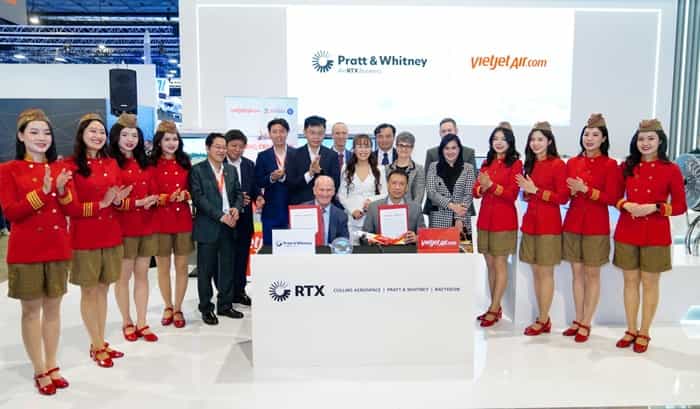
Vietjet Managing Director Nguyen Thanh Son (right) and Rick Deurloo, President of Commercial Engines, Pratt & Whitney (left), exchange the agreement to select engines and engine maintenance services for 44
The Bigger Picture: Aviation’s Centre of Gravity Shifts
Forecasts consistently point to Asia-Pacific becoming the world’s largest aviation market within the next two decades. Against that backdrop, Vietjet’s twin strategy of financial participation paired with fleet modernisation appears less opportunistic and more methodical.
There is also a philosophical shift underway. Airlines once focused almost exclusively on aircraft orders and route launches. Today, the smarter operators are embedding themselves more deeply in financing ecosystems, ensuring access to capital even when economic conditions turn unpredictable.
Put simply, resilience is becoming as valuable as reach.
Final Approach
What emerged from Singapore was not a single announcement but a coordinated blueprint for finance, fleet, sustainability, and regional connectivity moving in disciplined formation.
For an airline barely older than some of the aircraft it now orders by the dozen, Vietjet is displaying the composure of a far more seasoned carrier.
And while aviation has always rewarded boldness, it tends to favour those who combine ambition with structure.
On this evidence, Vietjet is doing precisely that, and the Asia-Pacific skies may soon feel the effects.