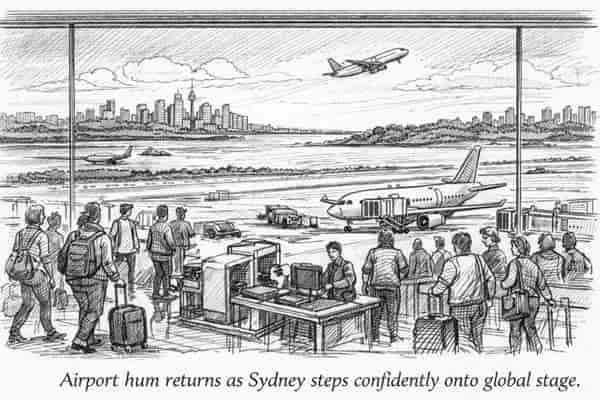
There is a particular energy to a truly busy airport. Not chaos, good airports rarely descend into that, but momentum. Aircraft edging toward taxi lines at dusk, the quiet choreography of ground crews, the murmur of travellers rediscovering the simple pleasure of going somewhere.
By that measure, Sydney Airport has rarely looked healthier.
The harbour city’s primary gateway closed 2025 with a record 17.17 million international passengers, the largest annual tally in its history, and a number that confirms global travel is no longer cautiously rebuilding; it is advancing with confidence.
Across the entire precinct, more than 42.54 million passengers passed through the airport during the year, up 2.7 per cent on 2024. Encouragingly, the strength was not confined to a holiday spike. Traffic built steadily before culminating in a December quarter that produced 4.62 million international travellers, itself another record.
Domestic and regional routes played their part as well, rising 2.1 per cent year-on-year, with 6.79 million passengers moving through Terminals 2 and 3 in the final quarter alone.
Airports are not given to chest-thumping, but behind the measured corporate language, one suspects there were a few satisfied glances exchanged in executive corridors.
The Return of Distance And Confidence
What makes these figures noteworthy is not simply their scale, but their composition.
Outbound Australian travel held broadly steady, a reminder that locals have long treated overseas trips as something closer to a national pastime than a luxury. The real lift came from inbound markets, where capacity returned, routes thickened, and travellers followed.
China led the resurgence, with passport holders climbing 12.2 per cent compared with the same quarter a year earlier. Much of that momentum has been supported by China Southern Airlines, which confirmed it will expand its Sydney–Guangzhou operation to three daily year-round flights, the highest frequency the route has seen.
Elsewhere, South Korean arrivals rose an impressive 15.3 per cent, while Japan and the United Kingdom posted gains of 8.3 per cent and 7.4 per cent respectively.
For seasoned aviation watchers, the pattern feels familiar. Restore capacity, maintain reliability, and demand tends to organise itself.
Sydney’s geographic advantage, equal parts gateway and destination, remains intact.
Growth Without the Growing Pains
Traffic records are flattering. Managing them is another matter entirely.
Encouragingly, operational performance held remarkably firm throughout the busiest periods of the year. More than 99.8 per cent of domestic passengers and 99.4 per cent of international travellers cleared security screening within ten minutes, metrics many global hubs would regard with quiet envy.
Immigration processing also improved, with 90 per cent of inbound passengers clearing within 34 minutes, representing an 8.1 per cent improvement on the previous year.
Behind the scenes, the progressive rollout of inbound kiosks has helped smooth arrival flows, while new security lanes at Terminals 1 and 2 are already reducing friction at precisely the moment volumes are rising.
Chief executive Scott Charlton struck a tone of calm satisfaction when reflecting on the year.
“2025 marked a record year of international passengers for Sydney Airport reflecting sustained demand for travel and Sydney’s role as Australia’s primary international gateway.
“International travel accelerated throughout the second half, with the final quarter delivering the highest volumes of the year. This reflects the recovery of key inbound markets and the return of airline capacity.”
Perhaps more telling was his emphasis on delivery over celebration, a habit common among airport leaders who know that growth is only admirable when it is repeatable.
Construction as a Signal of Intent
Airports rarely invest billions on a whim.
Sydney is currently pressing ahead with a sweeping capital program designed not merely to cope with future demand, but to shape it. The $200 million Terminal 2 upgrade is due for completion later this year, while the integrated expansion of the T2/T3 precinct is moving from blueprint to reality.
Simultaneously, the airport has launched a global tender to assemble architectural and engineering partners for a $6 billion pipeline of works over the next five years, a figure that speaks more to ambition than to maintenance.
All 15 new screening lanes at the international terminal are now operational, while CT-enabled technology in Terminal 2 allows passengers to keep laptops and liquids inside their bags, a small procedural mercy that frequent flyers tend to appreciate disproportionately.
Automatic bag drops continue to proliferate, supporting an increasingly plausible ambition: reducing the journey from kerb to gate to around fifteen minutes.
In aviation, time saved is reputation earned.
A Better Airport Is Also a More Enjoyable One
Infrastructure is not solely about throughput. Passenger experience, once treated as decorative, has become strategic.
Terminal 3 now carries a noticeably stronger culinary accent, welcoming recognised Sydney dining names such as Maggio’s, Icebergs and Slim’s Quality Burgers. Airports learned long ago that travellers remember meals almost as clearly as flights; bringing a sense of place indoors is rarely wasted effort.
Meanwhile, the airport’s transfer facility has entered a new chapter under the banner SYD Transfer, consolidating domestic connections and trimming transfer times.
It is an operational refinement that passengers may never consciously applaud, yet would certainly notice if removed.
Policy, Fuel and the Longer View
Beyond terminals and timetables lies a broader economic conversation.
Sydney Airport has continued to work with the Australian Federal Government on policy settings to strengthen productivity and resilience across the aviation sector. Priorities include border modernisation, expanded bilateral air rights and investment in Sustainable Aviation Fuel.
On that front, the airport welcomed the New South Wales Government Renewable Fuel Strategy, a framework intended to help establish a domestic SAF industry, a development likely to matter greatly as airlines navigate the industry’s complex path toward lower emissions.
Environmental credentials were further reinforced through a decade-long habitat restoration partnership with the
Taronga Conservation Society Australia, supporting the airport’s Net Zero 2030 targets while delivering tangible conservation outcomes in regional New South Wales.
For an industry frequently scrutinised on sustainability, substance carries more weight than slogans.
Eyes Firmly on 2026
Charlton has been clear about what comes next.
“Looking ahead to 2026, our focus is firmly on delivery as we progress our development program to add capacity and continue improving the passenger experience.”
Translated from executive dialect, that means cranes will remain part of the skyline for some time yet.
Still, expansion is rarely undertaken for appearances. It reflects confidence not just in passenger numbers, but in Australia’s enduring appeal as both destination and departure point.
Final Boarding Call
Viewed from altitude, 2025 feels less like a peak and more like a recalibration.
Demand is resilient. Airlines are recommitting aircraft. Governments are re-engaging with aviation policy. Infrastructure is accelerating.
Most importantly, Sydney Airport is behaving like an organisation planning decades ahead rather than quarters.
Airports, after all, are more than transit nodes. They are economic engines, national shopfronts and for many travellers, the first handshake with a country.
Judging by the latest figures, that handshake is growing firmer by the year.
by Susan Ng – (c) 2026.
Read Time: 8 minutes.
About the Writer.
 With the polish of an international hotel professional and the instincts of a born storyteller, Susan Ng learned hospitality where it truly lives behind reception desks, in banquet halls, beside linen carts. She understands that excellence isn’t announced; it’s felt, in the small, quiet gestures that linger long after checkout.
Away from the bustle, her curiosity found a new front desk: the blank page. Her blog, candid and gently wry, drew readers who recognised truth when they saw it. She wrote about grace and imperfection with the steady eye of someone who had lived both.
Today, at Global Travel Media, Susan brings that same warmth and insight to her stories. Expect writing that is polished, generous, and reassuring, like the perfect welcome after a long journey.