
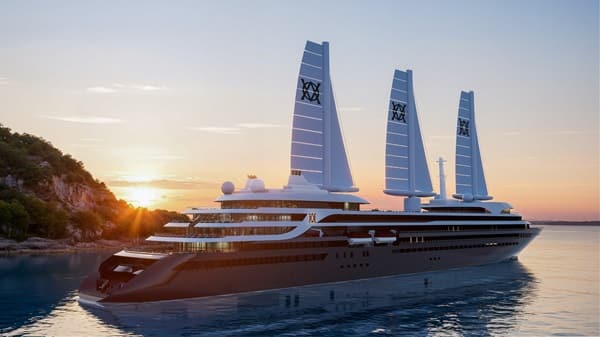
In an industry that has never been short on ambition, Atlas Ocean Voyages has just raised the mast quite literally.
The boutique expedition line has announced it is building its first-ever luxury expedition sailing yacht, the Atlas Adventurer, a next-generation newbuild that signals not merely fleet expansion, but a philosophical statement about where high-end exploration cruising is heading.
Launched in 2028, the new Atlas-class vessel will extend the company’s global footprint into Asia and Africa, while entrenching its credentials as one of the most technologically progressive and environmentally conscious players in the luxury expedition market.
In Australia, Atlas Ocean Voyages is represented exclusively by Cruise Traveller, the nation’s largest expedition and small ship specialist, a partnership that places Australian travellers neatly in the slipstream of one of the industry’s most intriguing developments.
A yacht that sails properly
Unlike the decorative sails occasionally draped across modern cruise ships like nautical costume jewellery, Atlas Adventurer is the real thing.
The 26,000-gross-tonne, 210-metre yacht will feature three towering carbon masts, solid sails and electric-hybrid propulsion, engineered to harness wind power wherever conditions allow. When the sails fill, and the batteries hum, the ship can operate in near silence, delivering zero-emission cruising and what Atlas describes as “a silent presence on the water”.
It is not merely romantic. It is strategic.
With ports around the world tightening environmental regulations and smaller destinations guarding access ever more jealously, silent, low-impact vessels are no longer indulgences. They are passports.
James A. Rodriguez, President and CEO of Atlas Ocean Voyages, is candid about what is driving the build.
“This new Atlas-class sailing yacht represents the next step in our growth,” he said. “It allows us to expand our destination footprint into regions our guests have been asking us for, while further solidifying Atlas’ position within the luxury expedition cruise category.”
The language is corporate. The ambition is not.
Rodriguez describes the vessel as “a powerful expression” of Atlas’ future: “thoughtful growth, intentional design, and deeper global exploration”. In an era when cruise lines routinely promise authenticity while delivering congestion, those words will be tested far from brochure copy.
A bridge across five centuries
If Rodriguez speaks for the future, Mystic Invest chairman Mario Ferreira speaks for history.
“With Atlas Adventurer, we are introducing a new generation of luxury expedition sailing yachts,” Ferreira said. “This vessel serves as a bridge between the wind mastery of the 15th century and the solid sails and electric propulsion of the 21st century.”
It is an evocative image: caravels reborn in carbon fibre, not mere rhetoric.
The yacht will be powered by dual-fuel engines and a formidable nine-megawatt marine battery system, allowing high speeds even in light wind and virtually silent operation when conditions permit. Zero-speed fin stabilisers, reinforced hull, vertical stabilisers and Ice Class 1B (Polar Category C) capability ensure that elegance does not come at the expense of resilience.
Ferreira is explicit about the vessel’s regulatory future-proofing. The ship is designed to comply with future zero-emission port requirements and navigate silently into “some of the most exclusive and restricted small ports around the world”.
Translation: where others will be turned away, Atlas intends to be waved through.
Boutique scale, expanded ambition
For all its technology, Atlas Adventurer remains a boutique proposition.
The yacht will carry up to 400 guests, attended by 275 crew, a ratio that suggests service will remain personal rather than procedural. Every cabin will be a suite. Space will be generous. Crowding, if the designers have done their sums properly, will be theoretical.
Seven dining venues will include specialty restaurants and a new culinary studio designed for hands-on learning and destination-driven programming. Five lounges, cocktail bars, two outdoor bars, a large swimming pool, an expanded wellness centre and a marina platform with ocean pool complete the resort equation.
Yet this is not a floating Riviera.
Purpose-built expedition capability remains central: Zodiacs, luxury motorboats, reinforced hull, polar rating. In other words, silk gloves over steel hands.
Atlas is promising “elevated comfort” without abandoning what first attracted its loyal following: access to remote, fragile and culturally rich destinations without the logistical bruising that often accompanies adventure travel.
Asia and Africa in the spotlight
From late 2028, Atlas Adventurer will begin exploring a swathe of Asia, including Japan, South Korea, China, Vietnam, Indonesia, Malaysia, Thailand, and the Philippines, before turning west towards the Indian Ocean and Africa: Seychelles, Madagascar, Tanzania, Kenya, Mozambique, and South Africa.
These are not headline itineraries in the mass market. They are complex, port-constrained, regulation-heavy regions that reward patience, diplomacy and quiet entry.
They also happen to be the precise destinations that affluent, time-poor, experience-hungry travellers increasingly crave.
For Atlas, the geographic expansion is as strategic as the ship itself. It diversifies beyond traditional polar and Atlantic itineraries, positions the brand in emerging luxury corridors and places it squarely in competition with the most sophisticated small-ship operators in the world.
Details of suite design, dining concepts and itineraries will be released over the coming months, a slow reveal that suits a brand intent on building anticipation rather than discounting it.
Australia in the front row
For Australian travellers, the significance is immediate.
Joe O’Sullivan, Managing Director of Cruise Traveller, sees the vessel as a natural fit for the local market.
“The debut of Atlas’ first sailing yacht represents an exciting new chapter for the brand and will appeal to Australians seeking immersive exploration paired with refined elegance and grace,” he said.
O’Sullivan notes the appeal of Asia and Africa to Australians already comfortable with long-haul travel, cultural immersion and wildlife-driven itineraries.
“Atlas Adventurer will chart new waters for Atlas, venturing into Asia and Africa, destinations rich in culture, wildlife, and unforgettable discovery.”
He adds that Atlas’ broader philosophy resonates strongly with Australian tastes: “no-fuss, effortless elegance, an abundance of space, elevated cuisine, efficient service, affordability, and a focus on authentic, low-impact visits to smaller ports and remote and pristine places”.
In an age when luxury is increasingly defined by the absence of queues, noise, crowds and compromise, that positioning is astute.
Australians can already register interest for the inaugural 2028–29 season through Cruise Traveller, positioning themselves at the head of what will almost certainly become a tightly rationed launch programme.
More information is available at: https://www.cruisetraveller.com.au/atlas-ocean-voyages.
A quiet revolution at sea
There is something quietly radical about Atlas Adventurer.
Not loud, not ostentatious, not defined by rooftop rollercoasters or artificial sky domes. Instead, it promises wind, silence, technology and access to a vessel designed not to announce itself, but to arrive unnoticed.
In a cruising world increasingly polarised between floating megacities and hyper-niche expedition craft, Atlas is staking out an intriguing middle ground: serious exploration delivered with the manners of a private yacht and the discipline of an environmental engineer.
If the execution matches the promise, Atlas Adventurer will not simply extend a fleet.
It may help redefine what luxury expedition cruising looks like when the future finally catches up with the romance.
by Octavia Koo – (c) 2026.
Read Time: 6 minutes.
About the Writer.
I ndonesian-born Octavia Koo arrived in Australia in the early 1980s, drawn by the creative promise of Sydney and a place at UNSW, where she studied Arts and soon discovered her flair for visual storytelling. She began as a graphic designer, quickly turning her sharp eye for detail towards the digital frontier, designing websites and crafting polished descriptions that draw people in and keep them reading.
Her next chapter took her to Singapore, where she built and managed blogs for several tourism platforms, uncovering a natural gift for SEO long before the term became fashionable. There, amid the buzz of ITB Asia, she met Stephen, who suggested she consider Global Travel Media. A few years later, she did just that.
Now part of GTM’s editorial family, Octavia brings a quiet brilliance to her work. She merges art, technology, and intuition to tell travel stories that charm and perform, much like their author.