

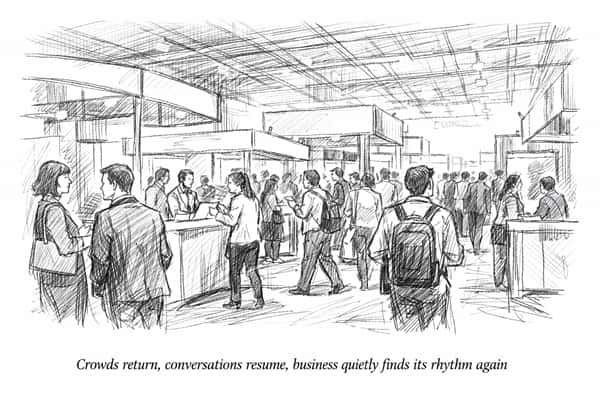
Thailand’s exhibition boom is back, and this time it feels real.
For a while there, Thailand’s exhibition industry felt a bit like a hotel buffet at closing time. Plenty on offer, not much appetite.
That mood has shifted.
You can see it in the scale and ambition of the new two-year calendar released by IMPACT Exhibition Management, the country’s dominant events operator. But more tellingly, you can hear it in the tone. This isn’t about filling halls for the sake of it. It’s about confidence returning to face-to-face business, and a quiet belief that people are finally ready to show up again.
IMPACT, which runs the sprawling Muang Thong Thani precinct north of Bangkok, has never been short of floor space. What it’s been testing over the past few years is relevance — what still draws crowds, what doesn’t, and where the real money now sits.
The answer, it seems, is a careful blend of the practical and the pleasurable.
On one end of the spectrum are the big trade engines: construction technology, digital business platforms, lighting, smart living, woodworking and furniture. On the other hand, some exhibitions speak directly to how people now spend and justify their disposable income: pets, food, wine, wellness and lifestyle experiences.
That split runs cleanly through IMPACT’s 2026–27 program.
The business-heavy shows return in force from mid-2026. DigiTech ASEAN and its AI Connect offshoot plant a flag firmly in the region’s ongoing digital transformation conversation. These are not glossy futurism expos; they are networking-heavy, card-swapping affairs designed for companies still trying to work out what digital actually means for their bottom line.
September, traditionally the exhibition high season, becomes almost industrial in its density. Construction technology, lighting design, smart living and furniture manufacturing all converge across multiple halls in the same week, a deliberate clustering that makes life easier for regional buyers and more complicated for anyone hoping to dip in for just an afternoon.
What’s interesting is not just the scale, but the framing. These are no longer pitched as standalone showcases. They’re positioned as meeting places, markets where deals are expected to happen, not merely discussed.
Yet it’s the consumer-facing events where the shift in mood is most obvious.
Pets, once a niche retail category, are now treated as an industry in their own right. The international dog and cat shows, alongside the pet variety festivals in both Bangkok and Chiang Mai, aren’t shy about it. Insurance, pet-friendly hotels, premium nutrition, lifestyle accessories, it’s all there, reflecting a market that has grown up fast and shows little interest in going backwards.
Food follows the same trajectory. The Foodism Show, now paired with a health and wellness expo, leans heavily into the idea that eating well is no longer a trend but an expectation. Plant-based products, functional foods, supplements and medical nutrition sit side by side, pitched equally at trade buyers and curious consumers.
Then there are the crowd-pleasers, the events that remind you exhibitions don’t have to feel worthy to be worthwhile.
The Shell Shuan Shim collaboration is unapologetically festive: a ten-day outdoor sprawl of certified restaurants, live music and cooking demonstrations that turns Thailand’s obsession with food into something closer to a cultural event. Likewise, the wine showcases — timed neatly around festive periods trade less on education than on discovery and indulgence.
Cultural programming has also been sharpened. Ma Nuea Expo, celebrating Northern Thailand’s crafts and heritage, wears its “from past to future” theme lightly, favouring accessibility over nostalgia. It’s heritage without the museum glass.
Even the automotive events, vintage classics on one end, high-octane speed festivals on the other, feel less like enthusiast gatherings and more like lifestyle statements, cars as spectacle, not just machinery.
What ties all of this together is IMPACT’s increasingly clear sense of what exhibitions are for. Not just to inform or display, but to connect industries to buyers, consumers to brands, tradition to modern life.
There’s also a quiet understanding at work here: not every event needs to chase international headlines. Some need to work commercially, culturally, and socially within their own markets.
For Australian businesses and travel operators, that matters. Thailand remains one of the region’s most important hubs for exhibitions and meetings, and a barometer for where Asian consumer and business sentiment is heading. When the halls fill in Bangkok, they tend to fill elsewhere soon after.
This calendar suggests something else, too: a return to confidence without bravado. No talk of “reinvention” or “new normal”. Just the steady reassembly of an industry that knows what it does best when given the chance.
After a few uncertain years, Thailand’s exhibition scene isn’t trying to impress anymore.
It’s simply getting back to work.
by Yves Thomas – (c) 2025
Read time: 5 minutes.
About the Writer.
 Something quietly magnetic about Yves Thomas is the poised calm of someone who’s seen the world from both sides of the reception desk. A graduate of Bangkok University International, Yves earned her Bachelor of Arts in International Tourism and Hospitality Management and stepped straight into the beating heart of Thailand’s travel industry.
She worked with some of the country’s finest destination management companies, mastering the art of making other people’s holidays unforgettable.
In time, the call of the open road grew louder than boardroom meetings. Yves packed her bags, swapped conference calls for compass points, and set off to rediscover the joy of travel on her own terms. Somewhere between Chiang Mai and Copenhagen, she began to write small reflections that soon became her travel blog, a journal full of warmth and insight.
Now calling Hua Hin home, Yves has joined Global Travel Media to share those reflections with a broader audience not as a publicist, but as a storyteller with a traveller’s soul and a professional’s eye for detail.
=====================================











