

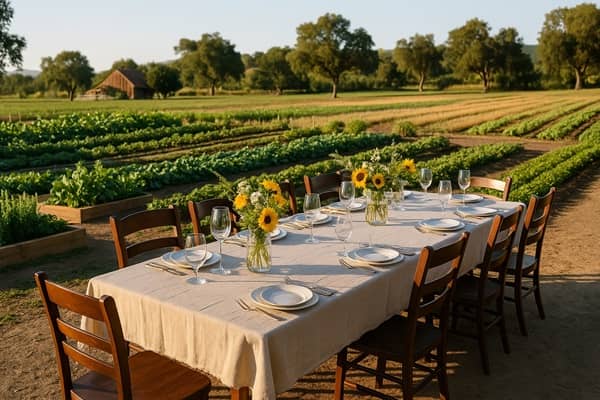
If the future of meetings is meant to leave a lighter footprint, California is already walking the talk barefoot through organic soil, no less. Across the Golden State, a quiet revolution is underway, one led not by boardrooms and PowerPoint decks, but by regenerative farms, carbon-neutral wineries and kitchens that take their ethics as seriously as their flavour profiles.
Sustainability, once a fashionable add-on, is now a core expectation. With 62 per cent of global event organisers set to prioritise sustainability by 2025, California’s meetings and events sector has seized the moment and the moral high ground. From the sunburnt stretches of Greater Palm Springs to the rolling vineyards of Sonoma and the salt-flecked air of the Pacific coast, the state is proving that exceptional gatherings can nourish both people and the planet.
This is not sustainability as theatre. It is sustainability with dirt under its fingernails.
Regenerative Roots: Where the Land Leads the Agenda
At Aziz Farms in Greater Palm Springs, meetings begin where the menus do in the soil. This working regenerative farm transforms corporate intelligence into agricultural enlightenment, offering farm-fresh dining built around responsibly grown dates and seasonal produce. Guests are not merely fed; they are connected. Chef-led dinners bring the landscape directly to the plate, forging rare intimacy between guest, grower and cuisine.
Further south in Encinitas, Fox Point Farms has quietly become one of Southern California’s most compelling models for regenerative hospitality. Equal parts farm, brewery and event space, it hosts groups inside a closed-loop ecosystem that champions soil health, biodiversity and waste reduction. Its on-site “Farm-to-Tap” brewery, the first of its kind in San Diego, demonstrates that sustainability can be both principled and profitable.
In Morgan Hill, Terra Amico Farms places guests at the centre of its regenerative mission. Here, sustainability unfolds through crop rotation, composting and biodiversity restoration. Visitors can sip herb-infused cocktails, dine on chef-crafted menus and tour the land itself, a living classroom in ecological recovery.
The message is clear: regeneration is no longer a buzzword. It is the business model.
From Vine to Table: Where Wine Meets Conscience
Nowhere does sustainable indulgence shine more brightly than in Sonoma County, the quiet titan of California’s eco-forward wine economy. At SingleThread Farm Restaurant, fine dining begins on a 24-acre regenerative farm before emerging on the plate with quiet sophistication. Rodney Strong Vineyards, meanwhile, stands as Sonoma’s first certified carbon-neutral winery, proof that premium wine and planetary accountability can comfortably share a cellar.
Nearby, Enclos at Stone Edge Farm has earned the rare honour of a Michelin Green Star, fusing haute cuisine with carbon-conscious engineering. It is sustainability with silver-service precision.
In Fairfield’s Suisun Valley, Two60 Kitchen & Bar draws its globally inspired menus from neighbouring farms. At the same time, Il Fiorello Olive Oil Company offers sustainable tastings and chef-led workshops that honour the region’s agricultural heritage. These are not add-ons for visiting groups — they are the main event.
In Temecula, EAT Marketplace brings a different voice to the table. Women-led and purpose-driven, the restaurant hosts retreats, workshops and private events focused on regenerative agriculture, inclusivity and community. Its success is a quiet rebuke to the notion that sustainability lacks commercial muscle.
Coastal Stewardship: Where Ocean Breezes Meet Ethical Kitchens
Along the coast, Carlsbad’s Omni La Costa Resort harvests more than sunshine. Thousands of resident bees pollinate its grounds and produce honey for the resort’s kitchens, nestled beside herb gardens redolent with basil, fennel and chives. It is hyper-local sourcing taken to its logical, delicious conclusion.
In Elk Grove, Chef Marie Merts steers Todo Un Poco with a fiercely local compass, partnering with farms such as Bella Vida and Cliff’s Garden to craft seasonal menus with minimal carbon impact. Each plate is a tangible expression of community-backed sustainability.
And then there is Long Beach’s Heritage, the city’s first Michelin-starred restaurant and a zero-waste pioneer from its earliest service. Awarded both Michelin Star and Green Star in consecutive years, Heritage hosts intimate groups of up to 80 guests and has become a lodestar for purpose-led dining on California’s southern coast.
The Business Case for Doing the Right Thing
California’s sustainable meetings movement is not driven by ideology alone. Data, demand and durable commercial logic underpin it. Event organisers increasingly understand that delegates expect more than four-star comfort. They want meaning with their menus and values with their venues.
Sustainability, once an aspirational extra, has become a competitive advantage.
What California is offering, with quiet confidence, is a blueprint for the future of business gatherings, one where regeneration is profitable, community partnerships are strategic assets, and flavour is never sacrificed on the altar of ethics.
In the end, California’s message to the global meetings industry is both elegant and disarmingly simple: you can feed the people, the planet and the bottom line all at the same table.
by Jason Smith – (c) 2025
Read Time: 5 minutes.
About the Writer
 Jason Smith has the kind of story you can’t fake, built on long flights, new cities, and that unmistakable hum of hotel life that gets under your skin and never quite leaves. Half American, half Asian, he grew up surrounded by the steady rhythm of the tourism trade in the U.S., where his family helped others see the world long before he did.
Eager to carve out his own path, Jason packed his bags for Bangkok and the Asian Institute of Hospitality & Management, where he majored in Hotel Management and found a career and a calling. From there came years on the road, Singapore, Malaysia, Vietnam, each stop adding another thread to his craft.
He made his mark in Thailand, eventually becoming Director of Sales for one of the country’s leading hotel chains. Then came COVID-19: borders closed, flights grounded, and a new chapter began.
Back home in America, Jason turned his knack for connection into words, joining Global Travel Media to tell the stories behind the check-ins written with the same warmth and honesty that have always defined him.











