Why are clearly defined standards the foundation for the ethical, effective implementation of AI-powered operational solutions?
Today, companies everywhere are racing to integrate artificial intelligence into their operations, believing it will help them offer faster service. These predictive insights will enable more effective strategic decision-making and reduced labour costs. However, a critical oversight will quietly unravel their ambitions: AI can’t help a business deliver on its brand promise if it hasn’t been precisely defined.
In other words, AI can’t know you until you know yourself.
Standards: The Original Operating System
Before we talk about algorithms, let’s talk about alignment.
Every hospitality business runs on internal (and external) standards—including rules, procedures, rituals, and cultural touchpoints—that define how work gets done and how guests are treated. Standards are the heart and soul of a brand, manifested for your guests.
Well-implemented standards will be invisible to hotel guests; however, when standards aren’t clearly defined, the result will be a less cohesive, less enjoyable experience for guests, despite everything looking “good” on the surface.
Here’s an example…
Recently, I walked into a hotel that described itself as “elegant and luxurious.” The flowers were beautiful, and the marble floors were spotless, but the bell staff never made eye contact, and the check-in process took more than 20 minutes. Nothing was wrong, per se, but everything felt… off. Overall, it did not match up with my expectations of what an elegant and luxurious hotel experience would feel like.
So, what was wrong?
The (lack of) standards were!
Unfortunately, many hotels have let their brand standards fade into the background, buried in PDFs, trapped in binders, or informally passed down from employee to employee through word-of-mouth.
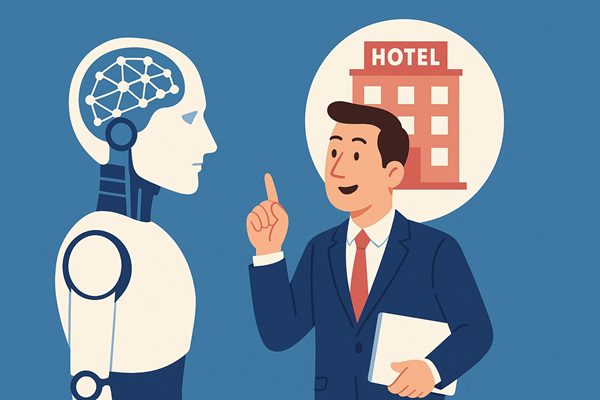
While still far from ideal, when humans effectively interpret the nuance of a brand, the output remains intentional. But AI doesn’t intuit; it obeys. So, when standards are undocumented, vague, or contradictory, AI doesn’t just falter; it risks misrepresenting the very essence of your brand.
AI Without Context Is Just Code
There’s a tendency to view AI as a plug-and-play fix that will automatically solve every problem immediately. But optimisation requires a goal. Speed alone is not excellence, and automation without clarity can amplify inconsistency.
What does a “clean” hotel room mean to a five-star spa vs. an express airport hotel?
How should an AI chatbot respond to a complaint at a luxury resort vs. an elite member of a budget chain?
These questions only have answers when standards exist to define them.
Hospitality: Where Standards are the Product
In hospitality, standards aren’t just internal metrics but also fundamental in shaping the guest experience. The way each guest is greeted, the cadence of service during a massage and the sequence of a turndown service… each of these small moments adds up to something much bigger in the minds of your guests: trust and satisfaction.
When AI is used to automate inspections, guide staff behaviour, or forecast guest needs, it’s only effective if the AI knows how the ideal guest experience should look, not only the mechanics but also the tone, timing, and intention. AI can only make good recommendations if your brand has identified and communicated what is “right” and “wrong” according to your expectations.
That’s the job of standards.
The Ethical Stakes Are Real
Without standards, AI makes operational errors and risks making ethical ones. Consider potential bias in hiring, discriminatory loan approvals, or customer service systems that escalate issues disproportionately. These aren’t just bugs; they’re the product of systems trained without context, nuance, and an internal compass.
It’s your job as the user of the AI solution to provide that internal compass through your specific brand standards. Not just the technical specs but also your brand’s values, rules of engagement and specific procedural guidelines for fairness, empathy and escalation.
Without the appropriate context, AI will only offer tone-deaf responses, unethical behaviour, or automation that feels deeply inhuman, a loss for both hotels and guests.
Rediscovering Your Identity
Perhaps the greatest gift AI is offering hoteliers today is the chance to ask:
Who are we, really?
What do we stand for?
What do we want our guests to remember about their stay with us?
And do the systems that we have in place reflect that?
For many hotels, the truth is uncomfortable. Their standards were last updated years ago, or worse, never written down.
Instead of keeping it locked in management’s heads, hoteliers need to embrace intelligent systems that capture that intelligence, refine it to translate the brand’s identity into operational clarity and make it accessible to both humans and machines.
Only then can you invite AI into the room. At that point, AI becomes less of a magic trick and more of a multiplier of operational efficiency and ROI.
Because the future of intelligent hospitality doesn’t start with artificial intelligence; it begins with self-awareness.
By Adam Tuttle, Co-Founder & CEO of Yipy.