

If Accommodation Australia were a schoolteacher handing out half-year report cards, Australia’s hotels would be staring down a red pen scrawl that reads: “Improved performance—still room for improvement!”
Australia’s peak accommodation industry body has released its 2025 mid-year report on national hotel occupancy. While the nation’s capital cities have collectively pulled up their socks, there’s still a bit of detention-worthy behaviour—namely, revenue slippage in several bigger states.
But let’s start with the gold stars, shall we?
According to the figures, Australia’s capital cities recorded a rise in average occupancy rates over the first half of 2025. Hobart, often the underdog in the classroom of capital cities, topped the improvement leaderboard, with a 5.6% jump in average occupancy—reaching a respectable 79.3%. Revenue was also up, with the Tasmanian capital posting a 3.8% increase in average daily room revenue. That’s enough to earn it a seat at the front of the class.
Perth, however, may just have pinched Hobart’s shiny gold star. Accommodation Australia CEO James Goodwin said, “Of all the capital cities, Perth recorded the highest overall average occupancy rate—clocking in at 79.9% for the six months to June 2025.”
Following behind Perth and Hobart was Sydney, which, while not in the class in occupancy, still held onto its title as the city with the highest average revenue per room. This proves that Harbour views still command a premium price tag.
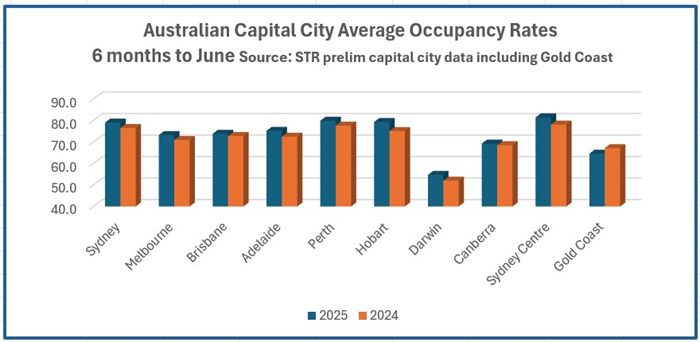
Hobart and Perth shine bright as Aussie capitals lift hotel occupancy in 2025.
Lions Roar, Hotels Soar
But if there’s one clear winner in this mid-year assessment, it’s not a city, but a team—specifically, the touring British and Irish Lions. Their much-anticipated rugby tour has given the hotel sector a mighty “kick-start”, especially in key match cities like Perth, Brisbane, Canberra, and Adelaide.
Let’s crunch a few figures.
In Perth, hotel occupancies jumped 10% on the same period last year during the first Lions fixture. Brisbane didn’t just follow suit—it went full sprint, with occupancy rates soaring into the 88–90% range for not just the night of the July 19 test match, but for three days prior. On match day itself, average daily rates reportedly doubled from 2024. Yes, doubled. Try telling a hotelier that sport doesn’t matter.
Canberra and Adelaide also won, hosting earlier matches in July. In both cities, game day occupancies exceeded 95%, with the days leading up to each event also showing a healthy booking bump. Footy fans don’t just travel—they book, spend, and stay.
Mr Goodwin put it plainly: “Forward hotel bookings for the remainder of the tour are strong and reinforce the importance of Australia continuing to attract world-class sporting and entertainment events.”
The message is loud and clear: Bring on the blockbusters—rugby, concerts, expos, the works—and the hotel sector will respond with open arms and crisp linens.
Not All Sunshine
But even with the rising tide of occupancy, not all figures were cause for celebration. Five capitals—Sydney, Melbourne, Adelaide, Darwin and Canberra—saw their average daily room revenue slip during the year’s first half compared to 2024.
The reasons vary, but as Mr Goodwin pointed out, external factors play a big part. The Gold Coast, for instance, saw a drop in average occupancy for the six months, mainly due to the cyclone that battered Queensland in March.
Darwin, though showing a 5.2% increase in occupancy, was building from a lower base—a reminder that not all growth is created equal. Still, every little bit helps in an industry still navigating post-pandemic recovery, weather upheavals, and a fiercely competitive domestic market.
Moving Forward
Accommodation Australia plans to release its full report at the end of the year, and industry insiders will be watching closely to see if the second half of 2025 brings sustained momentum—or more unexpected curveballs.
Still, there’s much to be optimistic about with sporting blockbusters filling rooms and smaller capitals like Hobart and Perth punching above their weight. One only hopes that by year’s end, the industry’s report card reads less “must try harder” and more “best in class.”
For now, though, let’s give Hobart a polite round of applause, a standing ovation to Perth, and a rousing haka to the British and Irish Lions. Because in the grand scheme of tourism economics, it turns out a rugby ball can move more than just players—it moves bookings, boosts revenue, and keeps the hotel lights on.
If you’d like more information on Accommodation Australia’s research or hotel performance insights, visit: https://www.accommodationaustralia.org.
By Susan Ng











