

It appears that the modern traveller is no longer just checking the weather and flight times—they’re also keeping a close eye on geopolitical barometers. A new global survey has revealed that once relegated to the bottom of a consular webpage, travel advisories are now sitting squarely at the top of the modern explorer’s checklist.
The Global Rescue Summer 2025 Traveller Safety and Sentiment Survey offers a revealing snapshot of traveller sentiment in an increasingly jittery world. A healthy 63% of experienced globetrotters now say that government-issued travel advisories influence their destination “at least a moderate amount”. That’s not just a whisper of concern—it’s a clear signal that caution has become the new carry-on.
“There’s no doubt about it—official safety warnings are swaying travel decisions in a way we’ve not seen before,” said Dan Richards, CEO of The Global Rescue Companies and a member of the US Travel and Tourism Advisory Board. “People want more than an itinerary—they want reassurance.”
Women and Youth Lead the Charge Toward Caution
While everyone seems to be perking up their ears when embassies issue warnings, the data shows that women and youth are most attuned. Women were 6% more likely than men to change their travel plans based on advisories, while younger travellers—those sprightly under-35s—were significantly more responsive than their more seasoned, silver-haired counterparts.
It’s the sort of generational divide that speaks volumes. The older crowd, perhaps steeled by a few decades of tough luggage and tougher customs officers, remains more intrepid. But the younger set, savvy in mobile alerts and real-time embassy tweets, is veering towards prudence.
Middle East, Asia and the Americas in the Crosshairs
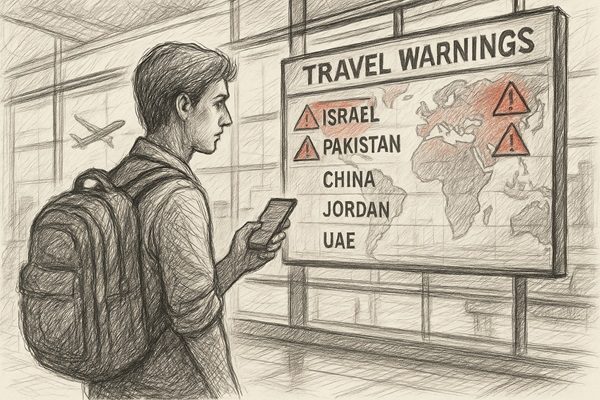
When explicitly asked which countries they’d avoid based on updated advisories, travellers gave a clear list of ‘not this time, thank you’. Topping the list in Asia and the Middle East were Israel (64%), Pakistan (63%), Jordan (49%), China (45%), and the UAE (35%).
Again, women were markedly more cautious, particularly regarding Israel and Jordan. Perhaps more attuned to their own State Department’s wording, American travellers were twice as likely to shun China as their non-US counterparts.
Over in Europe, where history, culture and cheese abound, the picture is rosier. A majority—59% of respondents—said they wouldn’t let elevated advisories put them off visiting the Continent. Though Albania did ring a few alarm bells (22% said no thanks), only minor hesitations were noted for France (7%) and Spain (5%).
The Americas fared less favourably. A sizeable proportion of travellers said they’d sidestep Colombia (34%), Mexico (33%) and the Dominican Republic (29%). Again, American respondents were more wary than their global peers—particularly regarding Mexico and the Dominican Republic.
Safety as a Service: Extraction Membership on the Rise
With all this caution in the air, it’s little surprise that travellers are also getting serious about their safety toolkits. 72% of respondents said they either already have, or are actively considering, security extraction coverage—a sort of emergency parachute for the travel set.
Richards notes, “Security membership services are becoming a core part of travellers’ safety plans. From political unrest to regional instability, people want backup they can count on.”
Interestingly, non-US travellers were a few points ahead of their American cousins when considering security membership, but slightly behind in already holding such a plan. Perhaps this signals a growing appetite for ‘travel insurance 2.0’—plans that go well beyond missed luggage and into crisis evacuation territory.
Back in the Day vs. Today’s Travel Realities
Once upon a time, a sturdy backpack and a Lonely Planet were enough to see you through any rough patch. But in today’s climate of rolling headlines and unpredictable flare-ups, the discerning traveller is packing not just passports and power adaptors, but also real-time risk intelligence and evacuation support services.
It’s a brave new world for the travel industry—one in which security and spontaneity now dance an uneasy tango.
The message is clear for tour operators, hoteliers, and tourism boards hoping to woo travellers in 2025 and beyond: safety sells.











