

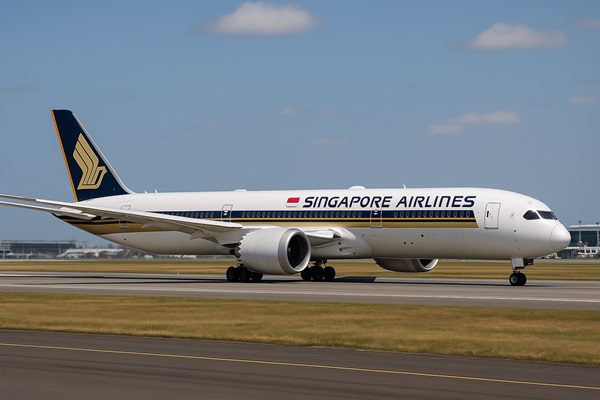
Singapore Airlines and Scoot carry record-breaking passenger volumes while navigating yield pressure, rising costs, and volatile markets.
In a fiscal quarter that saw more clouds than clear skies for the global aviation industry, the Singapore Airlines (SIA) Group has managed to keep its engines humming, posting a robust operating profit of $405 million for the first quarter of FY2025/26. While this marks a 13.8% dip from the previous year, in the current turbulent environment, it’s less a nosedive and more a textbook example of controlled descent with engines still running strong.
The result, announced on 28 July 2025, is a testament to the Group’s resilience and long-term strategic discipline—old-school values that still seem to have wings.
Record-Breaking Passenger Traffic
The aviation stalwart carried an impressive 10.3 million passengers over the three months ending 30 June 2025—a new record for the Group, which includes Singapore Airlines and its low-cost sibling Scoot. This represented a 6.9% year-on-year increase, reflecting continued strong demand across regional and long-haul routes, particularly as the traditional Northern Hemisphere summer began to heat up.
The group passenger load factor climbed to 87.6%, up 0.7 percentage points, driven by traffic growth outpacing capacity expansion—always a good sign for the bottom line.
Yet, the increased capacity across the industry had an undeniable impact: passenger yields fell 2.9%, landing at 10 cents per revenue passenger-kilometre. With more airlines adding bums-on-seats at a furious pace, pricing pressure was inevitable. Still, in aviation as in life, volume often trumps margin.
Revenue and Expenditure: A Balancing Act
Group revenue rose 1.5% to $4.79 billion, up $72 million from the previous year. Encouraging, to be sure—but expenditures weren’t far behind, growing 3.2% to $4.386 billion, primarily due to non-fuel costs ballooning by 8.5% amid inflationary pressures and capacity growth.
Fuel, that perennial wild card, offered a bit of reprieve: net fuel costs dropped by $108 million (7.9%), aided by a 16.9% dip in oil prices. However, this was partly undone by a $109 million swing in fuel hedging, turning last year’s gain into this year’s loss. Ah, the hedging gods giveth and taketh away.
Still, maintaining operating profit above $400 million in such conditions is no small feat.
Net Profit: A Reality Check
On the bottom line, net profit slipped 58.8% to $186 million, down from $452 million in Q1 last year. This was mainly due to a one-two punch of reduced interest income—courtesy of lower interest rates and smaller cash piles—and a $122 million reversal in the Group’s share of associates’ results. Last year, we saw profit from associates; this year, we saw losses, notably from Air India.
The change stems from SIA’s increased exposure to Air India following its full integration with Vistara and the start of equity accounting from December 2024. With transformation taking place at cruising altitude, turbulence is to be expected.
A Rock-Solid Balance Sheet
As of 30 June 2025, the Group’s shareholders’ equity stood at $15.8 billion, up $100 million from March. Debt levels fell by $1.4 billion to $11.5 billion, reducing the Group’s debt-equity ratio to a respectable 0.73—numbers that would warm the hearts of both conservative investors and nostalgic accountants.
Meanwhile, cash and bank balances dropped by half a billion to $7.8 billion, mainly due to loan repayments and aircraft capital expenditures. Still, the Group holds $3.3 billion in untouched credit lines—enough to weather a monsoon.
Expanding Fleet, Evolving Network
With an average aircraft age of just 7 years and 9 months, the Group’s fleet remains sprightly. By quarter’s end, the operating fleet stood at 204 aircraft, including Scoot’s growing stable. The low-cost carrier welcomed an Airbus A321neo, a Boeing 787-8, and an Embraer E190-E2 into service—each as fuel-efficient as a catnap.
SIA and Scoot now serve 129 destinations across 37 countries, and that number is only expected to grow. With Jetstar Asia ceasing operations on 31 July, the Group has moved to plug the gaps across Malaysia, the Philippines, Sri Lanka, and Thailand, ensuring Singapore remains a hub to be reckoned with.
Among Scoot’s newest routes: Iloilo City (Philippines) and Vienna (Austria), with Da Nang, Kota Bharu, and Nha Trang on the departure board for Q2.
New Scoot services to Labuan Bajo and Medan (Indonesia) and Okinawa (Japan) are in the works, pending regulatory nods. In a display of corporate decency not often seen these days, the Group is actively accommodating Jetstar Asia’s affected passengers and offering jobs to impacted staff.
Green Skies Ahead: Sustainable Aviation Fuel
The Group ramped up its sustainability credentials in a nod to the future (and perhaps a jab at greenwashing critics). SIA inked new deals with Neste and World Energy to procure Sustainable Aviation Fuel (SAF) and SAF certificates.
Specifically, the Group secured 1,000 tonnes of CORSIA-eligible neat SAF from Neste and another 2,000 tonnes via emissions reductions through World Energy’s Book & Claim model. The total carbon reduction? A tidy 9,500 tonnes of CO₂—enough to offset the guilt of a few million miles.
Malaysia Airlines Alliance, Mandai Wildlife Tie-Up
July brought conditional approval from Singapore’s Competition and Consumer Commission for a long-anticipated commercial joint venture with Malaysia Airlines. Once Malaysian authorities give the tie-up the green light, it promises enhanced connectivity, expanded codeshare routes, and marketing collaboration to boost tourism across both nations.
Closer to home, a delightful new partnership with the Mandai Wildlife Group will offer SIA customers unique experiences at Singapore’s famed wildlife parks, including exclusive merchandise and conservation support. It’s tourism meets eco-consciousness, and it’s bound to appeal to families and green-minded travellers alike.
The Air India Bet
The Group remains firm on its multi-hub strategy, with India as the jewel in its crown. Through its 25.1% stake in Air India and its longstanding partnership with Tata Sons, SIA continues to back the national carrier’s transformation—albeit with some turbulence. Time will tell whether this bet on the subcontinent yields first-class returns.
Outlook: Cautious Optimism in a Turbulent World
The airline expects robust demand to continue in Q2, bolstered by the Northern Hemisphere summer peak. But this isn’t the golden age of aviation of the 1990s. Today’s skies are crowded with uncertainty—from geopolitics and inflation to shifting supply chains and regulatory red tape.
Cargo demand, particularly, remains uneven due to tariffs and trade tensions. Nonetheless, the Group’s diversified operations, spanning multiple continents and revenue streams, provide a reassuring degree of insulation.
SIA’s plan? Stay nimble, disciplined, and focused on product leadership, network expansion, and digital innovation—the pillars upon which Singapore Airlines has long built its premium reputation.
By Susan Ng











