

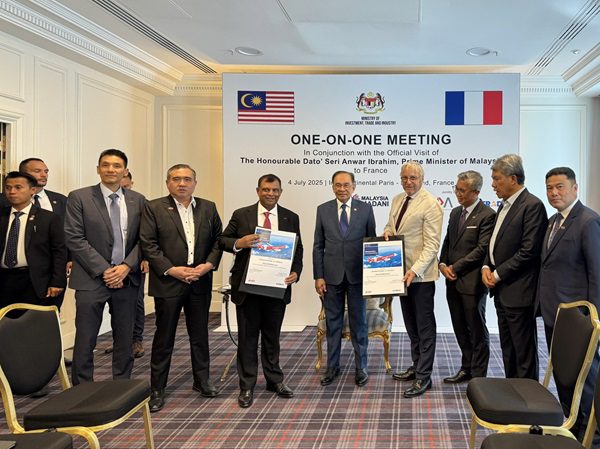
AirAsia has inked what might well be the most ambitious deal since Captain Cook set out with a sextant and a schooner. In a USD12.25 billion swoop, the Malaysian budget behemoth has signed a Memorandum of Understanding for 70 of Airbus’s gleaming, long-range A321XLR jets — aircraft capable of stitching together continents and ambitions in one low-cost leap.
You read that right: 70 shiny new A321XLRs — 50 firm orders with options on another 20 — to be delivered between 2028 and 2032. And with that, Tony Fernandes, the airline’s ever-visionary co-founder and Capital A boss, has declared his intentions not with a whisper but with a jet-engine roar: AirAsia is going global.
“We pioneered low-cost travel in Asia – now, we are taking it to the next level,” Fernandes announced in Paris, alongside Airbus’s Commercial Aircraft CEO Christian Scherer and Malaysia’s Prime Minister, Dato’ Seri Anwar Ibrahim, who stood witness to the aviation spectacle. “This is about exponential growth, connecting geographies beyond ASEAN, and making flying even more democratic.”
From Budget to Borderless
Once upon a time, low-cost carriers were strictly short-haul affairs — puddle-jumping across state lines, charging extra for peanuts and cheekily reminding passengers to pre-pay for their baggage or bring a sherpa. But AirAsia’s move to acquire these long-legged A321XLRs signals a different ambition altogether.
Designed for narrow-body range but wide-body reach, the A321XLR (that’s Extra Long Range if you please) can fly up to 8,700km — enough to launch non-stop budget flights from Kuala Lumpur and Bangkok to the Middle East, Central Asia and even Europe, all while burning 20% less fuel per seat than its predecessor.
If successful, AirAsia will become the world’s first low-cost narrow-body network carrier — a phrase that might cause traditional flag carriers to spill their champagne.
New Hubs, New Horizons
The plan is to make AirAsia’s twin hubs — Kuala Lumpur and Bangkok — not merely gateways to ASEAN but central nodes in a new, affordable web of intercontinental air travel. It’s nothing short of democratising the skies.
“AirAsia is proud to lead the charge in making our world smaller,” Fernandes beamed. “We can’t wait to paint the skies even wider in red.”
Christian Scherer from Airbus, never one to undersell a good fuselage, echoed the sentiment: “AirAsia Group is creating solid fleet efficiencies, allowing global network expansion. The A321XLR unlocks new opportunities to link primary and secondary cities all around the globe.”
In other words, watch out, Heathrow, Frankfurt, and Dubai — the red tide is rising.
A Green Skies Strategy
Beyond the bravado and bookings, there’s also a shrewd environmental play here. With 20% lower fuel burn per seat, these A321XLRs bring a greener hue to AirAsia’s famously red brand. That’s no small feat in a world where airlines are being told — quite rightly — to clean up their act.
Fernandes, ever the PR maestro, also framed the deal as part of the carrier’s commitment to sustainability. By matching capacity with demand through a versatile fleet—the A320s for short-haul, A330s for high-density, and now A321XLRs for long-range missions—AirAsia is poised to keep both emissions and operating costs under control.
Target: 150 Million Guests a Year
This massive investment forms part of AirAsia Group’s wider ambition to carry 150 million passengers annually by 2030—up from around 100 million pre-COVID. Cumulatively, the group wants to reach a staggering 1.5 billion guests carried since its founding.
AirAsia has become a rags-to-riches success story since its humble beginnings in 2001 as a scrappy Malaysian upstart with just two aircraft. This disruptor shook up the skies in Asia and now has its eyes fixed firmly on the globe.
The Future of Low-Cost, Long-Haul?
With ultra-long-haul travel back on the table — especially for price-conscious millennials, digital nomads, and value-hungry leisure travellers — AirAsia’s A321XLR play could revive the fortunes of low-cost long-haul, a model that’s had more than a few false starts.
If the stars align and regulatory approvals play nice, we could soon see AirAsia jets ferrying travellers from KL to Almaty, Bangkok to Berlin, or even Bali to Barcelona—all for a fare that might leave traditional carriers clutching their seatbacks.
Whether the world is ready or not, Tony Fernandes and his team certainly are.













The A321XLR definitely couldn’t do Bali to Barcelona as that is 12,500+km