
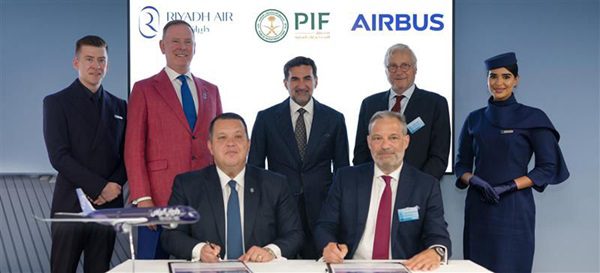
There’s nothing quite like a Parisian summer’s day to sign a few billion dollars’ worth of aircraft contracts—particularly when you’re a kingdom with serious aviation ambitions and a start-up airline itching to take off. That’s precisely the scene at the 55th Paris Air Show, where Saudi Arabia’s newest national carrier, Riyadh Air, strutted confidently onto the global stage with an order for up to 50 Airbus A350-1000 widebody jets. And that, dear reader, is no small commitment—it’s a sky-high declaration of intent.
With the ink barely dry on a ceremonial agreement, Riyadh Air’s Chief Financial Officer, Adam Boukadida, shook hands with Airbus’s EVP of Sales, Benoît de Saint-Exupéry, in the presence of a rather weighty audience: His Excellency Yasir Al-Rumayyan, Governor of the Public Investment Fund (PIF) and Chairman of Riyadh Air, plus Airbus Commercial CEO Christian Scherer and airline boss Tony Douglas. All eyes, of course, were on the gleaming future that the A350 represents—not just for Riyadh Air, but for Saudi aviation as a whole.
Long Haul Meets Lofty Vision
So, why the A350-1000? Well, with a staggering range of over 16,000 kilometres, this aircraft isn’t just long-haul—it’s ultra-long-haul, built to span continents effortlessly. Think Riyadh to Sydney, New York or Buenos Aires—non-stop, no sweat. Riyadh Air can tick off its ambitious “100 destinations by 2030” vision in style and comfort.
“This deal demonstrates Riyadh Air’s strategic role in positioning Saudi Arabia as a global aviation hub,” said Al-Rumayyan, outlining the grand plan with the quiet confidence reserved for those who’ve read every page of their Vision 2030 manual—and possibly edited it.
Indeed, Riyadh Air is more than just another airline; it’s a cornerstone of Saudi Arabia’s broader economic diversification strategy. PIF, the kingdom’s sovereign wealth fund, is backing it all the way to transform Riyadh into a central global air transport node—just in time for the Riyadh Expo 2030 and FIFA World Cup 2034™.
Growing Fleet, Global Ambition
This new order complements Riyadh Air’s existing commitment of 132 aircraft, bringing its total order book to 182 aircraft. That’s not bad for a start-up airline that hasn’t flown a commercial route yet.
As CEO Tony Douglas put it (and one suspects he practised this line on the flight over):
“Agreeing this deal for up to 50 Airbus A350-1000 aircraft is an important statement of intent… we are in a position to fulfil our ambitious network goals.”
A seasoned aviation executive, Douglas is no stranger to scaling airline operations. Under his watch, Riyadh Air has already secured its Air Operator’s Certificate (AOC), unveiled swish new cabin interiors, and is preparing to announce its initial destinations before the end of the year.
And it’s not all talk—Douglas says the airline aims to create 200,000 jobs (direct and indirect) and contribute a tidy US$20 billion to Saudi Arabia’s non-oil GDP. Lofty goals, yes, but you don’t launch a national airline to aim low.
First-Class Flash and Digital Dazzle
With that many aircraft en route, you’d better believe the interiors won’t be business as usual. Riyadh Air is going for full-tilt elegance, with a stylish and exclusive First-Class cabin planned for its A350s. This follows the recent reveal of its Business Class concept, which—judging by the glossy renders—seems tailor-made for travellers who like their Arabic coffee served with seamless connectivity.
Of course, the A350-1000 supports it all: a roomier cabin, better fuel efficiency, and digital innovation that makes in-flight entertainment feel less like a mid-air compromise and more like your lounge room at 38,000 feet.
Christian Scherer of Airbus summed it up:
“The A350-1000 is the world’s most modern and efficient widebody aircraft. It’s an honour to partner with Riyadh Air and support their bold, connected, and sustainable future.”
Tourism, Trade, and Tectonic Shifts
Behind all the press release polish, there’s a serious strategy at play. Riyadh Air isn’t just ferrying passengers—it’s ferrying Saudi Arabia’s future tourism, trade, and diplomatic identity. With the eyes of the world soon to fall upon the Kingdom via high-profile events and cultural showcases, Riyadh Air is positioned as the front door to a new Saudi Arabia.
Part of that, of course, means encouraging inbound visitation—more tourists, business travellers, cargo, and a new generation of Saudis taking to the skies. It’s all very neatly aligned with the Saudi National Transport and Logistics Strategy and the National Tourism Strategy, both of which Riyadh Air supports by increasing air transport capacity, boosting freight logistics, and expanding passenger movement.
Put another way: Riyadh Air isn’t just flying planes. It’s building bridges.
A Final Word from the Flight Deck
If this latest Paris Air Show spectacle is anything to go by, Riyadh Air is clear for take-off. With its growing fleet, global vision, and full-throttle commitment to connectivity, the airline is more than just a piece in the Kingdom’s economic puzzle—it’s a jet-powered ambassador with a First-Class smile and a seatmap to the world.
And in an industry where bold ambition often meets brutal reality, Riyadh Air’s deal with Airbus suggests they’re not only ready for take-off—they’ve already hit cruising altitude.
Watch this airspace.
By Susan Ng