


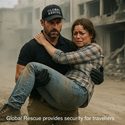
 There was a time when the most stressful things about travel were forgetting your toothbrush or discovering that your room didn’t have a minibar. Not anymore. In a world where conflict can erupt quicker than you can say “boarding pass,” travellers are turning en masse to Global Rescue, the international security outfit that’s more SAS than travel agent.
With world events hurtling toward chaos and your average travel insurance looking about as useful as a chocolate teapot, Global Rescue has reported a record-smashing surge in security membership purchases in 2025. And it’s not just a slow burn—this is a five-alarm fire of demand.
According to the company, purchases of its security memberships have climbed a whopping 26% year-to-date compared to 2024. June alone saw a 40% leap over the same month last year, and the week of June 16–22 brought a dramatic 41% year-on-year spike. That’s not so much a trend as a stampede.
Dan Richards, CEO of Global Rescue and member of the U.S. Travel and Tourism Advisory Board at the U.S. Department of Commerce, put it plainly:
“Travellers are no longer willing to risk being caught unprepared in a conflict zone. They want the ability to make a single phone call and have a team of security professionals mobilised to help them. That’s exactly what a Global Rescue membership provides.”
And who could blame them? From Israel to Iran, from unstable patches of Europe to troubled pockets of Asia and Africa, the geopolitical powder keg has rarely felt so volatile. Simply put, more people are waking up to the reality that travel today doesn’t just require a suitcase and sunscreen—it requires a plan.
Global Rescue’s security memberships read like a James Bond briefing, but with more practical results. We’re talking:
-
24/7 access to military special ops veterans and intelligence experts
-
Destination-specific security alerts in real time
-
Emergency extraction from hotspots ranging from war zones to riot-stricken cities
In other words, this isn’t your grandfather’s travel insurance—it’s a lifeline for the modern globetrotter.
Harding Bush, associate director of security operations at Global Rescue—and, not incidentally, a former Navy SEAL—says travellers are far savvier than they used to be.
“People are travelling with their eyes open. They’re seeing the headlines—airspace closures, armed conflict, civil unrest—and making smarter decisions before they go,” Bush explains. “Security memberships give travellers direct access to the people who’ve responded to the world’s worst crises.”
Gone are the days when “being prepared” meant packing extra socks. Today, it means having a literal extraction team in your contacts list. It’s the sort of service you hope never to use, but feel oddly reassured just knowing it’s there, like carrying a parachute on a cruise.
One could argue that travel is returning to its roots. Before the days of GPS and pre-dawn airport transfers, going abroad always held a whiff of the unpredictable. Global Rescue’s renaissance suggests that the old-school adventurer mindset is back—but with a decidedly modern toolkit.
Still, there’s a certain irony in all this. The more connected the world becomes, the more fragile it appears. That’s not to say the joys of travel are dead—far from it. But in a time where conflict can alter your itinerary faster than a flight delay, those in the know are swapping complacency for contingency.
And while some may still shrug off the need for high-level travel security, Global Rescue’s skyrocketing numbers suggest otherwise. The message from modern travellers is clear: pack light, plan bright, and never assume the world will wait until your return to erupt.
Because when trouble strikes abroad, it’s not about finding a Plan B—it’s about making sure Plan A comes with a hotline to heroes.
By Jason Smith











