
 Suppose the walls of the original Waldorf Astoria in New York could talk. In that case, they’d likely whisper about scandalous liaisons, royal visits, debutante balls and more whispered deals than a political backroom in Canberra. But rather than staying in its gilded past, the hotel has inspired a worldwide dynasty—one that now spans 34 regal addresses across 18 countries, each proudly bearing the family crest of the Waldorf Astoria name.
“It all begins with The Greatest of Them All,” says Dino Michael, Senior Vice President and Global Head of Hilton Luxury Brands, as if reciting the preamble to a grand epic. And he’s not exaggerating. The original Waldorf Astoria, which opened in 1893, wasn’t just a hotel—it was a movement. A beacon of refinement, innovation, and charm that not only welcomed the world’s elite but also dared to invent the Waldorf Salad, Eggs Benedict, and Red Velvet Cake along the way. Frankly, it could’ve stopped there and still earned a chapter in history.
But in true New York fashion, it didn’t.
The Original That Launched a Thousand Lobbies
The hotel wasn’t merely a plush bed and a porter. It was a pioneer. It installed in-room telephones when most households didn’t have one on the wall. It employed female chefs when that was still seen as revolutionary. And it introduced room service as an indulgence, not just a convenience.
Fast-forward over a century, and that original spirit still courses through the veins of every Waldorf Astoria hotel, from the cliff-clinging elegance of Los Cabos to the breezy luxury of Costa Rica’s Punta Cacique.
“In every Waldorf Astoria around the world, we have tributes to the original,” Michael notes. “They inform our history and give a guiding nod to the past, but also allow us to reinterpret them for the future.”
In other words, think less museum, more modern opera—one that’s still hitting high notes with a knowing smile.
A Corridor Called Peacock Alley—and Other Legends
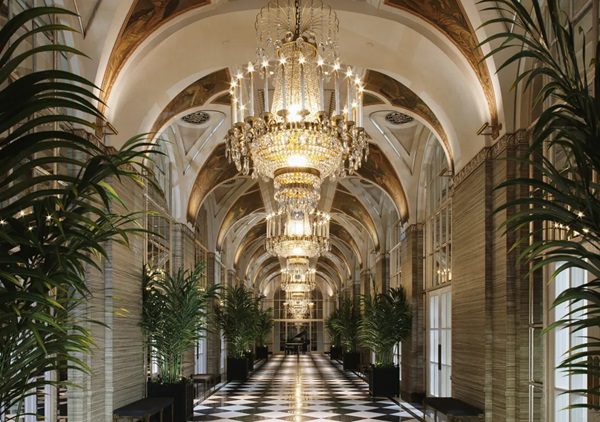
Perhaps the most iconic tribute is the ubiquitous “Peacock Alley.” Now, if that conjures up images of actual peacocks sipping martinis in silk smoking jackets, you’re not far off. The original Peacock Alley was a 300-foot marble corridor that connected the Waldorf and Astoria hotels, effectively becoming New York’s first runway for the upper crust to parade, preen, and, well, peacock.
Today, each Waldorf Astoria has its version—some a plush lounge, others a cocktail bar, but all paying homage to that legendary strut of 19th-century society.
At Los Cabos Pedregal in Mexico, for instance, guests can enjoy a curated Agave tasting, nodding cleverly to the local terroir. In Costa Rica’s Punta Cacique, guests sip a rum-forward “Nicoya” or a bold “Chorotega,” named after the region’s indigenous heritage—all within a reimagined Peacock Alley setting that feels as authentic as it does opulent.
That Clock, That Lady, That Legacy
No Waldorf Astoria is complete without its take on another icon: the lobby clock. The original, a towering triumph commissioned by Queen Victoria (as one does), featured reliefs of both British and American leaders, as well as a golden Lady Liberty perched triumphantly atop.
It wasn’t just a clock—it was a meeting place, a photo op, and a conversation starter. One could argue the entire social media concept of “let’s meet at the clock” was invented right there.
And as with the clock, so too with the standards. Every Waldorf Astoria worldwide takes its cue from the original, no matter the postcode—high-touch service, culinary mastery, and décor that whispers elegance rather than shouting excess. No revolving sushi belts here, thank you very much.
What Would Conrad Say?
As Waldorf Astoria continues to expand its noble footprint—from bustling metropolises to serene seaside sanctuaries—the late Conrad Hilton would likely be more than pleased.
“I think Conrad Hilton would be overwhelmed and overjoyed by what he sees today,” Michael muses. “If he toured the portfolio… the culinary excellence, our approach to wellness, the team dynamic, the energy and love for the brand—I think he’d be delighted.”
And really, who wouldn’t be?
This is a brand that didn’t just build hotels—it built temples of taste, where the past is respected, not replicated, where tradition informs innovation, rather than impeding it, where every martini is properly shaken, never compromised.
In a world increasingly obsessed with speed and minimalism, Waldorf Astoria has doubled down on grandeur. And thank heavens for that. Because there’s still something to be said for walking into a hotel lobby that makes you straighten your posture, tuck in your shirt, and wonder if perhaps you’ve just stepped into the pages of history.
The Waldorf Astoria remains the gold standard for hospitality—a heritage brand that isn’t afraid to evolve, yet knows better than to discard its past. It’s a rare and refined example of doing things the old-fashioned way, with just enough modern twist to keep it timeless.
And, really, in a world that’s forgotten how to iron a shirt, isn’t that just marvellous?
By Susan Ng