

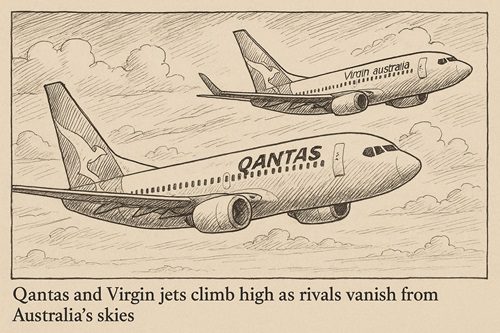
 In a move that would have made Sir Hudson Fysh nod with quiet satisfaction, Australia’s aviation giants — Qantas Group and Virgin Australia — have soared to new heights in profitability, buoyed by strong travel demand and an ever-thinning field of competitors. With the skies less crowded than ever and corporate travel rebounding, it’s a tailwind story for the ages.
The latest figures released by the Australian Competition and Consumer Commission (ACCC) confirm what many frequent flyers and industry observers have long suspected: fewer rivals mean fatter margins.
Qantas Group, ever the master of high-altitude domination, reported a sky-high earnings-before-interest-and-taxes (EBIT) figure of $1.5 billion for the first half of 2024–25. Of that eye-watering sum, $916 million was generated from its domestic operations — a feat that includes both Qantas and its budget sibling, Jetstar.
What’s behind the golden glow of Qantas’ earnings? In a word: dominance. The flying kangaroo still rules the roost in corporate travel, boasting an 80 per cent stranglehold on that lucrative market segment during the reporting period. It’s an area where Qantaslink and its premium domestic services remain virtually unchallenged.
“Qantas Group’s high half-yearly earnings reflect its dominance of the domestic airline sector, with Qantas and Jetstar accounting for over 60 per cent of passengers,” remarked ACCC Commissioner Anna Brakey in the report — a clinical and telling statement.
Jetstar, not to be overshadowed by its full-service sibling, recorded a blistering 53.7 per cent jump in earnings compared to the previous financial half. The low-cost carrier pulled in a tidy $269 million, thanks in no small part to being the last budget airline standing. The collapse of Tigerair in 2020 was already a boon, but the dramatic demise of Bonza in April 2024 sealed Jetstar’s solo act in Australia’s discount skies.
“Jetstar has been able to capitalise on the continued absence of competitive pressure from another low-cost carrier in the domestic market,” Brakey added, pointing to the airline’s strengthened margins and market share.
Virgin Finds Its Groove Post-Restructure
Not to be left clutching the chocks, Virgin Australia is enjoying its own renaissance. While the airline doesn’t publicise half-year financials, its former CEO, Jayne Hrdlicka, declared in February that it had achieved record profits for the half-year — no small feat considering its recent emergence from administration under Bain Capital.
Virgin’s rebound wasn’t just rhetoric. The carrier’s passenger share rose to 34.4 per cent in March 2025, a noticeable bump from 31.3 per cent a year earlier. This growth coincided with Rex Airlines pulling out of key capital city routes — a strategic vacuum that Virgin was too happy to fill.
Even more astutely, Virgin managed to secure leases on three of Rex’s Boeing 737 aircraft, providing the extra seat capacity needed to plug the gaps and boost its network reliability. In airline economics, sometimes it’s less about soaring and more about seizing opportunity while your competitors are stuck on the tarmac.
April’s Air Travel Frenzy Follows a Stormy March
Despite disruptions brought by Ex-Tropical Cyclone Alfred, Australia’s domestic travel scene has remained resilient. March 2025 was, by all accounts, a washout — literally. Passenger levels dipped by 4.9 per cent year-on-year, as stormy weather battered much of the east coast.
Brisbane to Sydney and Brisbane to Melbourne flights saw nearly 10 percent drops in passenger numbers. The Gold Coast and Maroochydore fared even worse, experiencing a 30.2 percent and 25.1 percent plunge in travellers, respectively. All this turbulence contributed to a nationwide flight cancellation rate of 5 percent—more than double the long-term industry average.
Yet April flipped the script. With Easter, ANZAC Day, and school holidays compressed into a three-week domestic travel blitz, airports were bracing for one of the busiest periods on record. Airservices Australia flagged 17 April — the Thursday before Good Friday — as the busiest domestic travel day in five years.
Amidst the chaos, airlines held their course. The on-time arrival rate has quietly improved over the past six months, reaching 80.2 percent in March 2025, just shy of the long-term benchmark of 80.7 percent.
“It is encouraging to see the on-time arrival rate improving,” said Brakey. “Travellers can have more confidence that their flight will arrive at the time they booked.” After years of pandemic-era turbulence and more recent weather woes, that’s music to many travellers’ ears.
The Fare Affair: Pricing Peaks and Valleys
For those keeping a close eye on their wallets, average airfares have mirrored seasonal patterns, with a few unexpected hiccups. Prices peaked in October 2024, only to fall by 16.1 percent over the next three months before climbing again by nearly 10 percent in March 2025.
“The trends observed in average airfares since January reflect seasonal factors and are broadly consistent with those observed in previous years,” Brakey noted with characteristic understatement.
Still, the airfare landscape of 2024–25 is tinged with the ghosts of glittery spectacles past. In February 2024, for instance, Taylor Swift’s concerts in Melbourne and Sydney drove demand and airfares to record-breaking heights. Add in an early Easter that same year, and you get a truly aberrational spike in travel patterns — one that’s still skewing the comparisons.
The ACCC’s Watchful Eye Returns
The current state of play in Australian aviation is under renewed scrutiny. The ACCC resumed its domestic airline market monitoring in November 2023, following a directive from the Treasurer. Its task? To keep a watchful eye on the prices, profits, and practices of Qantas, Virgin, Rex, and Jetstar over the next three years.
While Rex, once the underdog hero of regional travel, entered voluntary administration in July 2024, its regional services continue, bolstered by government guarantees that honour existing bookings.
The emerging picture is consolidation in an industry defined by turbulence and turnarounds. The big players are growing bigger, the small ones are falling away, and the era of fierce competition is looking more like a footnote than a feature.
Whether that’s good news for passengers or a storm cloud on the horizon depends on whom you ask. But one thing’s sure: for Qantas and Virgin, it’s blue skies.
By Michelle Warner











