

 In a sweeping shift that could rewrite the rules of online discovery, Google has quietly extended its AI Overviews to nine major European markets, marking the start of a new digital chapter that will affect every travel brand on the continent—and soon, beyond.
For those in the know, this development is more than a technical update; it’s a seismic shake-up of how travellers find, research, and book their holidays. And for many in the tourism space—particularly those relying heavily on organic traffic from search engines—the ramifications are already beginning to bite.
A Swift, Strategic Expansion
Google first released AI Overviews in the United States in May 2024. Since then, it has swiftly expanded into the United Kingdom, Brazil, India, Japan, Indonesia, and Mexico. Now, it’s Europe’s turn. Austria, Belgium, Germany, Ireland, Italy, Poland, Portugal, Spain and Switzerland have all been added to the rollout.
The feature, powered by generative AI, delivers digest-style responses to user queries at the top of Google’s results pages. That means fewer clicks to third-party websites—and less visibility for businesses unless their content makes it into those AI-generated blurbs.
The implications for industries built on search engine referrals—tourism included—are profound.
“This Isn’t a Blip—It’s a Redrawing of the Map”
Raúl Valencia, Vice President of CRO and SEO at Civitatis, one of the world’s most trusted names in Spanish-language travel experiences, is among the first senior figures to publicly sound the alarm.
“Google is no longer acting purely as a gateway,” he said in a candid statement. “It’s becoming the destination itself. And if we, as an industry, don’t evolve with that shift, we’ll be left behind.”
Valencia’s warning is not steeped in panic but pragmatism. He recognises the power of AI Overviews and the urgency with which companies must now revisit their content and SEO strategies.
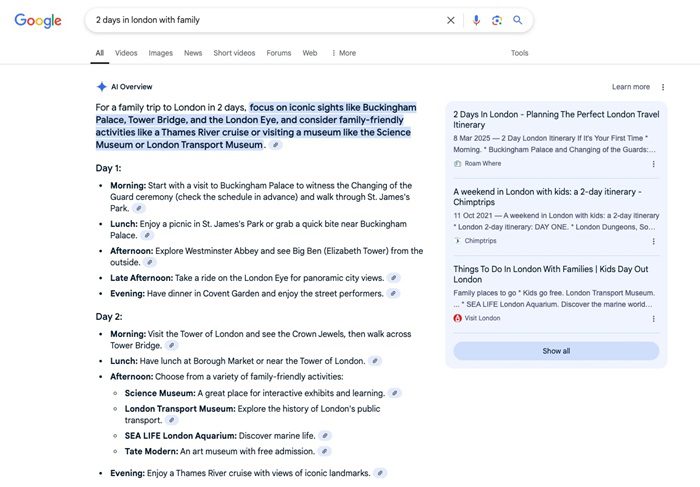
Google AI Overview – London example
Changing Traveller Habits, One Query at a Time
Consider this: millions of holidaymakers across Europe use Google monthly to explore ideas, compare options, and book experiences. From “best walking tours in Rome” to “family-friendly museums in Berlin,” these searches once sent a steady stream of traffic to tour operators, travel blogs, and booking platforms.
Many of those answers appear directly in the AI-generated box, skipping the middleman entirely.
“It’s not just about rankings anymore,” Valencia explained. “It’s about being featured in the AI’s voice. That means you have to speak the way your customer speaks and offer more than just basic information. You’ve got to deliver depth, trust, and originality.”
Three Essential Shifts Travel Brands Must Make
This digital fork in the road calls for decisive action. According to digital marketing experts and SEO strategists, the travel industry should now focus on three core tactics:
-
Richer, More Authoritative Content
Create travel articles, guides, and landing pages beyond surface-level descriptions. Use first-hand insights, expert quotes, and unique local context. AI can’t replicate experience—and that’s your edge. -
Answer Questions Naturally
Optimise for longer, more conversational queries. AI Overviews tend to serve content that sounds like the user’s voice. If your site includes natural-sounding answers to detailed questions (“Where can I go snorkelling with kids in Sardinia?”), you stand a better chance of being cited. -
Don’t Bet Everything on Google
Diversify your traffic sources. Build engaged communities on social platforms, strengthen email lists, and invest in content partnerships that place your brand in trusted media channels.
Innovation: A Legacy Skill, Not Just a Trend
Civitatis, for one, is not standing still. The brand has doubled on storytelling, data-driven insights, and partnerships with creators who can add a human voice to their travel experiences.
“Search engine optimisation hasn’t died,” Valencia added. “It’s simply entered a new era. This is an opportunity—not a death sentence—for those prepared to meet the moment.”
That readiness, he noted, will separate those who endure from those who fade into digital obscurity.
Beyond Europe: A Test Case for the World
Although this rollout targets Europe, industry insiders expect a global rollout to follow in the coming months. Australia, New Zealand, and Southeast Asia could very well be next.
Tourism boards, OTAs, and operators across these regions should treat Europe’s experience as a crystal ball—what’s unfolding there is likely a prelude to global change.
Final Thought: Adaptation Is the Price of Relevance
Search habits are evolving at speed, and AI is no longer a peripheral experiment—it’s the new front line of discovery. Tourism professionals must now ask themselves: Are we visible in this new world or just hoping to be?
For those willing to revisit their approach, reconnect with their audiences, and outthink the algorithms, the future is not just survivable—it’s ripe with opportunity.
The digital map has been redrawn. Whether your brand appears on it is entirely up to you.
Written by Anne Keam