

There was a time, many times, actually, when Thailand’s tourism fortunes could be explained with a single phrase: cheap and cheerful. The baht obliged by staying obligingly weak, visitors arrived in pleasing volume, and everyone pretended this was a sustainable business model.
Those days are fading.
As the baht firms again, now circling the 31-32 range against the US dollar, familiar anxieties have returned. Taxi conversations, hotel back offices and seaside cafés are all asking the same question: will a stronger baht scare tourists away?
The honest answer is that it already has—just not the ones we should miss.
Let’s start with the obvious. Flights into Thailand remain full. Hotel occupancy in Bangkok, Phuket and Samui is healthy. Immigration queues still snake with reassuring determination. Tourism, by any headline metric, is not collapsing.
But look closer, always advisable in Thailand, and you see a subtle change. Visitors are behaving differently. They still come. They spend less enthusiastically. Meals are simpler. Excursions are skipped. That extra night becomes a firm checkout.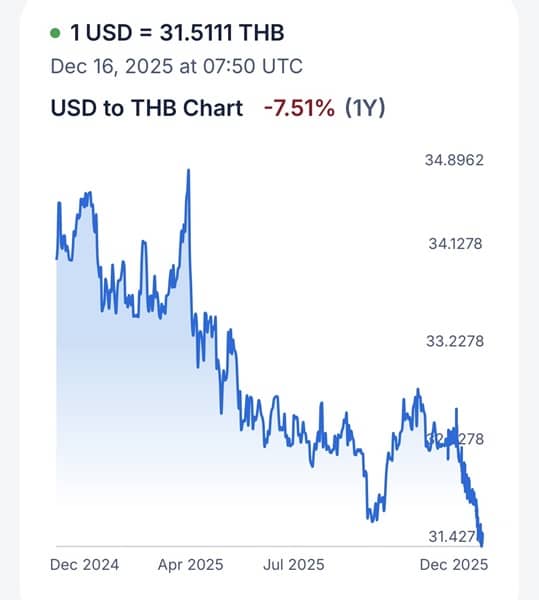
It is not anger. It is arithmetic.
Travellers on fixed budgets, particularly from Europe and North America, notice exchange rates with accountant-like precision. Backpackers feel it first. Families follow. Long-stay retirees and winter escapees, those quiet contributors to off-peak economies in Hua Hin, Pattaya and Chiang Mai, start counting rather than cruising.
Ask local businesses and the refrain is familiar: “Busy, but quieter.” The streets are complete. The tills are polite.
Perception, of course, is everything. A stronger baht arrives hand-in-hand with rising service charges, higher operating costs and the occasional irritation of inconsistent pricing. Repeat visitors remember when Thailand felt cheaper. Memory, like currency, has its own exchange rate.
And yet, tourism numbers hold firm. Why?
Because Thailand is no longer relying on one type of visitor. Short-haul travellers from Singapore, Japan, South Korea, Hong Kong, Australia and the Gulf are largely unmoved by modest currency shifts. They are not here for bargains. They are here for food, safety, service, wellness, and the sort of travel experiences that do not come with price tags.
They stay shorter, perhaps, but they spend better.
The baht’s strength is not accidental. A softer US dollar, shifting interest-rate expectations and steady tourism receipts have all played their part. Thailand’s external position remains stable, and global capital, now less starry-eyed about the dollar, is rediscovering regional currencies.

Luxury rail travel aligns with Thailand’s new image and offers a deeper, more memorable adventure.
This is not a crisis. It is a transition.
A stronger baht does what markets always do: it filters. Ultra-budget tourism softens. Experience-led travel strengthens. The industry, long addicted to volume, is being nudged gently but firmly toward value.
For some destinations, the adjustment is uncomfortable. Pattaya knows better than most that full beaches do not guarantee healthy balance sheets. High-volume, low-margin models feel the squeeze first. But this is also where opportunity lives: better products, more transparent pricing, and experiences worth paying for.
Thailand has long spoken about shifting from volume to value. The baht, it seems, has decided to help.
If the currency holds where it is, Thailand will not lose its appeal. It will simply refine it. The challenge now is execution, lifting standards, improving transparency and ensuring infrastructure keeps pace with a more discerning traveller.
A stronger baht is not the end of Thailand’s tourism story. It is the moment the industry grows up.
by Andrew J Wood & edited by Stephen Morton – (c) 2025
Read Time: 4 minutes.
About the Writer.
 A Yorkshireman by birth and a Bangkokian by choice, Andrew J Wood has been exploring Southeast Asia’s hospitality and culinary landscapes since 1991. A seasoned travel writer, raconteur, and hotel reviewer, Andrew combines old-school courtesy with a dry wit that’s unmistakably English.
His love of gracious service and good manners, traits he believes the world could use more of, shines through every word he writes. From the gleaming hotel lobbies of Bangkok to the bustling markets of Hanoi, he finds joy in the details: a warm smile, a well-brewed cup of tea, or a perfectly folded napkin.
For Andrew, travel isn’t just about movement; it’s about meaning, memory, and the gentle art of slowing down. In his book, the perfect Sunday is unhurried, well-fed, and always finished with something sweet.