
As Indonesia braces for another end-of-year travel surge, its national rail operator is quietly doing something both unfashionable and rather clever: looking after farmers while upgrading facial recognition software.
PT Kereta Api Indonesia (KAI), the country’s state-owned railway company, has unveiled a twin-track strategy designed to keep the nation moving smoothly through the 2025–26 Christmas and New Year period. One track runs straight through the paddocks and coastal markets of Banten Province. The other runs through server rooms, scanners and station gates.
Together, they tell a story of a railway operator who understands a simple truth often forgotten in transport planning: progress works best when it carries everyone along.
A commuter train with cabbages, crackers and common sense
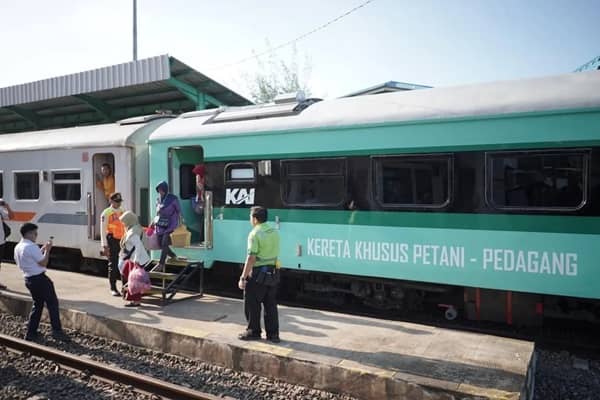
From 1 December 2025, KAI began operating what it calls the Farmer and Trader Train on the Merak–Rangkasbitung corridor, a busy commuter line in western Java. It is not glamorous. There are no panoramic windows or executive lounges. What it offers instead is something far more helpful to local economies: space.
The service provides dedicated cargo areas within commuter rolling stock, allowing farmers and small traders to transport agricultural produce, processed foods and handmade goods alongside regular passengers. For Indonesia’s micro and small enterprises, this is no slight shift.
The trains were redesigned in-house by Balai Yasa Surabaya Gubeng, KAI’s technical workshop, which reworked interiors, baggage sections, loading points and safety signage to suit mixed passenger-cargo use.
“The train has been engineered by our in-house experts to ensure safe, orderly, and convenient goods movement without disrupting passenger flow,” said KAI President Director Bobby Rasyidin, in remarks that reflect a pragmatic, almost old-school approach to public transport design.
Operating under a government-funded Public Service Obligation (PSO) scheme, the service costs just Rp3,000, with each user allowed up to two cargo units. It runs on 14 daily commuter services, stopping at 11 stations across agricultural and coastal communities.
On its first day alone, 95 users carried everything from fresh produce to snacks and handicrafts bound for markets in Serang, Cilegon and Merak. It is precisely the kind of modest beginning that, in transport history, often signals a lasting shift.
“Reliable logistics access for small producers is fundamental to local economies,” Rasyidin said. “This service opens a more predictable distribution channel for farmers and traders.”
In plain terms, it also reduces the number of trucks on the roads, fuel burned in traffic jams, and time lost between the farm gate and the market stall.
Facial recognition steps up before the crowds arrive
While vegetables ride the rails in Banten, KAI is also preparing for the less earthy realities of peak-season travel. The operator is expanding its facial-recognition boarding system, a technology it introduced in 2023 and has since scaled successfully.
According to KAI Vice President of Public Relations Anne Purba, the system was used 9.29 million times between January and October 2025, cutting paper ticket consumption by 23,245 rolls and delivering savings of around Rp341 million. Since launch, more than 19.4 million passengers have used the feature.
“Facial recognition shortens boarding time and significantly reduces paper waste, supporting more environmentally responsible operations,” Purba said.
The technology is now available at 22 major stations, with further rollouts planned ahead of the holiday peak to reduce queues and keep passenger flow moving. In a country where stations can swell dramatically during festive periods, automation is no longer optional.
“Digitalisation is not just innovation—it is increasingly essential to managing national mobility at scale,” Purba noted. “This system helps maintain operational stability when travel demand peaks.”
It is a refreshingly sober assessment, free of buzzwords and grounded in operational reality.
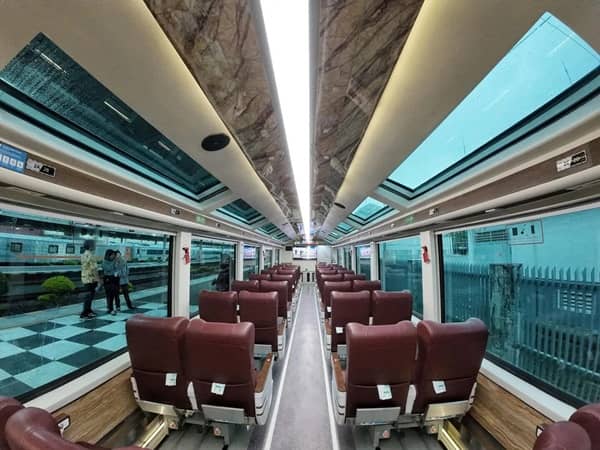
A special passenger train featuring oversized windows and often a large glass roof (sunroof) to provide unobstructed, wide-angle views of the passing scenery, turning the journey itself into a scenic experience.
Holiday demand rises, discounts widen.
Those peaks are already forming. For the travel period between 18 December 2025 and 4 January 2026, KAI had sold 629,060 tickets by 26 November—just over 21 per cent of the roughly three million seats available.
To spread demand and support affordability, the operator is offering 30 per cent discounts across 156 regular services and 26 additional economy-class trains, making 1.5 million discounted seats available from 22 December to 10 January.
“We are preparing large capacity and fare incentives to ensure safe, orderly, and accessible travel throughout the holiday season,” Purba said, adding that higher mobility is expected across both Java and Sumatra.
It is a familiar seasonal dance, but one now supported by better data, smoother boarding and—unexpectedly—a few crates of vegetables.
Old principles, modern rails
KAI’s approach mirrors international trends in railway modernisation, where technology is increasingly paired with social inclusion rather than set against it. In Europe and parts of Asia, mixed-use rail services and digital ticketing are becoming standard tools for reducing emissions and widening access.
“KAI is committed to building a rail ecosystem that supports grassroots economies while adopting technologies that meet global service standards,” Rasyidin said. “These initiatives reinforce railways as an inclusive, efficient, and sustainable mode of public transport.”
There is something reassuringly traditional in that philosophy. Railways, after all, were never meant to serve only one kind of traveller. They were built to connect towns, move goods and keep economies ticking along.
By putting farmers on commuter trains and faces on scanners, KAI is not reinventing the railway so much as returning it to its roots—just with better software and clearer signage.
by Octavia Koo – (c) 2025
Read Time: 4 minutes.
About the Writer.
 Indonesian-born Octavia Koo arrived in Australia in the early 1980s, drawn by the creative promise of Sydney and a place at UNSW, where she studied Arts and soon discovered her flair for visual storytelling. She began as a graphic designer, quickly turning her sharp eye for detail towards the digital frontier, designing websites and crafting polished descriptions that draw people in—and keep them reading.
Her next chapter took her to Singapore, where she built and managed blogs for several tourism platforms, uncovering a natural gift for SEO long before the term became fashionable. There, amid the buzz of ITB Asia, she met Stephen, who suggested she consider Global Travel Media. A few years later, she did just that.
Now part of GTM’s editorial family, Octavia brings a quiet brilliance to her work. She merges art, technology, and intuition to tell travel stories that charm and perform, much like their author.